
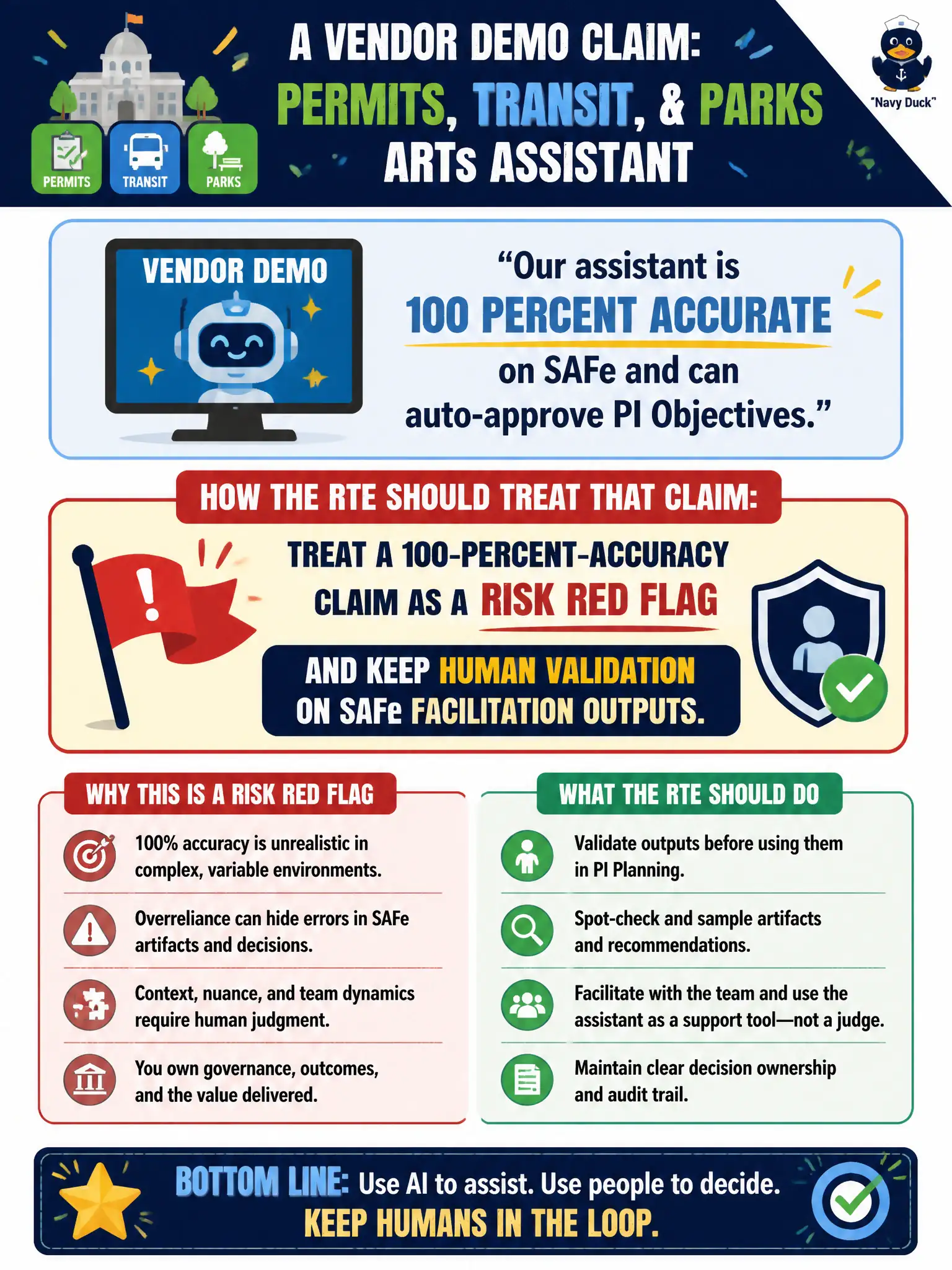
A vendor demo for the city's permits, transit, and parks ARTs claims its assistant is 100 percent accurate on SAFe and can auto-approve PI Objectives. How should the RTE treat that claim?
Select an answer to reveal the explanation.
Short Explanation
Anyone selling a never-wrong compass is selling a story, not a tool. Municipal trains still need humans on PI Objectives. A 100-percent claim is the red flag, not a reason to take hands off the wheel.
Full Explanation
A vendor claim of 100 percent accuracy on SAFe with auto-approval of PI Objectives is a risk red flag; humans must keep validation on facilitation outputs. For the city’s permits, transit, and parks ARTs, the RTE should treat that claim skeptically. Accepting auto-approval of PI Objectives because perfect accuracy removes the need for Business Owners eliminates a core SAFe accountability. Waiving prompt quality and context because a perfect model needs neither invites garbage-in outcomes. Replacing Inspect and Adapt with the vendor’s accuracy dashboard substitutes marketing metrics for empirical improvement. Exam caveat: strong tools can still err; procurement should demand evaluation evidence, not absolute accuracy slogans. Operational check: run a controlled trial on nonsensitive facilitation drafts, measure error rates with RTEs, and keep Business Owner approval of PI Objectives human-owned across the civic ARTs. Keep the civic mission visible when applying the technique so resident-facing outcomes stay the measure of success. In municipal ART practice, capture the rationale in facilitation notes so future coaches inherit the same standard. Re-validate after the next PI cadence event that the same control still fits current civic constraints.