
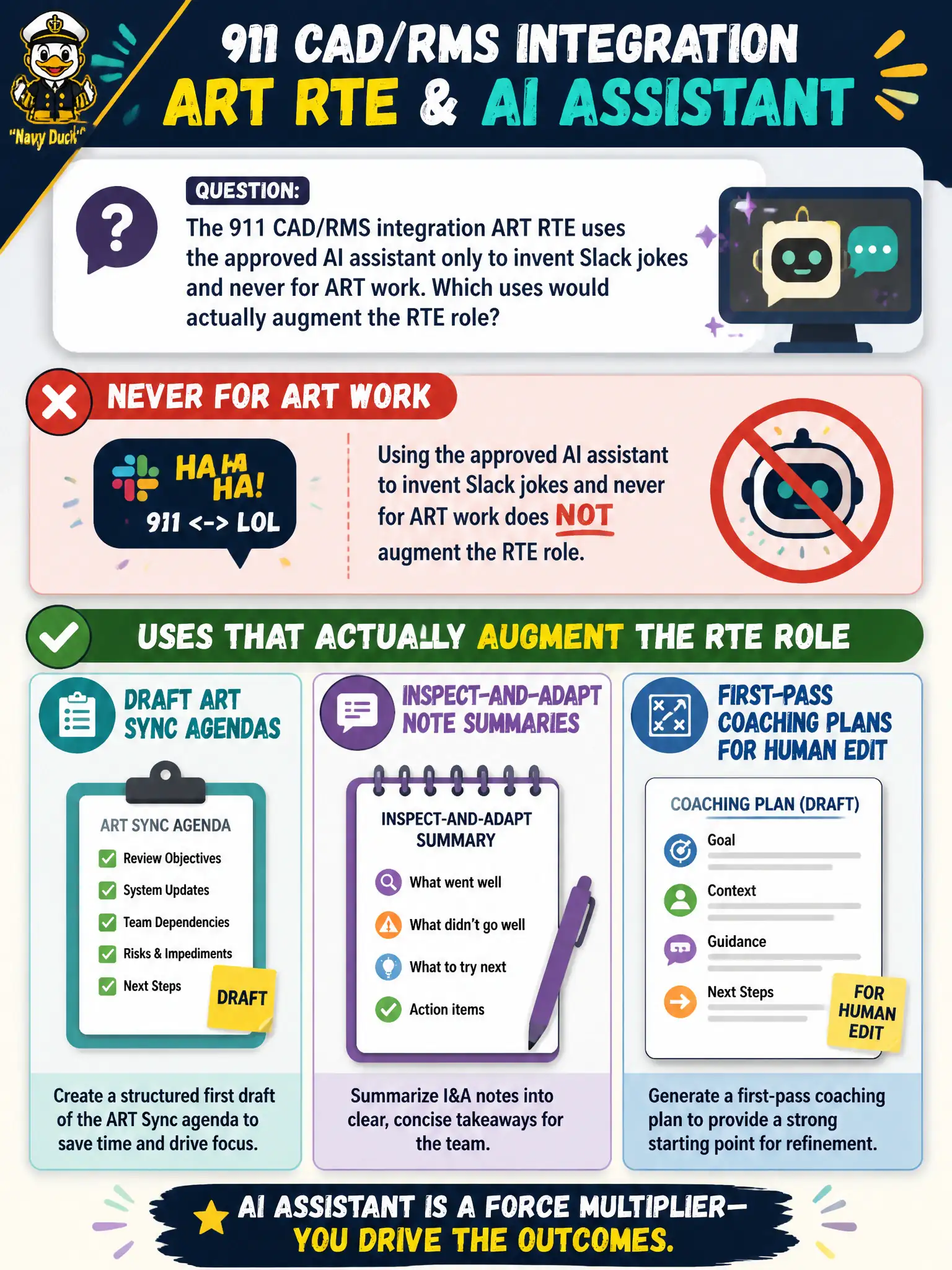
The 911 CAD/RMS integration ART RTE uses the approved AI assistant only to invent Slack jokes and never for ART work. Which uses would actually augment the RTE role?
Select an answer to reveal the explanation.
Short Explanation
Jokes are fine at lunch. The useful trick is letting the assistant draft the boring-but-real stuff—agendas, summaries, coaching-plan first passes—then editing them. That is work augmentation, not a novelty account.
Full Explanation
Legitimate AI augmentation for an RTE includes drafting ART Sync agendas, Inspect-and-Adapt note summaries, and first-pass coaching plans for human edit. On the 911 CAD/RMS integration ART, using the approved assistant only for Slack jokes wastes that capacity and invents a false rule that facilitation artifacts must never be machine-assisted. Generating public press releases that claim PI success without a System Demo is communication risk, not facilitation support. Auto-paging on-call dispatchers based on the model’s “mood” about incident volume is unsafe automation in public safety. Keeping AI limited to jokes because facilitation artifacts must never be machine-assisted confuses responsible use with total abstinence. Exam caveat: drafts remain drafts until humans validate facts, tone, and fitness for 911 stakeholders. Operational check: pick one recurring artifact—ART Sync agenda—draft it with the approved tool, edit with Scrum Masters, and run the human-facilitated sync; expand to I&A summaries only after that loop works. Keep the civic mission visible when applying the technique so resident-facing outcomes stay the measure of success. In municipal ART practice, capture the rationale in facilitation notes so future coaches inherit the same standard.