
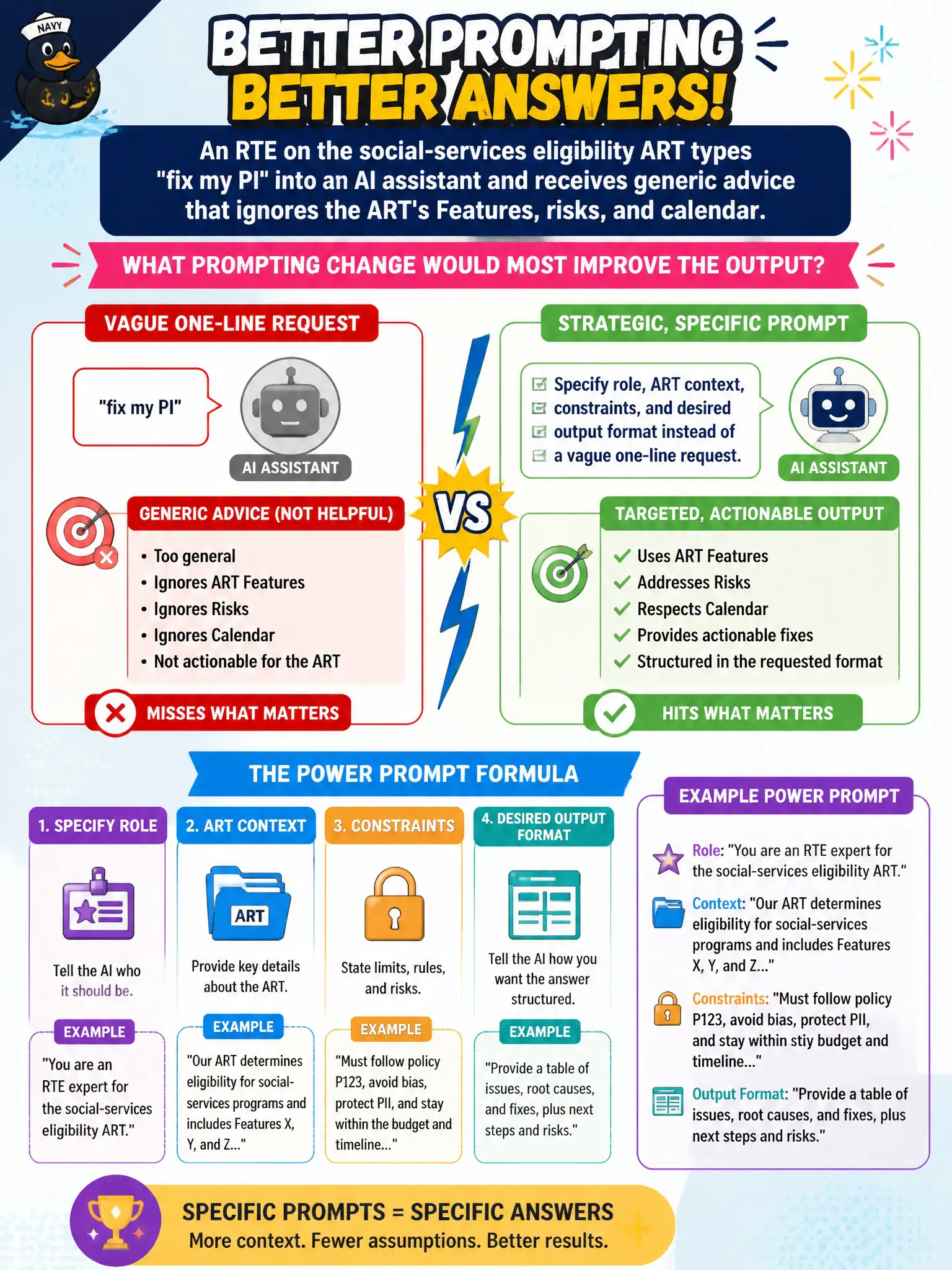
An RTE on the social-services eligibility ART types "fix my PI" into an AI assistant and receives generic advice that ignores the ART's Features, risks, and calendar. What prompting change would most improve the output?
Select an answer to reveal the explanation.
Short Explanation
"Fix my PI" is like walking into a shop and saying "make it better" with no car, no budget, and no keys. Assistants do better when the prompt says who to act as, what is going on, what the limits are, and how the answer should look. Vague in, vague out.
Full Explanation
Effective AI prompting for RTE work specifies role, ART context, constraints, and desired output format rather than a vague one-line request. On the social-services eligibility ART, “fix my PI” yields generic advice that ignores Features, risks, and calendar because the model was given no grounding. A grounded prompt tells the assistant who the RTE is, which municipal train, what is known about the backlog and ROAM board, and what artifact is needed. Repeating the vague phrase in all caps is not a priority signal that repairs missing context. Asking the model to invent SAFe events the ART does not run pollutes guidance with ceremony fiction. Stripping eligibility-program names so the model guesses the domain removes the civic specifics that make advice usable. Exam caveat: more context is not a license to paste citizen PII into unapproved tools—grounding must respect municipal data policy. Operational check: rewrite the prompt with role, eligibility ART facts, constraints, and a requested outline format; compare the new draft to the ART calendar and backlog before using any recommendation. Keep the civic mission visible when applying the technique so resident-facing outcomes stay the measure of success.