
A library digital-card Product Backlog has become a junk drawer of branch wishes, vendor tickets, and one-off reports, and there is no Product Goal. What should the Product Owner establish first?
Select an answer to reveal the explanation.
Short Explanation
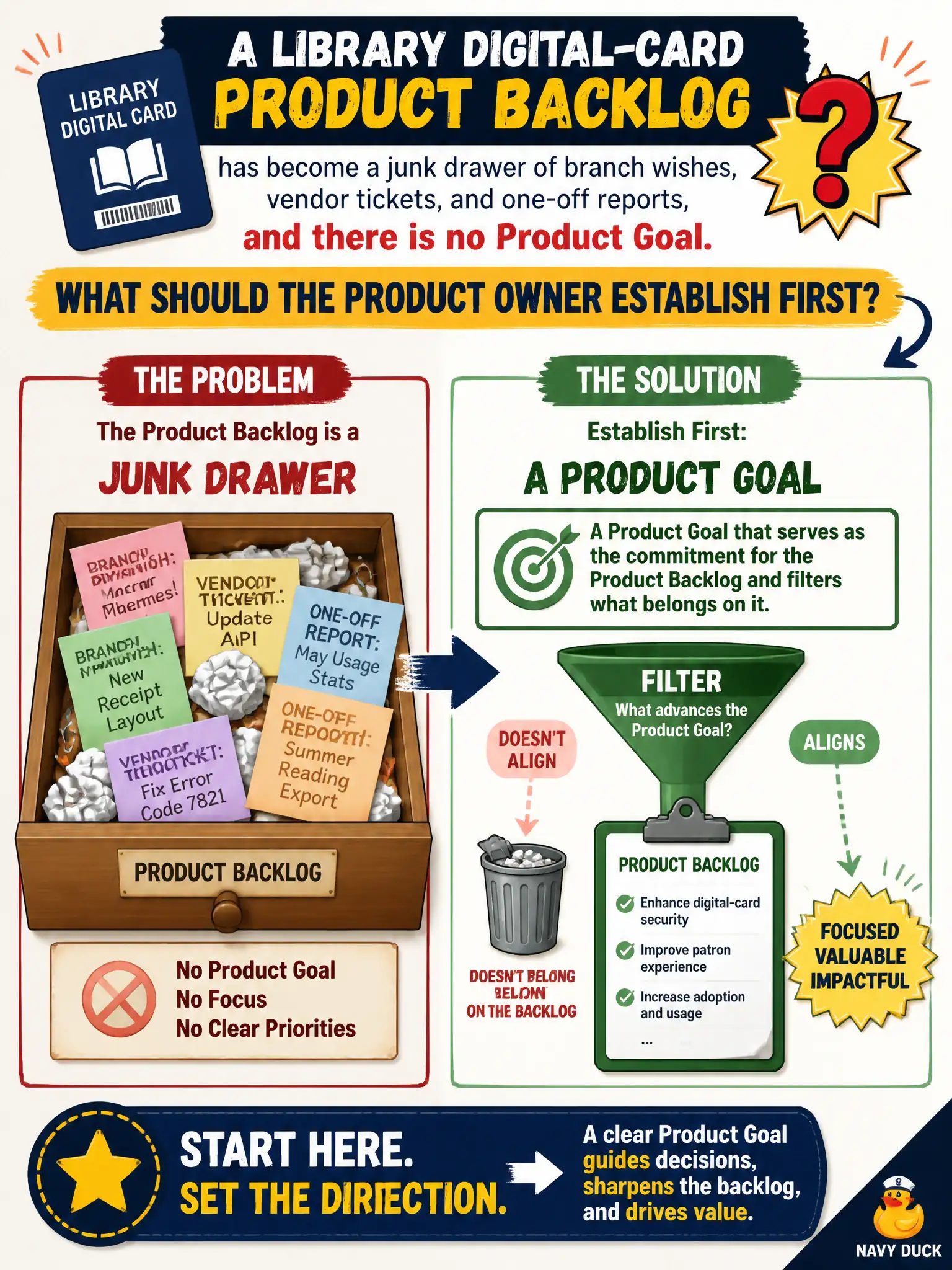
A backlog without a Product Goal is a junk drawer—easy to toss in another charger, impossible to say what finished looks like. The Product Goal is the commitment that says what this library card product is trying to become. Once that is clear, half the drawer does not belong.
Full Explanation
The Product Goal is the Scrum commitment for the Product Backlog; it describes a future state of the product the Scrum Team plans to achieve. When a library digital-card Product Backlog has become a junk drawer of branch wishes, vendor tickets, and one-off reports with no Product Goal, the Product Owner should establish a Product Goal that serves as that commitment and filters what belongs on the backlog. Without it, ordering is political inventory rather than progress toward a cardholder outcome.
A separate requirements baseline so every wish is documented before anything is ordered documents the junk drawer instead of aiming it. A velocity target that commits Developers to emptying the drawer this quarter substitutes output pressure for product direction. A portfolio Kanban of every branch request so nothing is ever declined institutionalizes never saying no.
Library cardholders experience one product future state; a junk-drawer backlog without a Product Goal cannot steer toward it.
Exam caveat: PSPO II Product Goal is the commitment that makes Product Backlog ordering coherent; documentation and velocity are not substitutes.
Operational check: write one Product Goal for the library digital-card product, remove or demote items that do not serve it, and reorder the remainder toward that future state.