
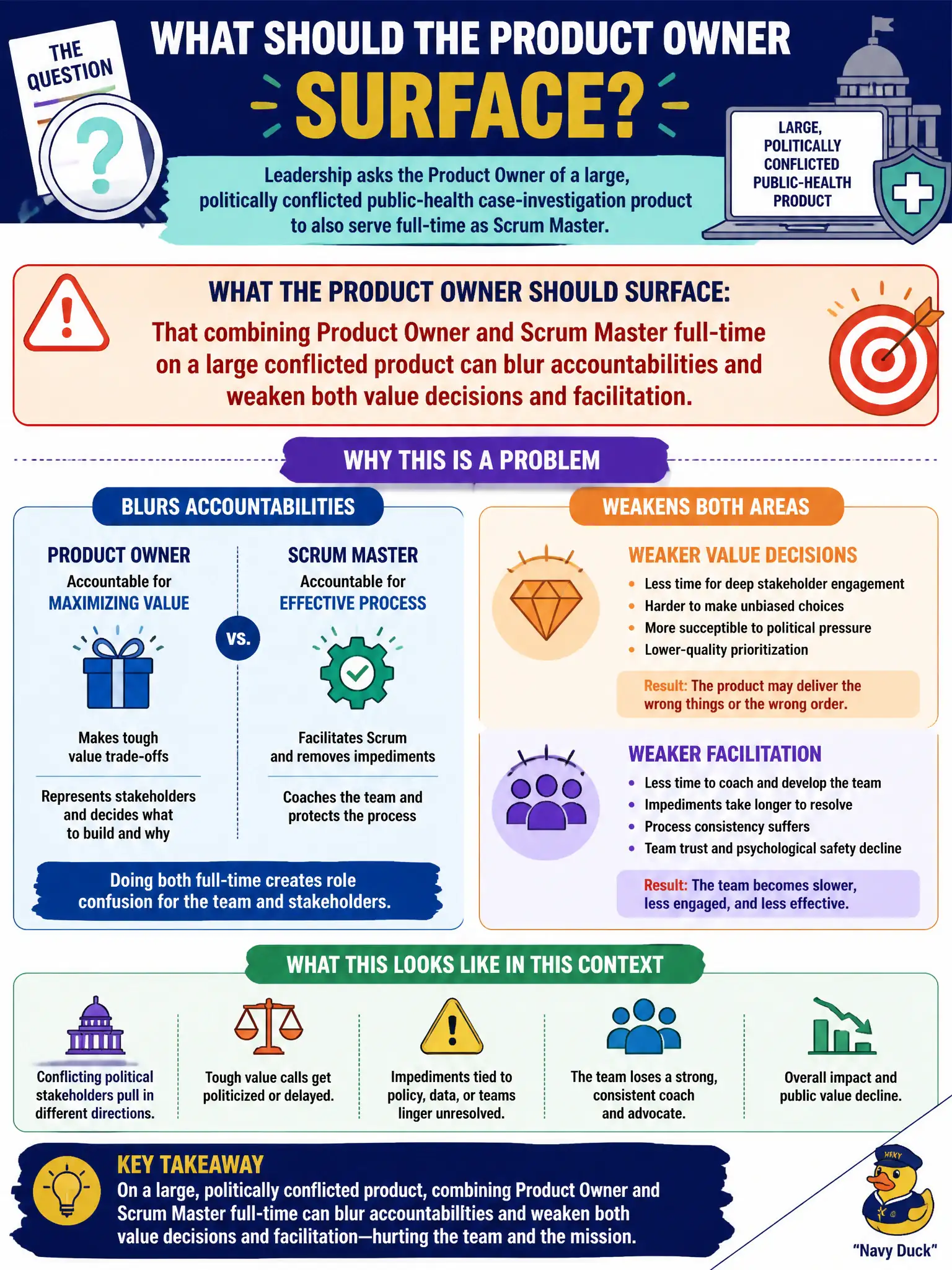
Leadership asks the Product Owner of a large, politically conflicted public-health case-investigation product to also serve full-time as Scrum Master. What should the Product Owner surface?
Select an answer to reveal the explanation.
Short Explanation
Wearing both badges on a messy case-investigation product is like being the referee and the coach in the same packed stadium. Value calls and facilitation start stepping on each other. Surface that blur now, before the conflict of interest is the operating model.
Full Explanation
Scrum defines distinct Product Owner and Scrum Master accountabilities. Combining them full-time on a large, politically conflicted public-health case-investigation product risks mixing value-maximizing decisions with facilitation and coaching, reducing effectiveness of both. The Product Owner should surface that blur so leadership understands combining roles can weaken both value decisions and facilitation rather than treating the merge as a free velocity trick.
Claiming combining accountabilities always increases velocity so the request should be accepted without discussion ignores conflict-of-interest risk on a contested civic product. Outsourcing Scrum Master accountability to a PMO scheduler while the Product Owner keeps both titles creates a paper merge and a facilitation vacuum. Asserting Product Owner and Scrum Master are identical accountabilities on public-health products so one person must hold both invents a false identity of roles.
Exam caveat: PSPO II allows one person to hold multiple accountabilities in theory but expects awareness that large conflicted products make the combination dangerous.
Operational check: document the political conflicts on the case-investigation product, recommend separate PO and SM accountabilities (or clear part-time boundaries), and refuse an undocumented full-time dual role.