
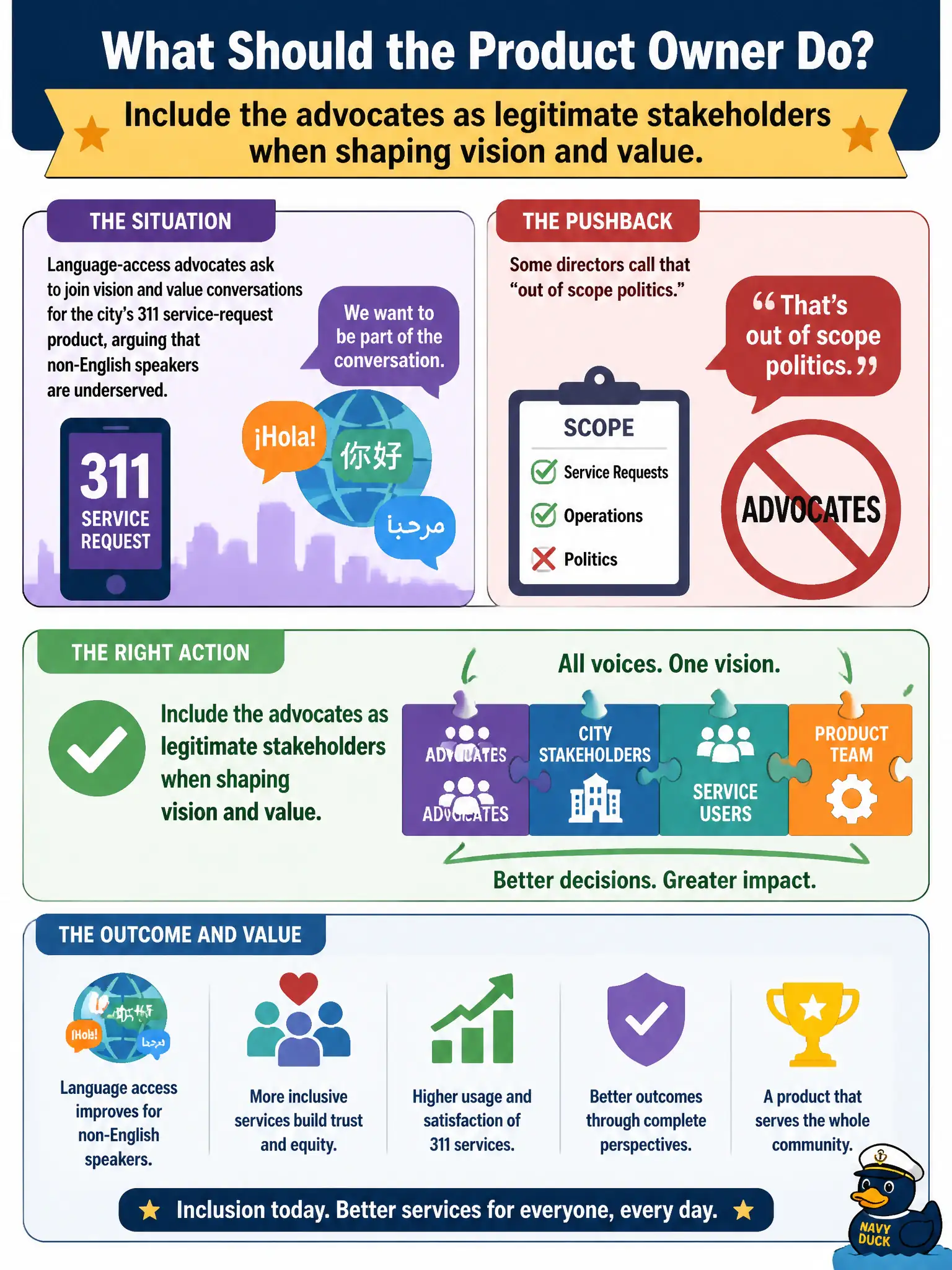
Language-access advocates ask to join vision and value conversations for the city’s 311 service-request product, arguing that non-English speakers are underserved. Some directors call that “out of scope politics.” What should the Product Owner do?
Select an answer to reveal the explanation.
Short Explanation
If half the city cannot use the door, the product is not “done for everyone.” Language-access folks are not a side protest; they are stakeholders for civic value. Leave them out and you are measuring success on the easiest speakers only.
Full Explanation
Equity and language-access advocates represent real customer outcomes for a municipal 311 service-request product. Including them in vision and value conversations helps the Product Owner see underserved demand and avoid optimizing only for already-served English speakers. That does not mean advocates order the Product Backlog, but their evidence is in-scope for Product Goal and value definition. Parking access in a later equity project or substituting a brochure treats inclusion as optional decoration rather than civic product quality.
Excluding advocates because only paying permit applicants count fails by inventing a paying-customer filter that does not fit 311 public service. Deferring all language-access input until next fiscal year’s equity project fails by treating access as out-of-band politics instead of current value. Asking communications for a translated brochure so the product stays English-only fails because a brochure is not an accessible service-request journey.
Exam caveat: Access advocates are legitimate stakeholders for vision and value; they advise, they do not replace Product Owner ordering. Operational check: Invite language-access partners into the next 311 vision workshop, capture underserved jobs-to-be-done, and show which backlog hypotheses address non-English request completion.