
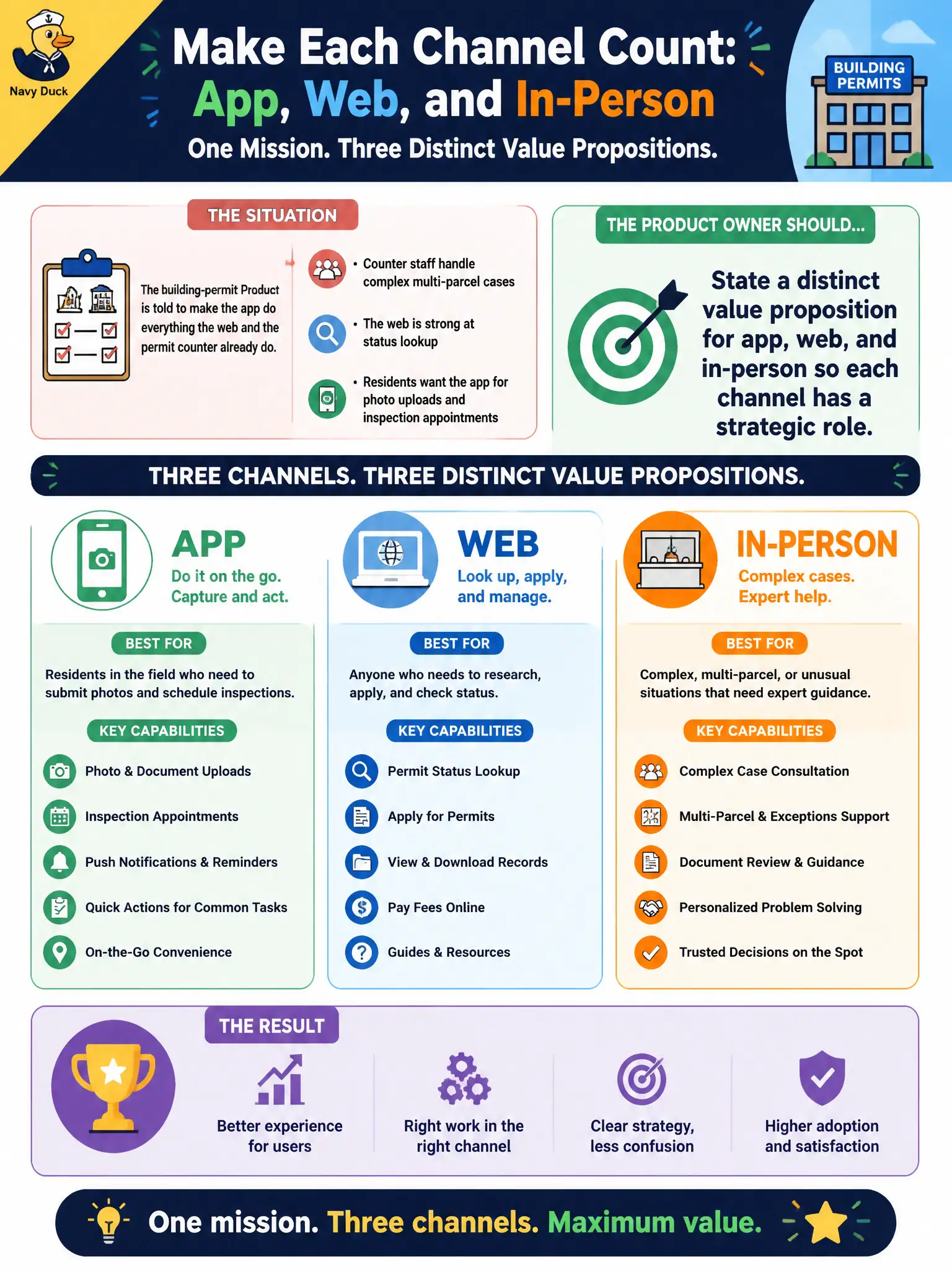
The building-permit Product Owner is told to make the app do everything the web and the permit counter already do. Counter staff handle complex multi-parcel cases; the web is strong at status lookup; residents want the app for photo uploads and inspection appointments. What should the Product Owner do?
Select an answer to reveal the explanation.
Short Explanation
The drive-through, the dining room, and the catering line are not supposed to be the same restaurant. Apps, websites, and permit counters win at different jobs. Name what each channel is for instead of cloning everything everywhere.
Full Explanation
Channels need distinct value propositions, not forced full parity. When the building-permit Product Owner is told to make the app do everything the web and the permit counter already do—while counter staff handle complex multi-parcel cases, the web is strong at status lookup, and residents want the app for photo uploads and inspection appointments—the Product Owner should state a distinct strategic role for each channel. Cloning every counter workflow into the app so channel strategy stays full parity wastes capacity on poor-fit complexity. Retiring the web and the counter once the app launches to force a single digital front door ignores evidenced channel strengths. Letting each channel’s loudest supervisor order the shared Product Backlog recreates local optimization. Exam caveat: some capabilities may intentionally appear in more than one channel; that is deliberate overlap, not a mandate for identical everything. Operational check: publish channel roles, order app work for photo upload and appointments, keep complex cases at the counter and status strength on the web, and inspect completion metrics per channel against those roles. Preserve a single ordered Product Backlog so municipal stakeholders can inspect opportunity cost without shadow lists or vanity launch calendars.