
The transit Product Owner's live app already sells passes and shows arrivals—the city's current value stream. Strategy also asks for exploration of on-demand microtransit in two neighborhoods. Finance wants 100 percent of capacity on pass-sales optimizations that print money now. What should the Product Owner do?
Select an answer to reveal the explanation.
Short Explanation
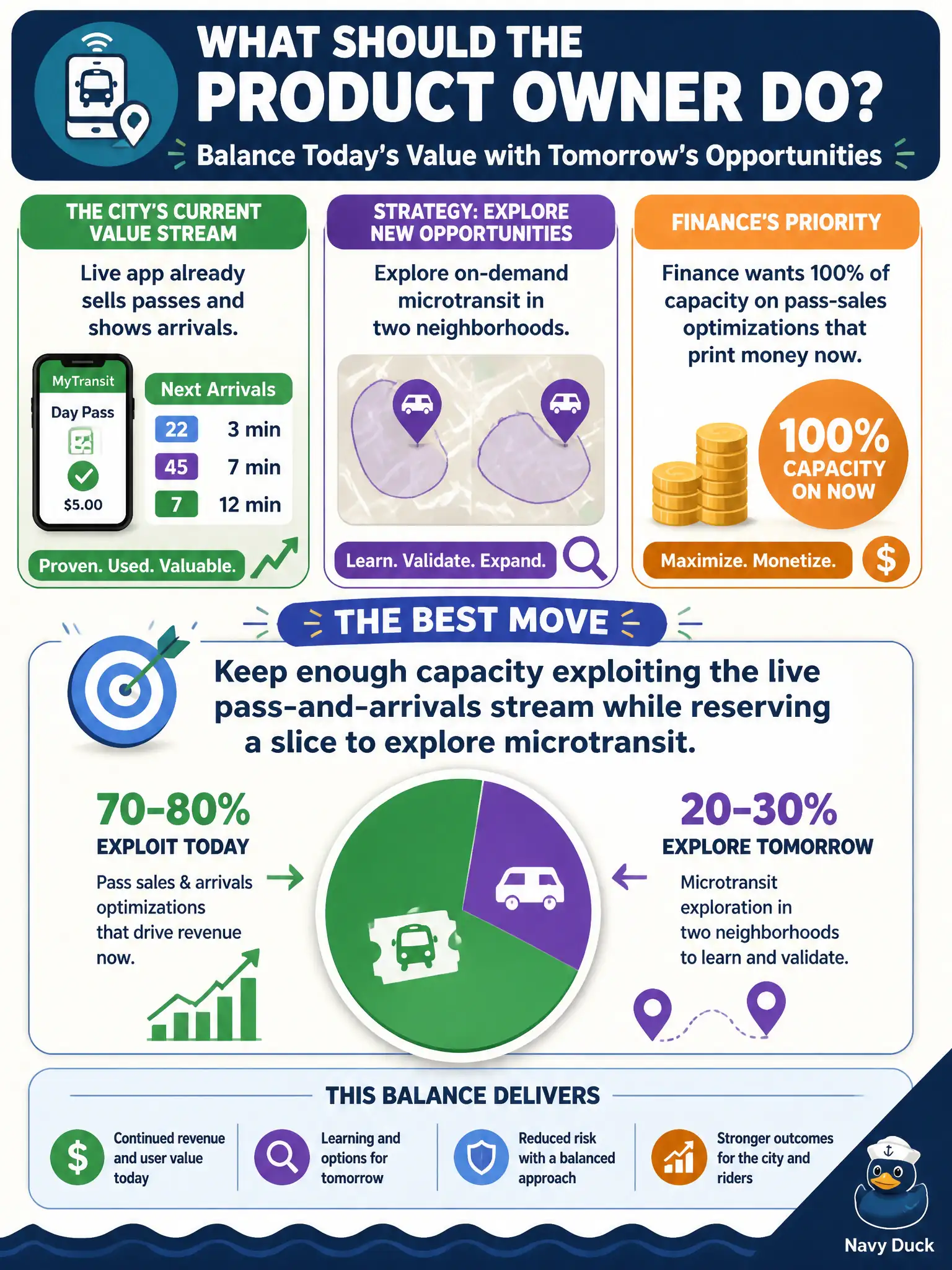
You still have to keep the buses running while you try a new neighborhood shuttle. Healthy strategy is not all harvest and not all science-fair. Protect the value people use today and still carve out room to learn the next bet.
Full Explanation
Healthy product strategy balances exploiting the current value stream with exploring future bets. When the transit app already sells passes and shows arrivals—the city’s live value stream—while strategy also asks for on-demand microtransit exploration in two neighborhoods and Finance wants one hundred percent capacity on pass-sale optimizations, the Product Owner should keep enough capacity exploiting the live stream while reserving a slice to explore microtransit. Pausing all exploration until pass-sale conversion is maximized for two fiscal years starves learning. Freezing the live app and moving the whole team onto a microtransit prototype endangers current value. Creating a second Product Owner so one only exploits and one only explores with no shared strategy fragments accountability. Exam caveat: the exploit/explore split is intentional and evidence-adjusted—not a permanent fifty-fifty rule. Operational check: allocate explicit Product Backlog capacity to pass/arrivals improvements and to a thin microtransit experiment with kill criteria, report both streams to Finance, and inspect rider outcomes before scaling exploration. Preserve a single ordered Product Backlog so municipal stakeholders can inspect opportunity cost without shadow lists or vanity launch calendars.