
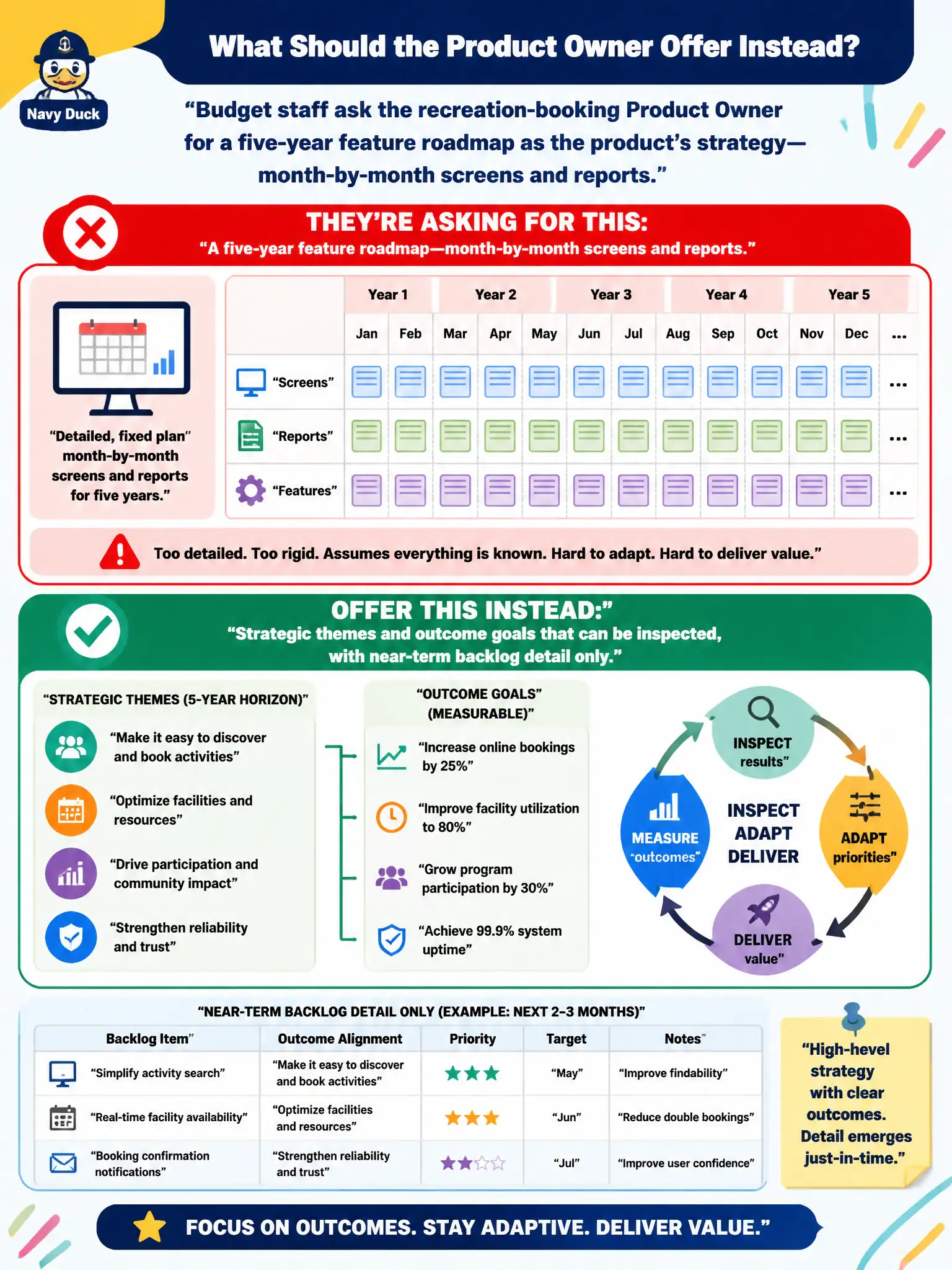
Budget staff ask the recreation-booking Product Owner for a five-year feature roadmap as the product's strategy—month-by-month screens and reports. What should the Product Owner offer instead?
Select an answer to reveal the explanation.
Short Explanation
A five-year list of screens is a grocery receipt, not a strategy. Parks still need a direction—who gets on a field, what outcome moves—plus next month's ordered work. Themes and goals can be inspected; a frozen feature novel cannot.
Full Explanation
Strategy is not a five-year feature catalog. When budget staff ask the recreation-booking Product Owner for a month-by-month five-year roadmap of screens and reports as the product’s strategy, the Product Owner should offer strategic themes and outcome goals that can be inspected, with detailed backlog only near-term. A locked list of features with dates through year five pretends certainty the market and city will not grant. A Gantt of vendor modules Finance can capitalize as fixed assets optimizes accounting over resident outcomes. A promise that every requested report appears in the year it was asked for turns stakeholder volume into a plan. Exam caveat: longer-horizon themes help budgeting; detailed feature promises years out fight empiricism. Operational check: publish outcome-oriented themes for recreation access and equity, keep only near-term Product Backlog detail forecastable, revisit themes as evidence arrives, and refuse a five-year screen list as a substitute for product strategy. Offer budget partners inspectable outcomes and themes for recreation access; withhold multi-year screen promises the evidence will invalidate. Re-validate the decision after the next Sprint Review using outcome evidence rather than output counts alone.