
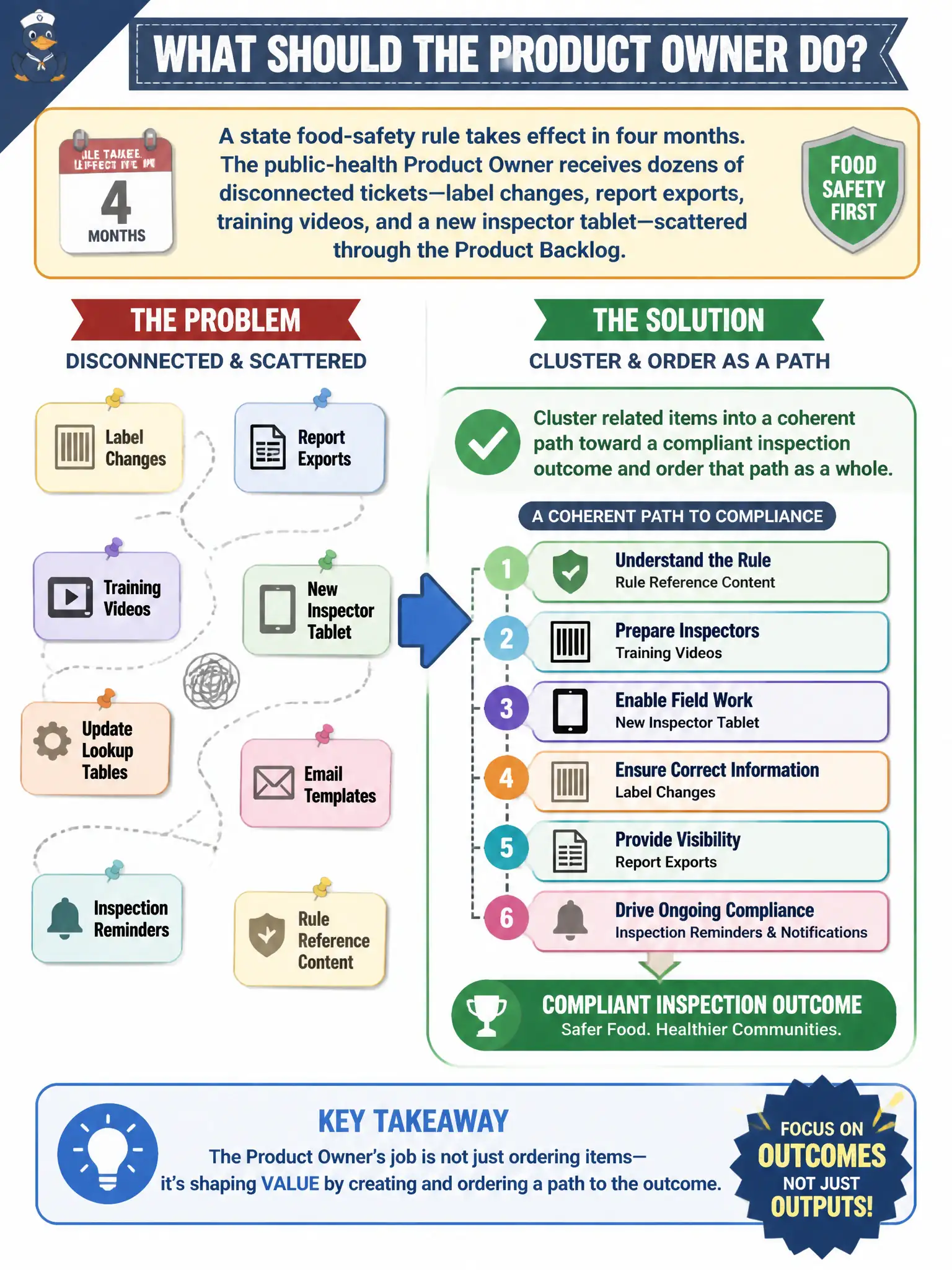
A state food-safety rule takes effect in four months. The public-health Product Owner receives dozens of disconnected tickets—label changes, report exports, training videos, and a new inspector tablet—scattered through the Product Backlog. What should the Product Owner do?
Select an answer to reveal the explanation.
Short Explanation
A compliance date is not a junk drawer. If you scatter label tweaks, tablet work, and training videos all over the backlog, the restaurant still is not inspectable when the law hits. Cluster the pieces into one outcome path and order that path so a legal kitchen actually opens.
Full Explanation
Compliance work still needs coherent product thinking. When a state food-safety rule takes effect in four months and the public-health Product Owner receives dozens of disconnected tickets—label changes, report exports, training videos, a new inspector tablet—scattered through the backlog, the Product Owner should cluster related items into a coherent path toward a compliant inspection outcome and order that path as a whole. Ranking tickets by which bureau submitted first so every unit gets a turn is fairness theater, not value or risk ordering. Placing every compliance ticket at the top in random order and stopping all other product work maximizes panic without a releasable compliance Increment. Waiting until Legal publishes a two-hundred-page interpretation before any item may be ordered delays learning that thinner slices could reduce residual risk sooner. Exam caveat: some legal clarity may be needed, but empiricism favors ordering a minimal valuable compliant path over waiting for perfect interpretation. Operational check: define the compliant inspection outcome, group enabling tickets under that path, order the path against residual regulatory risk, and inspect readiness with inspectors before the effective date rather than celebrating ticket count.