
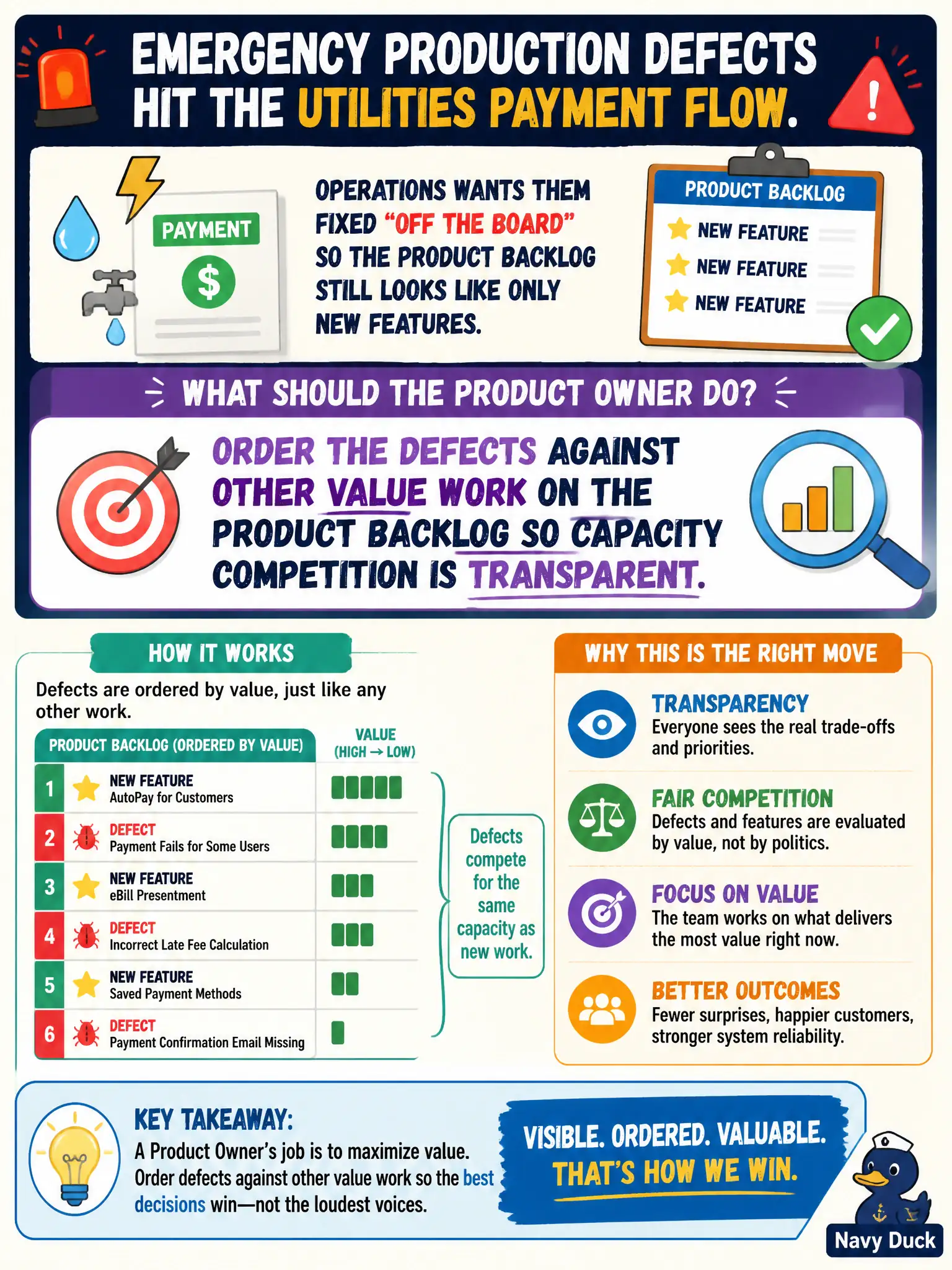
Emergency production defects hit the utilities payment flow. Operations wants them fixed "off the board" so the Product Backlog still looks like only new features. What should the Product Owner do?
Select an answer to reveal the explanation.
Short Explanation
A leak in the payment pipe is product work, even if it is not a shiny new faucet. Hiding defects off the board just hides where the hours went. Put them on the list and stack them against other value so everybody sees the trade.
Full Explanation
Defects that consume capacity are product work and belong in transparent Product Backlog ordering. When emergency production defects hit the utilities payment flow and operations wants them fixed “off the board” so the backlog still looks like only new features, the Product Owner should order the defects against other value work so capacity competition is visible. Pretending defects are not product work and letting a shadow operations team absorb them understates opportunity cost and breaks empiricism for water-bill collection. Placing every defect above all feature work automatically with no value comparison is as crude as ignoring defects—severity, risk, and impact still matter. Waiting until the next annual planning cycle to admit the defects exist is too slow for production payment failures. Exam caveat: severe production issues often outrank features in the moment, but the teaching point is transparent ordering—not a permanent defects-always-first rule. Operational check: add payment defects to the Product Backlog immediately, order them against current feature bets with operations present, protect the Sprint Goal collaboratively if mid-Sprint intervention is needed, and inspect collection continuity after the fix meets Done.