
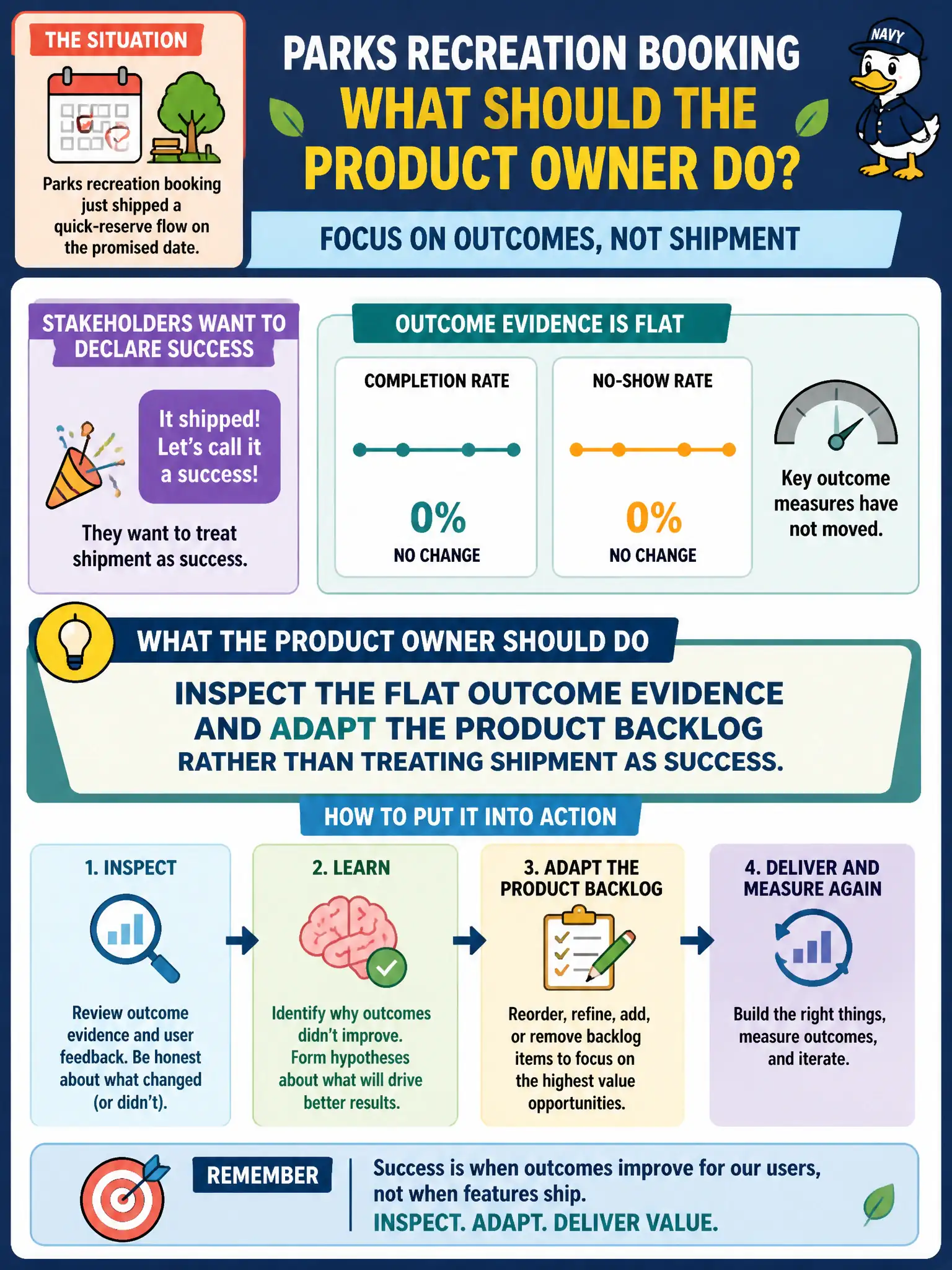
Parks recreation booking just shipped a quick-reserve flow on the promised date. Completion rate and no-show measures have not moved. Stakeholders want to declare the release a success because it shipped. What should the Product Owner do?
Select an answer to reveal the explanation.
Short Explanation
Shipping on Tuesday is not the same as families actually getting a field on Saturday. If the scoreboard did not move, the play was not the win—it was just a play. The Product Owner looks at the outcomes and restacks the backlog instead of hanging a success banner on a date.
Full Explanation
Value is realized in outcomes, not in the act of release. When parks recreation booking ships a quick-reserve flow on the promised date yet completion rate and no-show measures stay flat, empiricism requires the Product Owner to inspect that evidence and adapt the Product Backlog—new hypotheses, different slices, or stopping a weak bet—rather than declaring success by shipment. Closing the Product Goal because the ship date was met confuses output and calendar compliance with value delivered to families booking fields. Raising next Sprint’s velocity target so more booking features compensate for flat measures doubles down on output pressure without learning why outcomes did not move. Freezing the Product Backlog for two Sprints to avoid disturbing a freshly released flow prevents adaptation exactly when inspection says adaptation is needed. Exam caveat: a timely release can still be necessary for trust or compliance, but shipment alone is not proof of value on PSPO II-style outcome questions. Operational check: publish the flat outcome metrics beside the release notes, facilitate Sprint Review inspection with parks stakeholders, revise Product Backlog order toward the next testable hypothesis on completion or no-shows, and refuse to mark the civic Product Goal done until evidence moves.