
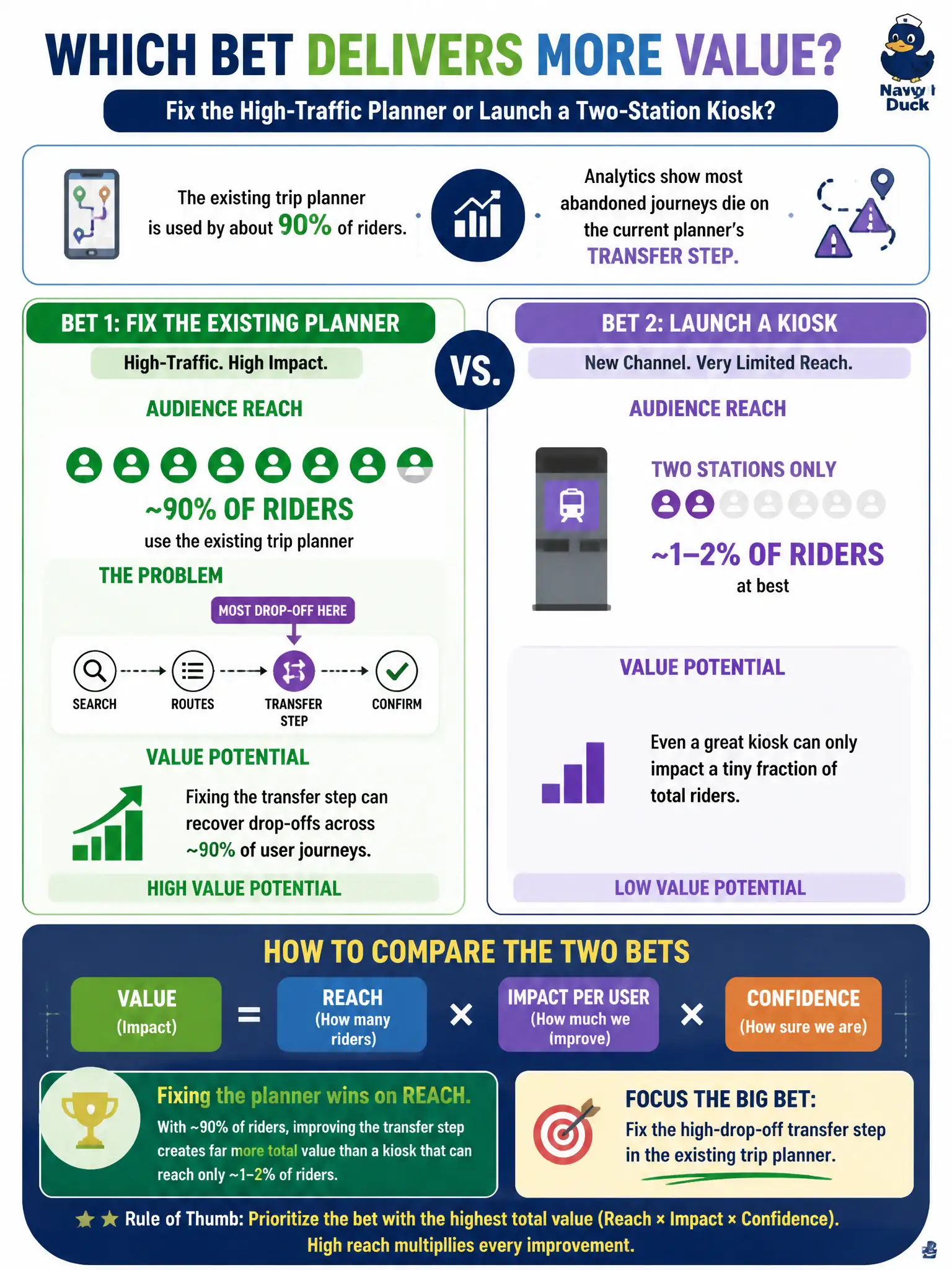
A city transit-app Product Owner can either reduce drop-off in the existing trip planner—used by about 90% of riders—or launch a brand-new kiosk channel at two stations. Analytics show most abandoned journeys die on the current planner's transfer step. How should the Product Owner compare the two bets?
Select an answer to reveal the explanation.
Short Explanation
Fancy new doors do not beat a crowded hallway that already dumps most people on the floor. If nine out of ten riders live in the trip planner, shaving pain there can dwarf a shiny kiosk two stations get to see. Value follows where the outcomes are, not where the novelty is.
Full Explanation
Opportunity cost is central when a city transit-app Product Owner chooses between bets. Improving an existing high-traffic journey often outperforms launching a new channel when evidence shows drop-off is concentrated in the current path—here, about ninety percent of riders already use the trip planner and abandon on the transfer step. The Product Owner should compare expected value using reach, outcome impact, and evidence: fixing that planner step can move outcomes for the majority audience, while a two-station kiosk can only reach a much smaller slice. Launching kiosks first because a new channel is always higher value treats novelty as a value model and ignores analytics. Asking the mayor which option sounds more innovative substitutes political preference for an inspectable comparison. Splitting capacity evenly so neither stakeholder group feels neglected is fairness theater, not empiricism. Exam caveat: new channels can still win when they unlock audiences the current journey cannot serve—but that claim needs evidence, not assumption. Operational check: quantify abandoned journeys on the transfer step versus projected kiosk reach and completion, order the higher-expected-value bet on the Product Backlog, ship a thin Increment, and inspect rider-completion measures before scaling either path across the municipal transit product.