
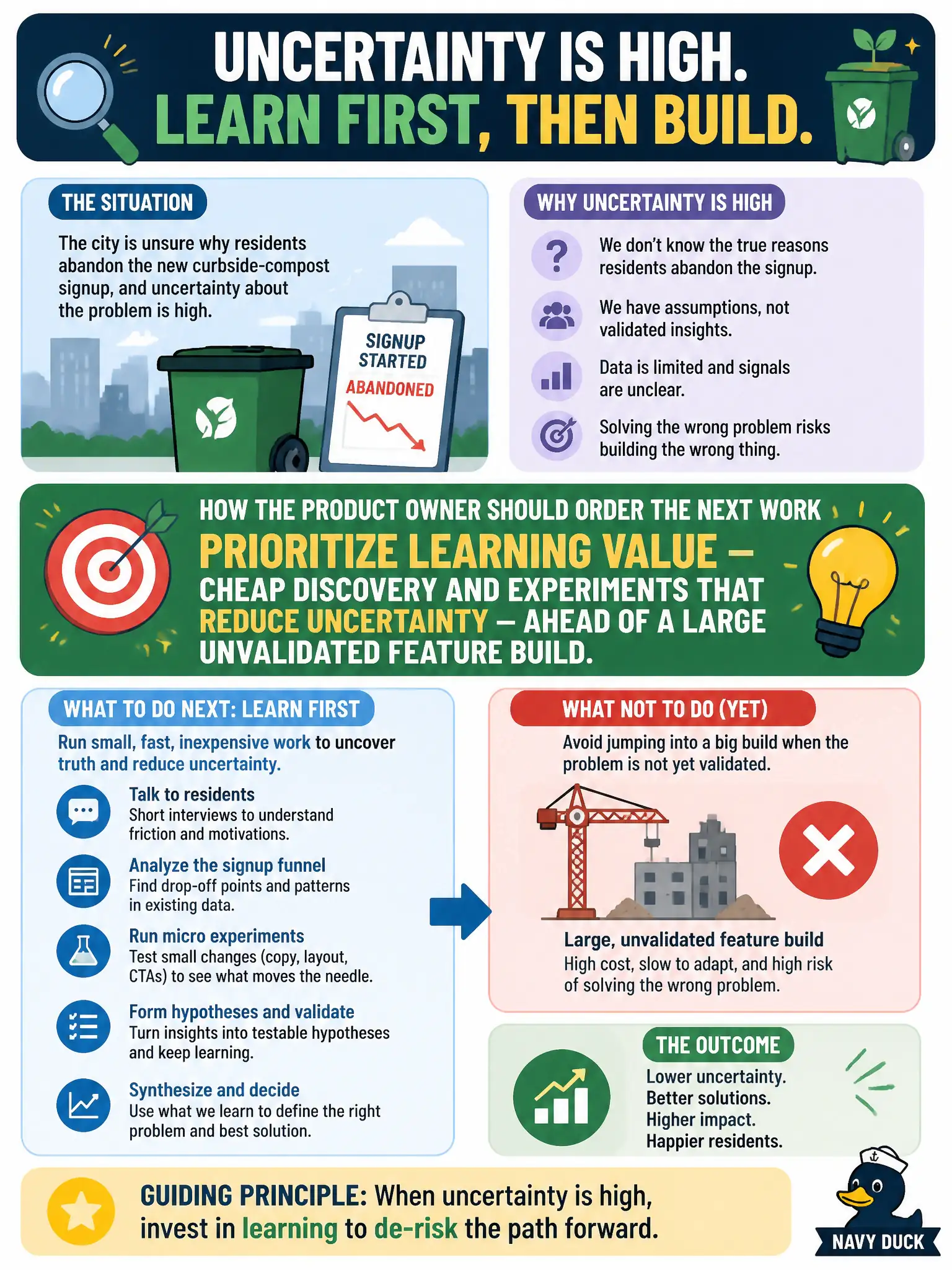
The city is unsure why residents abandon the new curbside-compost signup, and uncertainty about the problem is high. How should the Product Owner order the next work?
Select an answer to reveal the explanation.
Short Explanation
When you do not know why people walk away from the compost cart, more pavement is not the answer. Buy a cheap lesson first — a prototype, a few interviews, a tiny test. Information can be the most valuable thing on the backlog.
Full Explanation
Under high problem uncertainty about why residents abandon curbside-compost signup, the value of information can exceed the value of another large unvalidated feature. The Product Owner should prioritize cheap discovery and experiments that reduce uncertainty ahead of a full multi-language marketing campaign or platform build. Building the campaign first and studying drop-off after launch spends heavily before knowing the cause. Freezing the Product Backlog until a year-long research vendor delivers a final report delays empiricism the team could run in Sprints. Filling the next three Sprints with unused backlog items so utilization stays high produces inventory instead of learning. Exam caveat: learning work belongs on the Product Backlog when it is the highest-value next step. Operational check: order small abandonment experiments this Sprint, instrument drop-off steps, adapt the signup backlog from findings, and refuse utilization filler while the problem remains unknown. High uncertainty on compost signup abandonment makes learning the highest-value next order; campaigns and utilization filler both waste capacity. Run drop-off experiments in-Sprint and adapt from findings instead of waiting on year-long vendor research.