
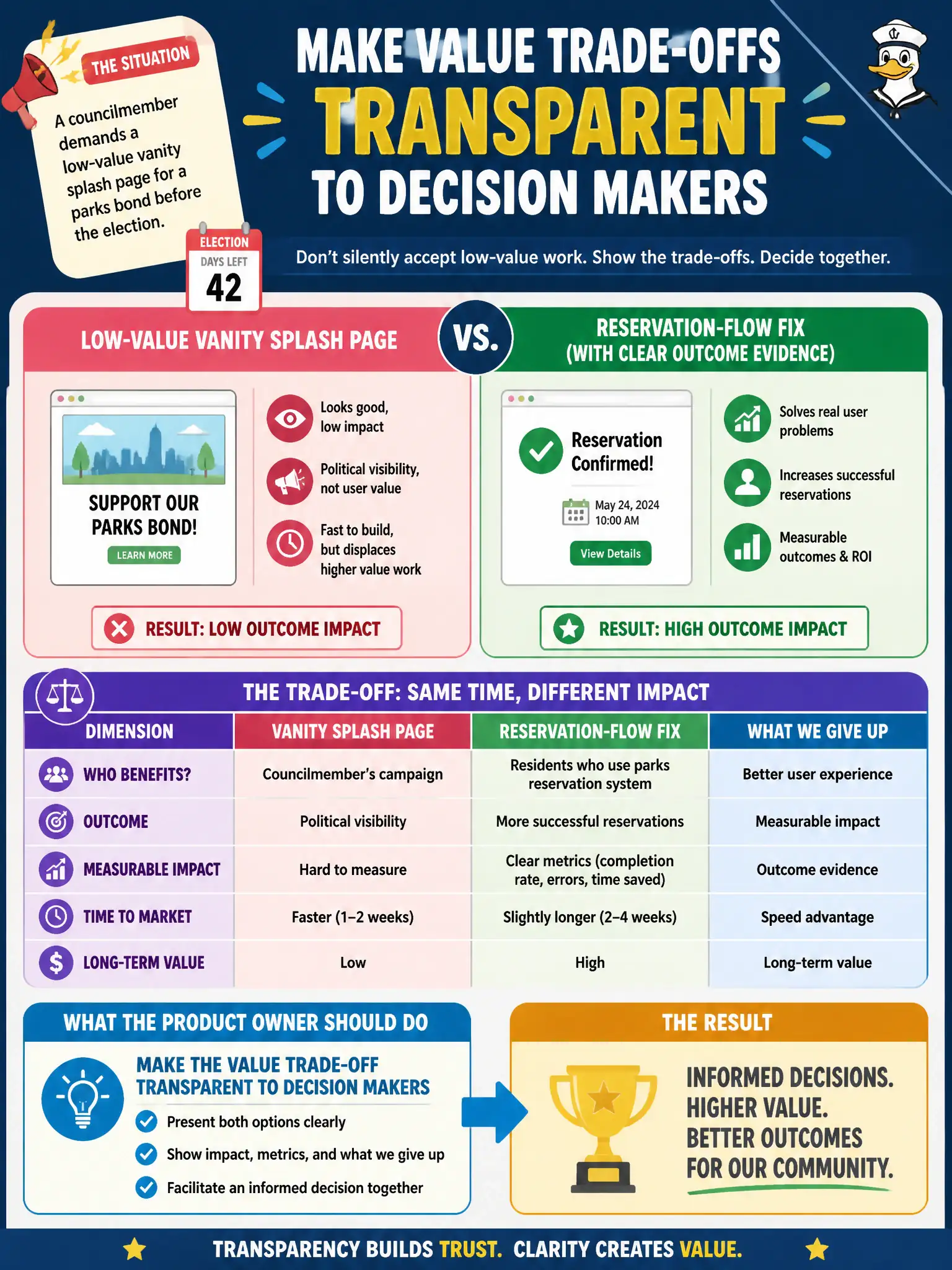
A councilmember demands a low-value vanity splash page for a parks bond before the election. The page would displace a reservation-flow fix with clear outcome evidence. What should the Product Owner do?
Select an answer to reveal the explanation.
Short Explanation
Vanity pages are campaign posters taped over the ticket window. The Product Owner's job is not to hide that trade-off. Put the lost reservation outcomes on the table and let decision makers own the choice in the light.
Full Explanation
When a councilmember demands a low-value vanity splash page for a parks bond that would displace a reservation-flow fix with clear outcome evidence, the Product Owner should make the value trade-off transparent to decision makers rather than silently accepting the vanity page. Silent insertion at the top of the Product Backlog to avoid political conflict hides opportunity cost. Asking the Scrum Master to refuse the councilmember on the team's behalf misassigns stakeholder negotiation. Creating a second Product Backlog for political requests hides the conflict instead of resolving it with evidence. Exam caveat: transparency of trade-offs is the Product Owner's duty under political pressure. Operational check: present expected outcome impact of the reservation fix versus the splash page, ask decision makers to choose knowingly, and record the decision so Sprint Reviews can inspect whether the chosen path produced value. Political vanity splash pages that displace evidenced reservation fixes require transparent trade-off conversations, not silent backlog insertion or a second political backlog. Record the decision makers' choice and inspect outcomes at Sprint Review. Bring both the vanity splash page and the reservation-flow fix to the decision forum with outcome forecasts side by side, and require an explicit choose-with-eyes-open ruling on the record.