
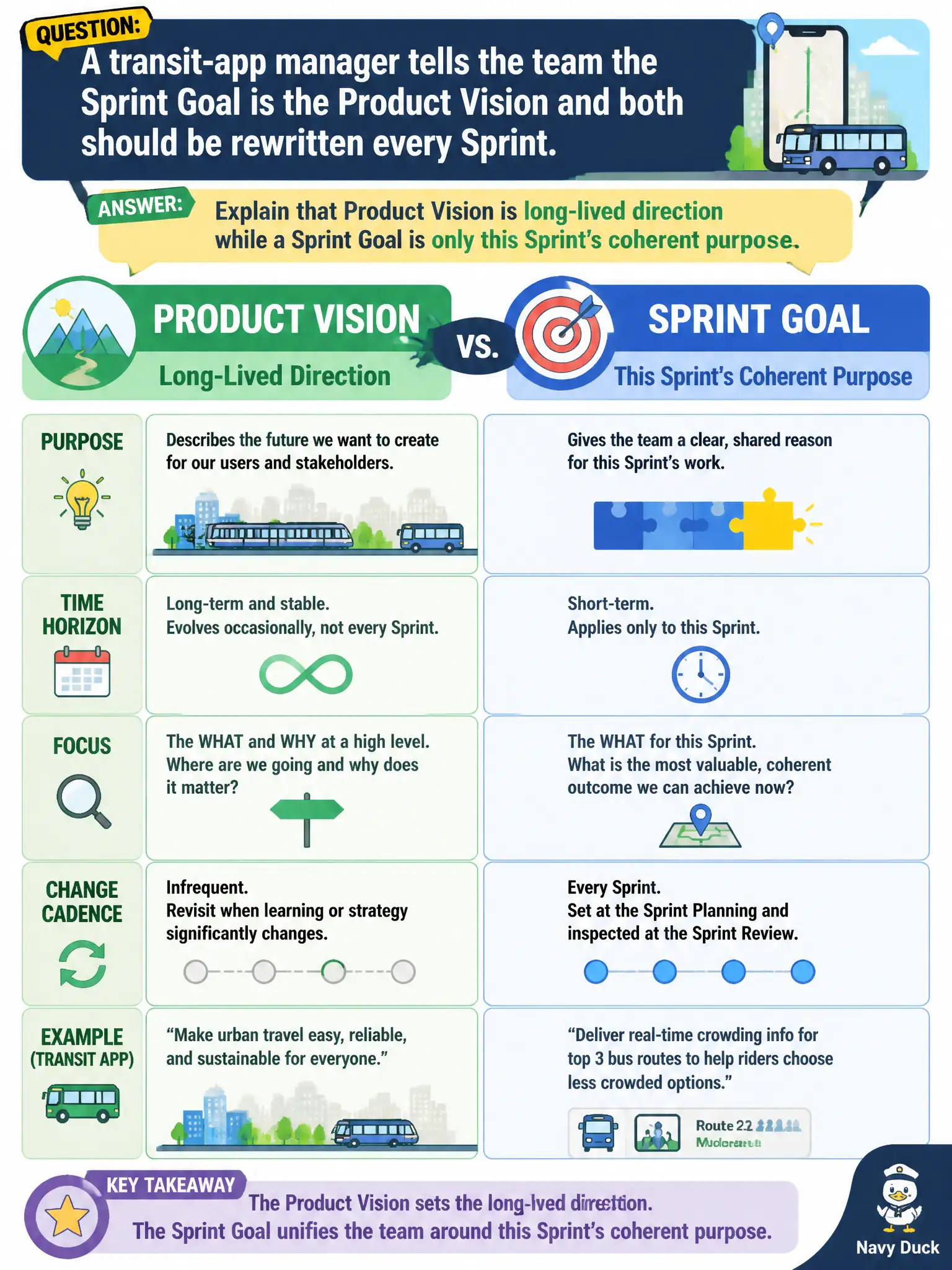
A transit-app manager tells the team the Sprint Goal is the Product Vision and both should be rewritten every Sprint. How should the Product Owner distinguish them?
Select an answer to reveal the explanation.
Short Explanation
Vision is the mountain you are hiking toward; the Sprint Goal is today's ridgeline. Mixing them up means either the mountain moves every two weeks or today's hike pretends to be the whole trip. Keep the long story stable and the Sprint story short.
Full Explanation
Product Vision is long-lived direction for the transit product; a Sprint Goal is only this Sprint's coherent purpose. They are not synonyms and should not be rewritten together every Sprint. Treating them as synonyms so stakeholders hear one simple message collapses planning horizons and leaves Developers without a stable north star. Replacing both with a quarterly scorecard abandons Scrum artifacts that connect vision to Sprint focus. Moving the Product Vision into the Sprint Backlog so Developers own both statements misplaces Product Owner accountability for vision and confuses Sprint-scoped work with product direction. Exam caveat: exam questions often blur vision and Sprint Goal—keep the time horizons distinct. Operational check: publish a stable Product Vision, craft each Sprint Goal as a single-Sprint outcome that advances that vision, and refuse weekly full vision rewrites driven by Sprint chatter or managerial convenience. Transit teams need a stable Product Vision across Sprints and a fresh Sprint Goal each Sprint; collapsing them weekly destroys both direction and focus. Audit recent Sprint Goals to ensure each advances the vision without rewriting the vision itself every Sprint.