
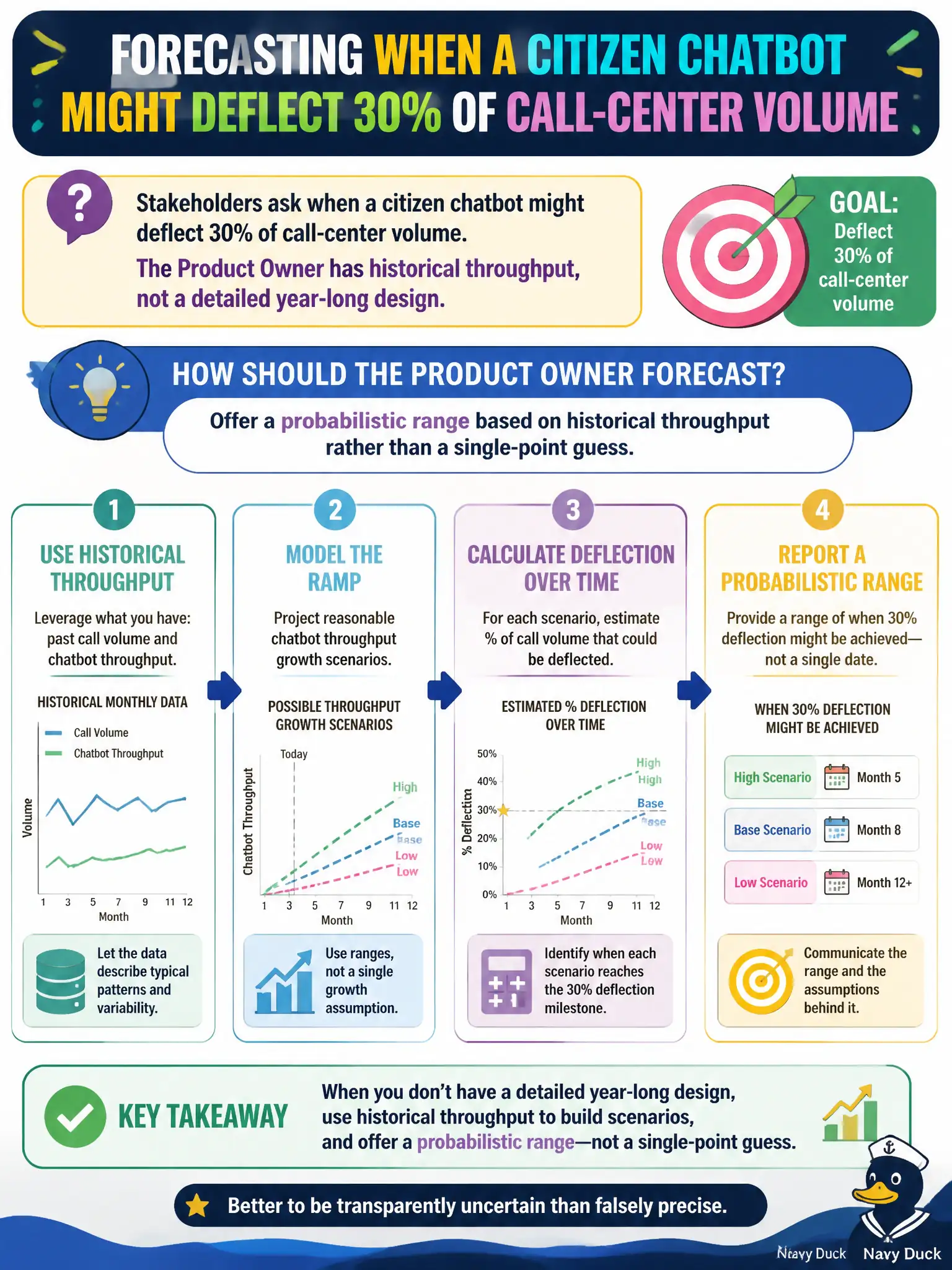
Stakeholders ask when a citizen chatbot might deflect 30% of call-center volume. The Product Owner has historical throughput, not a detailed year-long design. How should the Product Owner forecast?
Select an answer to reveal the explanation.
Short Explanation
Nobody knows the exact Friday the chatbot hits 30% deflection, and pretending to know does not help the call center. Use the throughput history to sketch a range, like a weather forecast with a high and a low. A single magic date is just a wish with a timestamp.
Full Explanation
When stakeholders ask when a citizen chatbot might deflect 30% of call-center volume and the Product Owner has historical throughput but not a detailed year-long design, a probabilistic range based on that throughput is the honest forecast. Range forecasts communicate uncertainty and beat single-point guesses while conversation design remains incomplete. Picking a single go-live Friday from best-case velocity and presenting it as certain injects optimism bias the call center will later experience as a staffing miss. Waiting until every conversation flow is designed before giving any date range delays useful empiricism stakeholders could already use for capacity planning. Promising 30% deflection on the date the call-center director prefers turns a metric into a political commitment detached from evidence. Exam caveat: PSPO II favors probabilistic, evidence-based outlooks over ceremonial dates when outcomes such as deflection rates depend on learning. Operational check: model deflection using recent throughput and observed variation, state the confidence band and the assumptions about conversation coverage, and schedule Sprint Review checkpoints that update the band as real deflection data arrives from live citizen chats.