
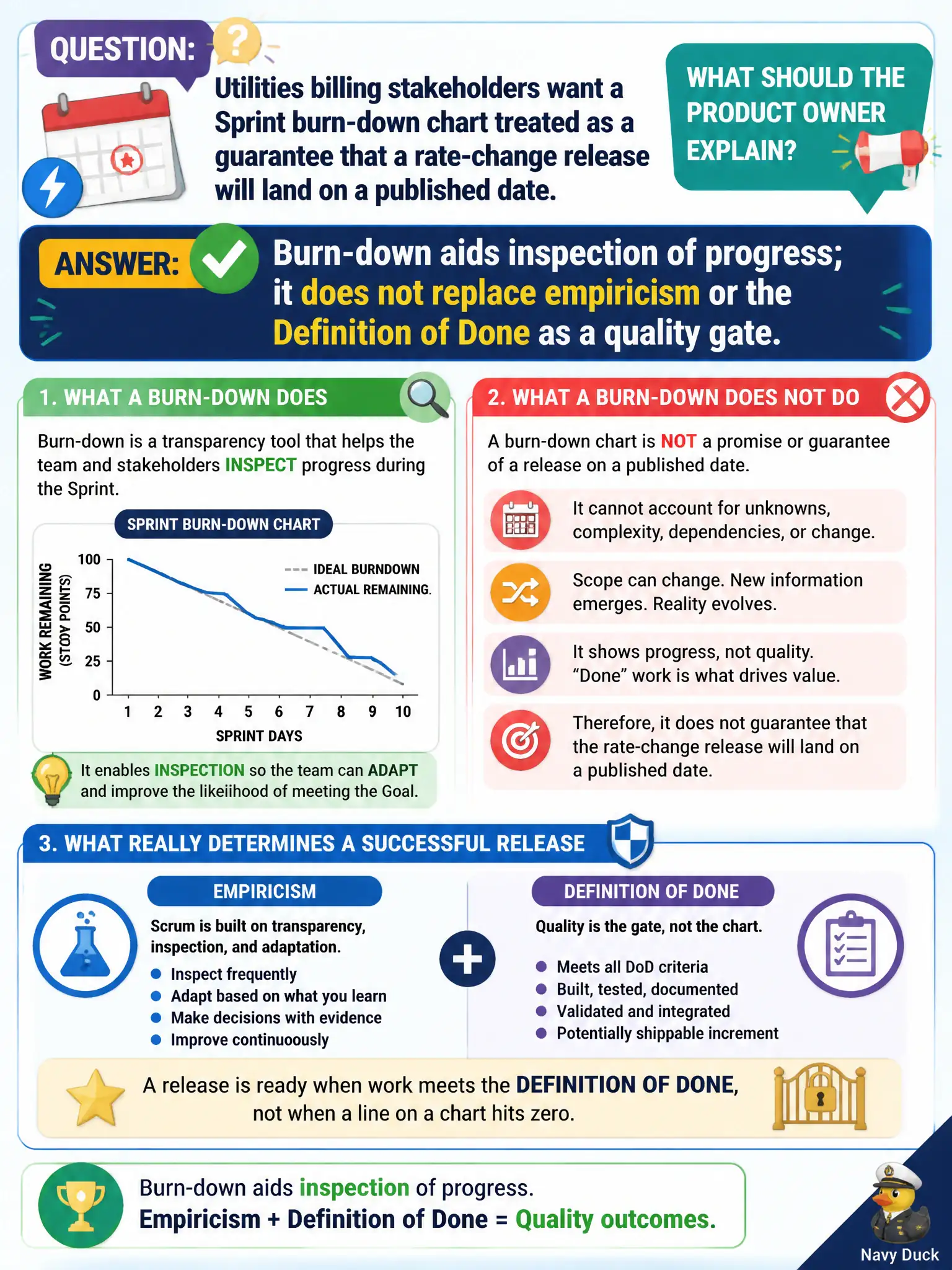
Utilities billing stakeholders want a Sprint burn-down chart treated as a guarantee that a rate-change release will land on a published date. What should the Product Owner explain?
Select an answer to reveal the explanation.
Short Explanation
A burn-down is a speedometer, not a signed warranty on the rate-change date. It helps the city see whether remaining work is moving, but Done still has to mean Done. If the line looks pretty and the Increment is junk, residents still cannot pay the new rates.
Full Explanation
Sprint burn-down charts aid transparency and inspection of remaining work on a utilities rate-change release; they do not replace empiricism or the Definition of Done as the quality gate for a releasable Increment. A burn-down that looks on track while items remain undone is still not a citizen-ready billing change, and residents cannot pay new rates on a pretty slope. Treating burn-down as a contract that commits the published date even when work is not Done confuses a progress aid with a guarantee and invites defective releases. Claiming burn-down replaces the Product Goal so stakeholders no longer need to inspect Increments removes the value conversation that Sprint Review exists to enable. Asserting that burn-down belongs only to the Scrum Master so the Product Owner should not discuss it with utilities leadership wrongly privatizes a forecast aid that Product Owners routinely use in stakeholder conversations. Exam caveat: charts support inspection; they never override Done or Product Goal accountability on the PSPO II exam. Operational check: when leadership points at the burn-down, ask whether every remaining backlog item for the rate change meets Done and whether the Increment has been inspected—if either answer is no, the date is still a hypothesis.