
The steering committee for a municipal affordable-housing lottery portal wants monthly slide decks of features shipped and hours billed. How should the Product Owner use Evidence-Based Management to change that conversation?
Select an answer to reveal the explanation.
Short Explanation
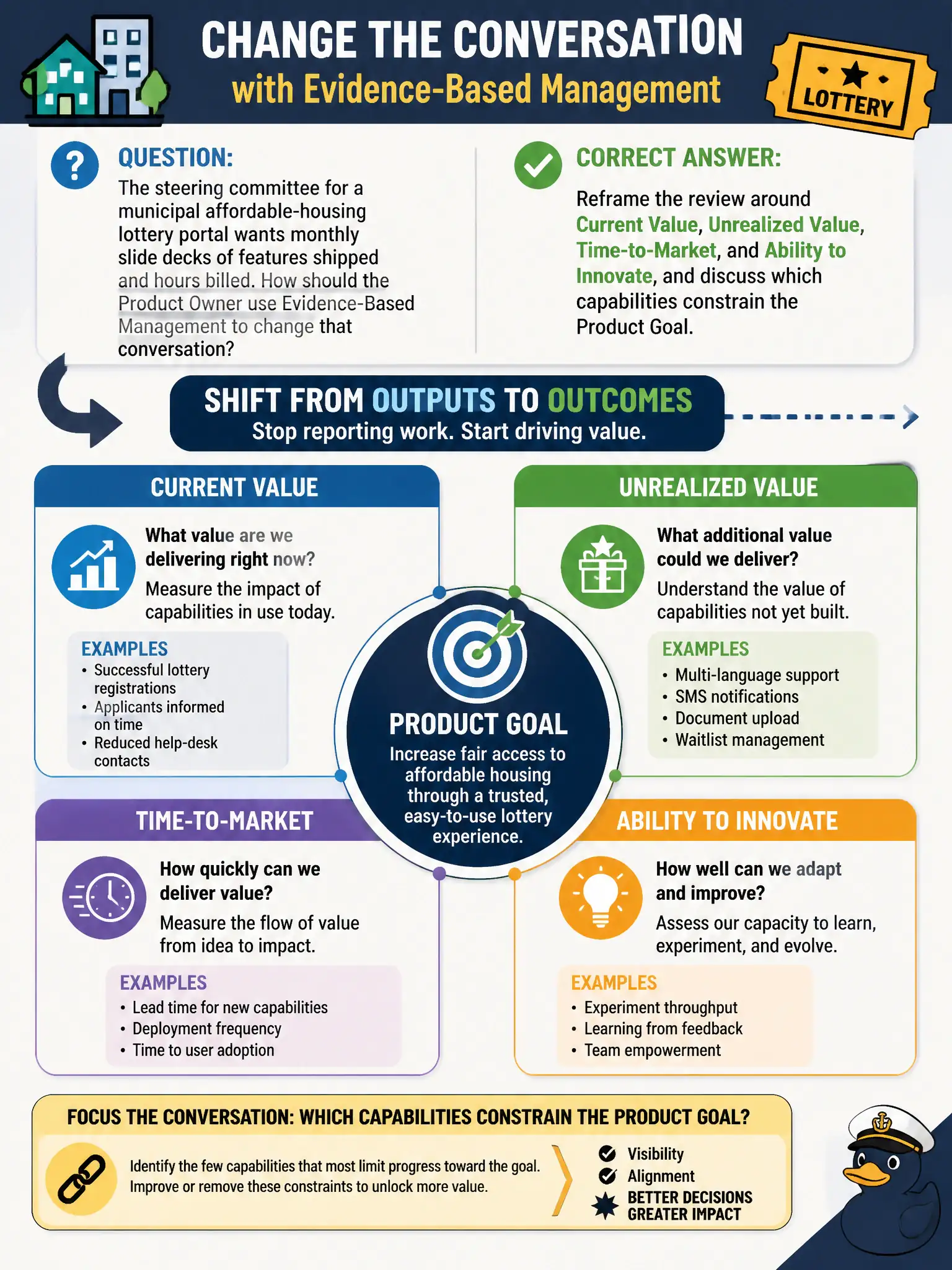
Feature lists and timesheets tell the committee how busy people were, not whether families can actually complete a lottery. Evidence-Based Management is the language for that shift: value and the capabilities that create it. Move the slides from output theater to Current Value, Unrealized Value, Time-to-Market, and Ability to Innovate.
Full Explanation
Steering conversations that count features and hours optimize for output, not for resident outcomes. Evidence-Based Management gives Product Owners a shared vocabulary—the four Key Value Areas—to discuss whether the affordable-housing lottery portal currently delivers value, where unmet demand sits, how long ideas take to reach residents, and whether the organization can still innovate. The Product Owner should reframe the review around Current Value, Unrealized Value, Time-to-Market, and Ability to Innovate, and discuss which capabilities constrain the Product Goal.
Agreeing to report only hours billed treats EBM as a developer dashboard rather than a leadership language for value. Replacing the committee with a change-control board that approves each feature as a project phase reinstalls waterfall governance. Translating reviews into a program increment burn-down so the committee can baseline scope recenters scope control instead of civic outcomes.
Exam caveat: PSPO II expects Product Owners to shift executive conversations from output theater to the four KVAs that constrain the Product Goal.
Operational check: replace the next lottery-portal committee deck's feature/hours slides with one slide per Key Value Area tied to the Product Goal, and end with the single biggest capability constraint to fund next.