
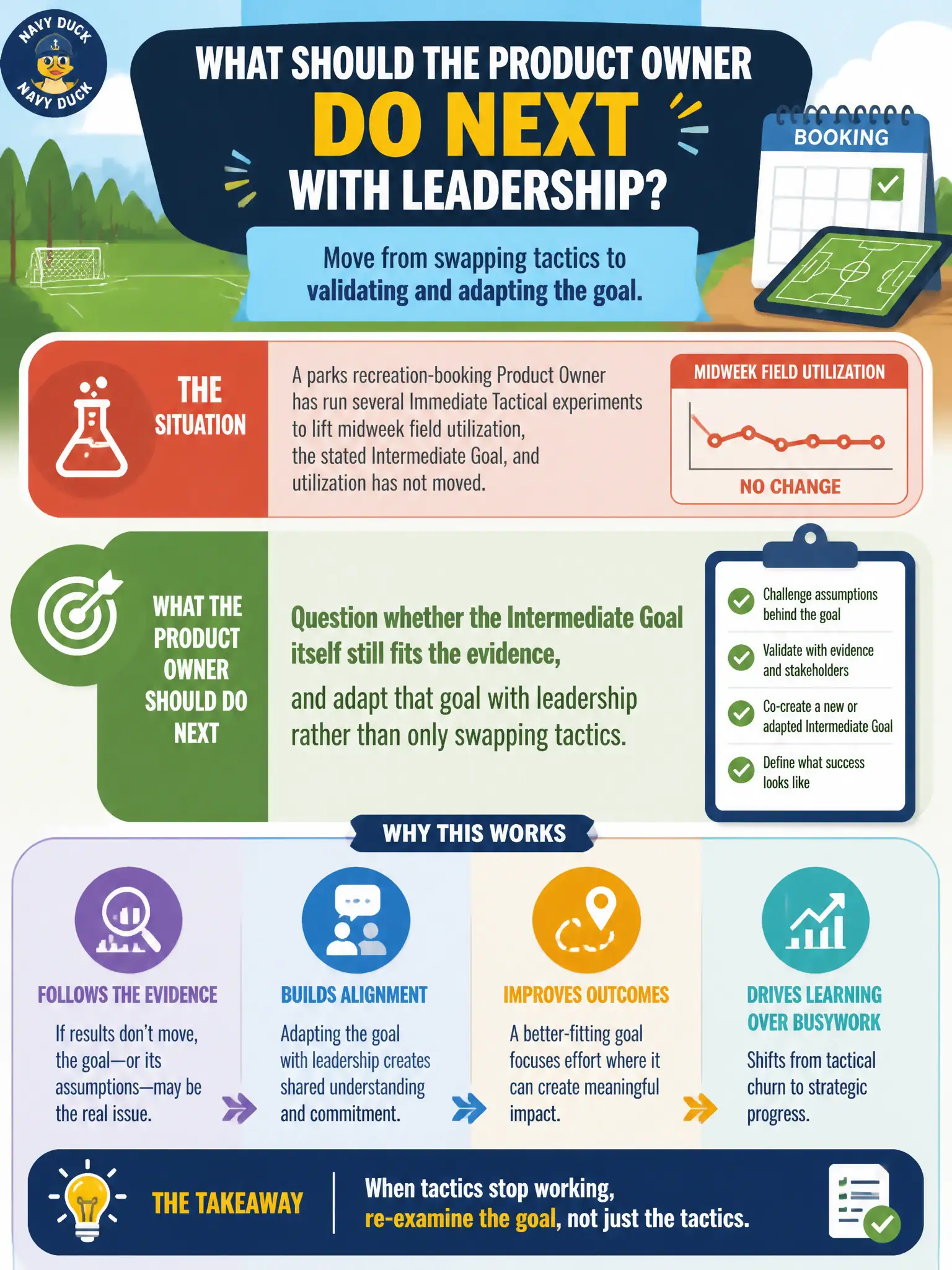
A parks recreation-booking Product Owner has run several Immediate Tactical experiments to lift midweek field utilization, the stated Intermediate Goal, and utilization has not moved. What should the Product Owner do next with leadership?
Select an answer to reveal the explanation.
Short Explanation
If every new play still leaves the field empty on Wednesday, maybe the game plan—not just the play-calling—is wrong. Tactics are supposed to serve an Intermediate Goal, and stubborn goals that never move deserve a hard look. Bring leadership the evidence and be willing to adapt the goal, not just shuffle experiments.
Full Explanation
Evidence-Based Management expects Immediate Tactical Goals to serve Intermediate Goals, which in turn serve a Strategic Goal. When a parks recreation-booking Product Owner has run several Immediate Tactical experiments to lift midweek field utilization and utilization has not moved, continuing to swap only tactics is stubbornness, not empiricism. The Product Owner should question whether the Intermediate Goal itself still fits the evidence and adapt that goal with leadership rather than only shuffling experiments.
Keeping the Intermediate Goal frozen and adding more of the same tactics until utilization appears ignores repeated falsification. Dropping Evidence-Based Management and replacing the Intermediate Goal with a story-point quota abandons outcomes for output. Hiding the failed tactics from leadership so the Strategic Goal is never discussed destroys transparency and blocks adaptation at every ladder level.
Exam caveat: PSPO II allows Intermediate Goals to change when evidence shows they are the wrong bet; endless identical tactics are not perseverance.
Operational check: bring leadership the series of failed midweek-utilization tactics and the flat measure, then decide together whether to change the Intermediate Goal, the measure, or the problem framing before funding another similar experiment.