
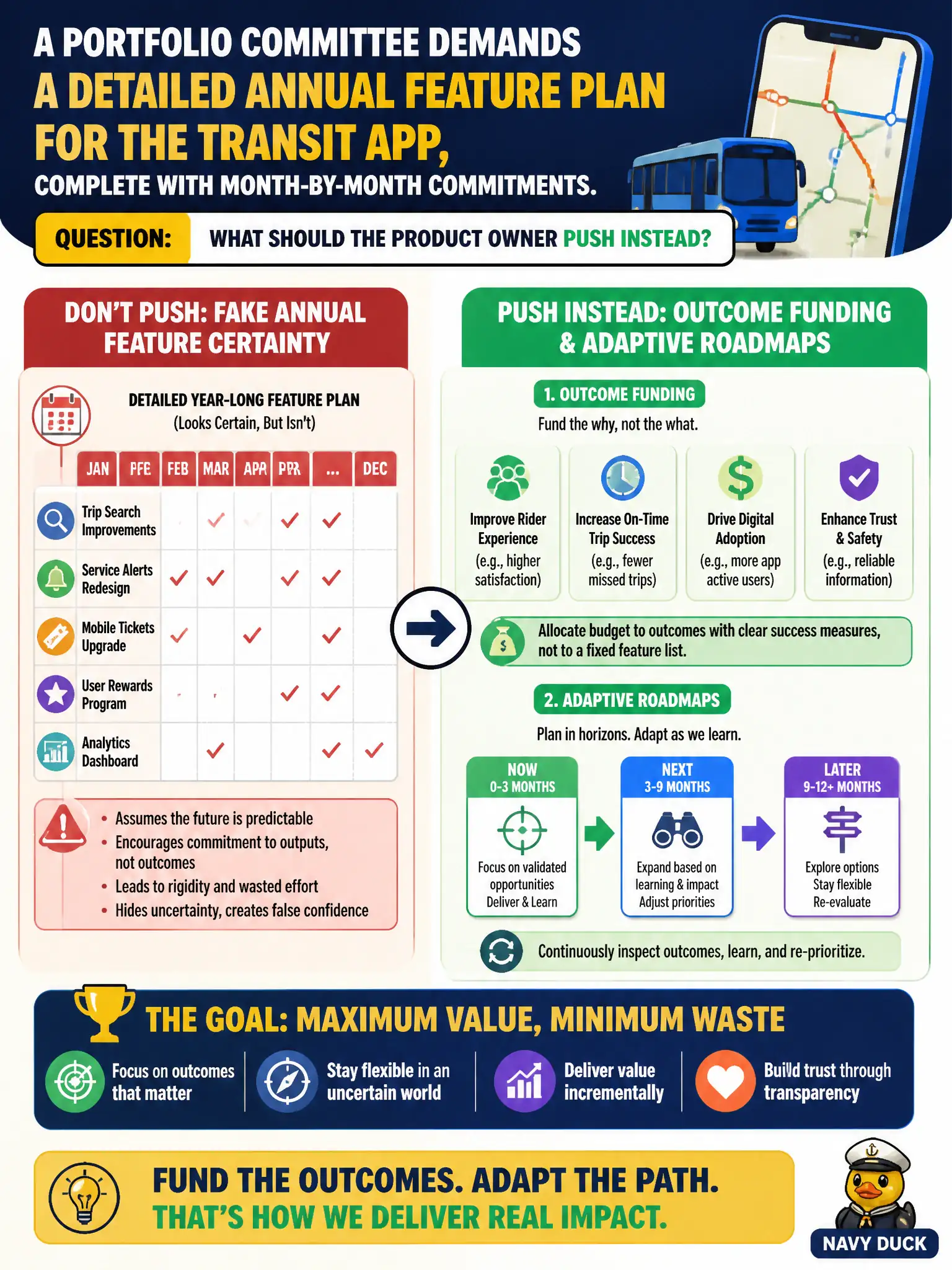
A portfolio committee demands a detailed annual feature plan for the transit app, complete with month-by-month commitments. What should the Product Owner push instead?
Select an answer to reveal the explanation.
Short Explanation
A month-by-month transit feature contract is a weather forecast tattooed on the wall. The city can fund outcomes and keep an adaptive roadmap without pretending next November’s screen is already known. Push outcome funding, not a fake annual certainty show.
Full Explanation
Agile portfolios fund outcomes and capacity so Product Owners can order empirically as evidence arrives for a transit app. When a portfolio committee demands a detailed annual feature plan with month-by-month commitments, that creates false precision and turns the Product Backlog into a change-control archive. The Product Owner should push outcome funding and adaptive roadmaps that keep near-term order honest rather than fake annual feature certainty. Replacing the backlog with a predictive breakdown or pausing Reviews until the plan is complete abandons Scrum’s inspect-and-adapt loop.
A locked feature contract with change-control forms for every backlog item fails by converting empiricism into paperwork. A predictive work-breakdown that replaces the Product Backlog for the fiscal year fails by abandoning ordered empirical product work. Stopping all Sprint Reviews until the annual plan is fully specified fails by delaying learning until predictive fiction is complete.
Exam caveat: Fund outcomes and keep adaptive roadmaps; do not tattoo month-by-month features as certainty. Operational check: Offer the committee an outcome-funded transit capacity model plus a rolling adaptive roadmap with firm near-term order and explicit uncertainty further out—without a locked annual feature contract.