
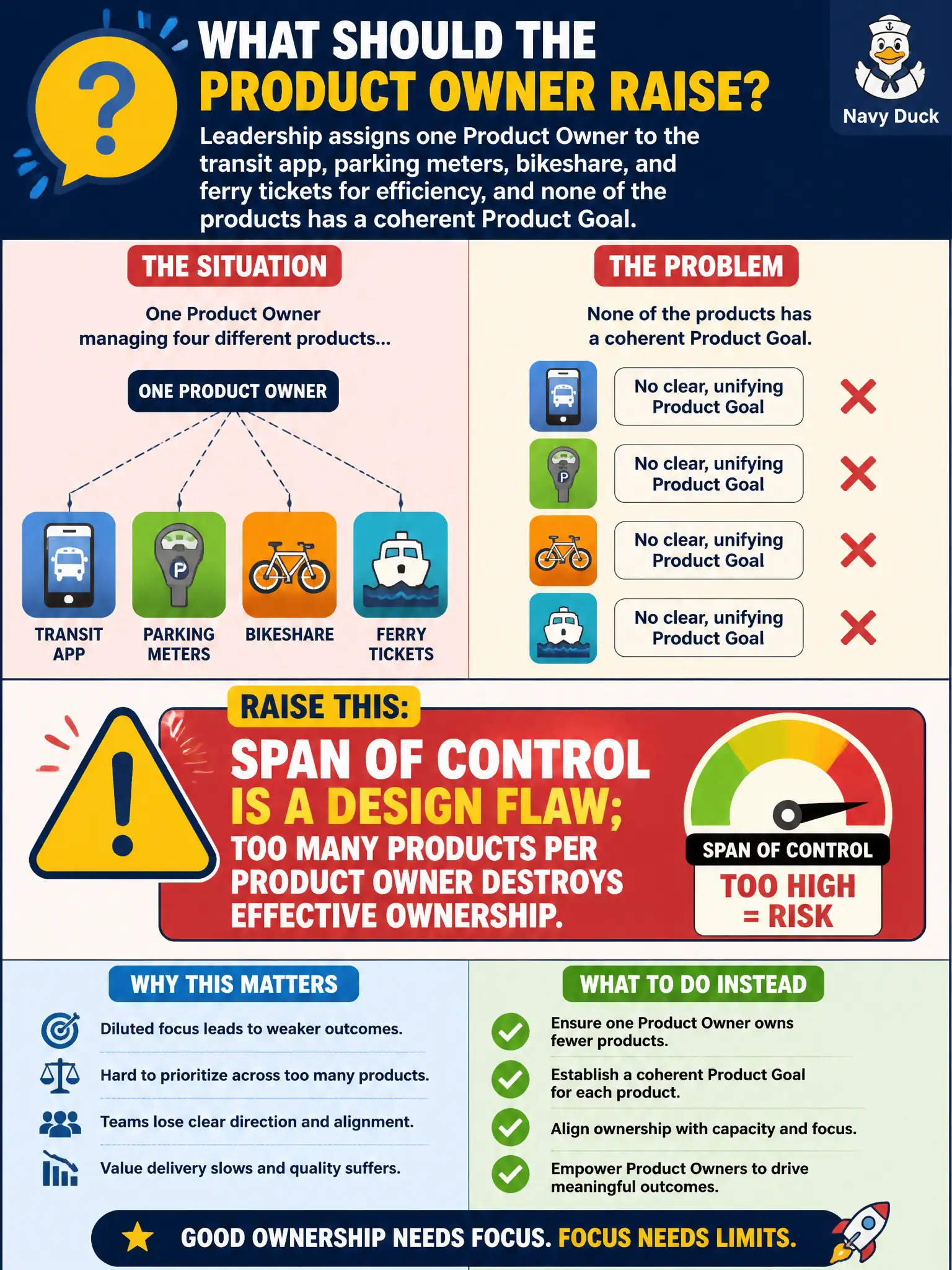
Leadership assigns one Product Owner to the transit app, parking meters, bikeshare, and ferry tickets for efficiency, and none of the products has a coherent Product Goal. What should the Product Owner raise?
Select an answer to reveal the explanation.
Short Explanation
Four products on one Product Owner is four kitchens and one cook. Transit, parking, bikeshare, and ferry each need a real Product Goal and real ordering attention. Raise span-of-control as a design flaw before “efficiency” turns into four neglected backlogs.
Full Explanation
Product Owner accountability does not scale by stacking unrelated products onto one person for efficiency. When leadership assigns one Product Owner to the transit app, parking meters, bikeshare, and ferry tickets, and none has a coherent Product Goal, span of control is a design flaw. Each product needs a coherent Product Goal, an ordered Product Backlog, and enough stakeholder engagement to maximize value. Excessive span of control makes those accountabilities theatrical; leadership must reduce the number of products per Product Owner.
Claiming one Product Owner can order any number of products if average velocity is reported together fails by hiding neglect behind a blended metric. Having a PMO scheduler order all four backlogs fails by outsourcing accountability. Adding a stakeholder committee per product without reducing load fails by adding noise without restoring ownership attention.
Exam caveat: Too many products per Product Owner destroys effective ownership; reduce span of control. Operational check: Ask leadership to assign distinct Product Owner capacity per product—or fewer products—so each of transit, parking, bikeshare, and ferry has a coherent Product Goal and attended backlog.