
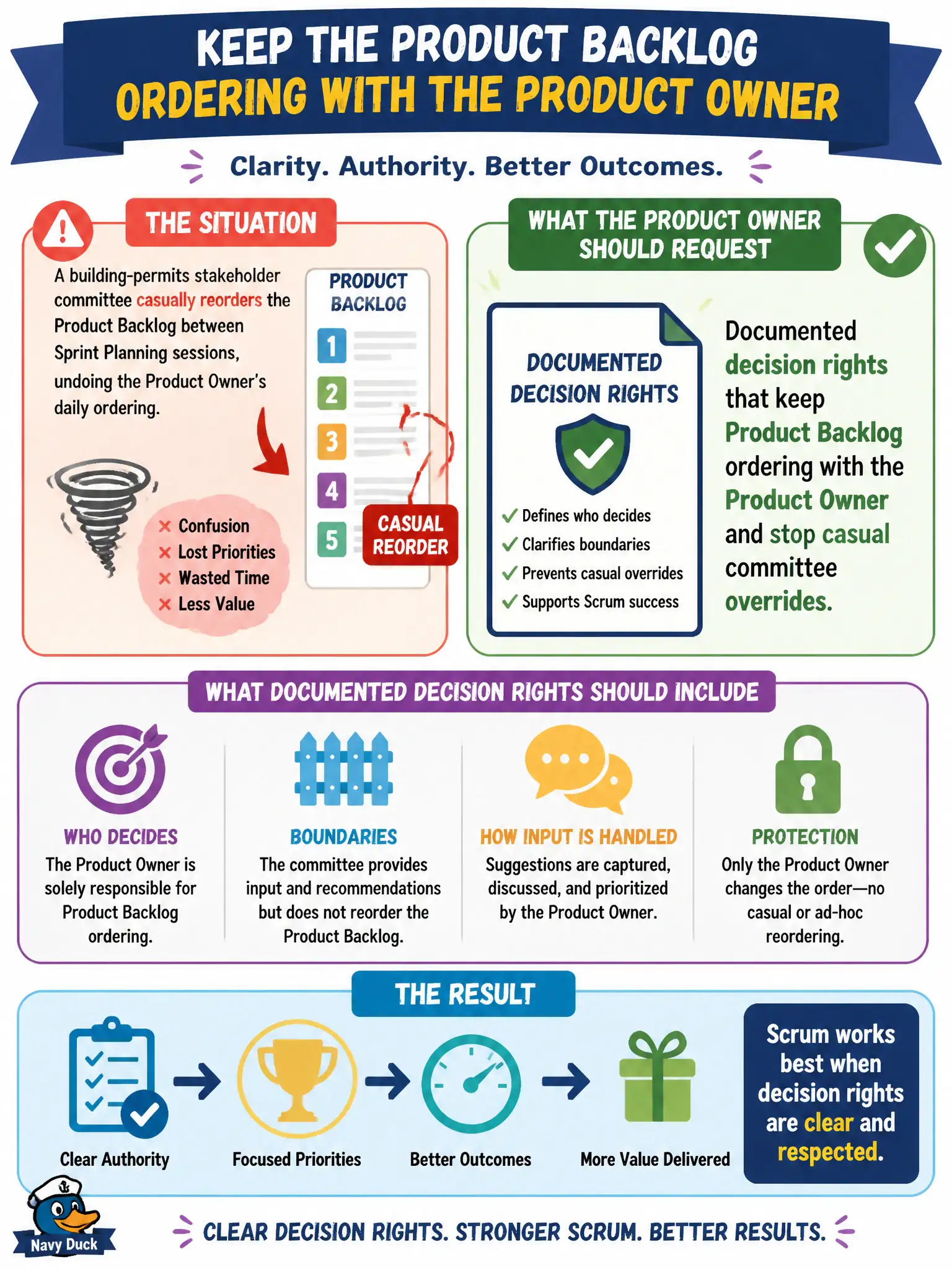
A building-permits stakeholder committee casually reorders the Product Backlog between Sprint Planning sessions, undoing the Product Owner’s daily ordering. What should the Product Owner request?
Select an answer to reveal the explanation.
Short Explanation
If a committee can reshuffle the permits backlog overnight, the Product Owner is a figurehead with a stapler. Clear decision rights are the fence around the garden: stakeholders can advise, but one person still orders the work. Write that down so daily value ordering is not a hallway vote.
Full Explanation
Effective Product Ownership requires real authority to order the Product Backlog of a building-permits product. When a stakeholder committee casually reorders the backlog between Sprint Planning sessions, transparency, Sprint focus, and the ability to maximize permit value are destroyed. The Product Owner should request documented decision rights that keep Product Backlog ordering with the Product Owner and stop casual committee overrides. Stakeholders can advise and escalate evidence; one person still orders the work so Developers are not chasing overnight politics.
Making the committee a second Product Owner fails by formalizing split accountability and conflicting orders. Asking Developers to ignore all committee requests until next fiscal year fails by avoiding stakeholder engagement instead of clarifying rights. A quarterly feature-lock workshop that freezes the backlog for twelve weeks fails by replacing empirical ordering with predictive lock-in.
Exam caveat: Documented decision rights protect Product Owner ordering without silencing stakeholder advice. Operational check: Publish a clear rule that the permits Product Owner alone orders the Product Backlog, committee input enters intake, and mid-cycle casual reorders are invalid without that Product Owner.