
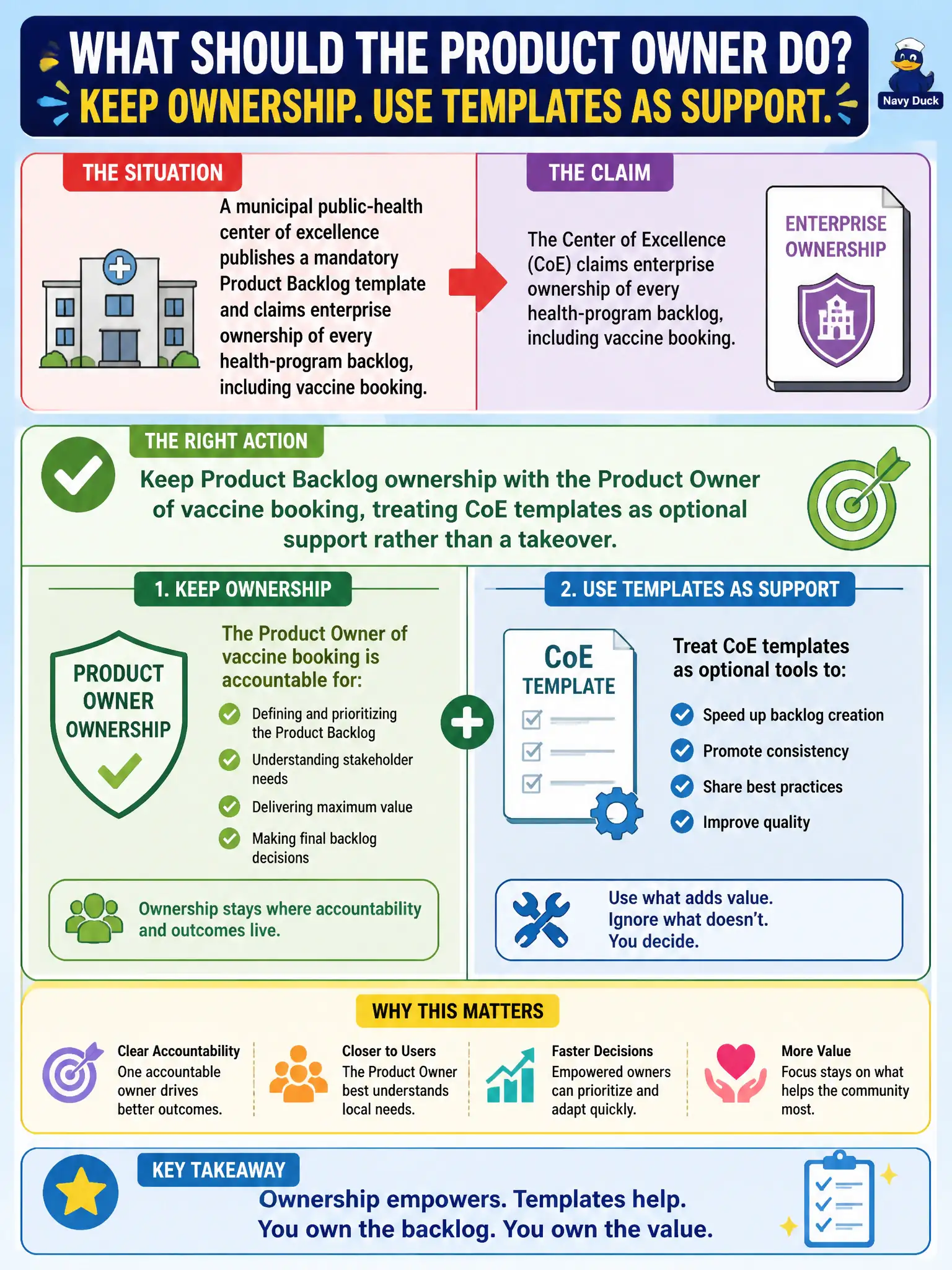
A municipal public-health center of excellence publishes a mandatory Product Backlog template and claims enterprise ownership of every health-program backlog, including vaccine booking. What should the Product Owner do?
Select an answer to reveal the explanation.
Short Explanation
A CoE is a helpful shop class, not the owner of every product’s shopping list. Templates can coach a vaccine-booking team; they must not snatch the Product Backlog. One Product Owner still owns ordering for that product, or the backlog becomes a corporate form instead of a value tool.
Full Explanation
Centers of excellence can spread practices, coaching, and optional templates, but they do not take Product Backlog accountability away from the Product Owner of a product. When a municipal public-health CoE publishes a mandatory template and claims enterprise ownership of every health-program backlog including vaccine booking, the Product Owner should keep backlog ownership local to vaccine booking and treat CoE templates as optional support rather than a takeover. Vaccine booking still needs one person accountable for ordering work against a Product Goal. Splitting ownership between a CoE “standard” list and a local list recreates conflicting orders.
Accepting CoE ownership so templates stay identical citywide fails by sacrificing product accountability for standardization theater. Splitting into CoE-owned standard and Product Owner-owned exceptions fails because two orderers still conflict. Transferring ordering rights to the CoE while keeping the Product Owner as a scribe fails by hollowing out the role.
Exam caveat: CoEs enable; they must not become shadow Product Owners of product backlogs. Operational check: Adopt useful CoE template elements voluntarily where they help vaccine booking, document that ordering authority remains with the Product Owner, and reject mandatory CoE reordering of the backlog.