
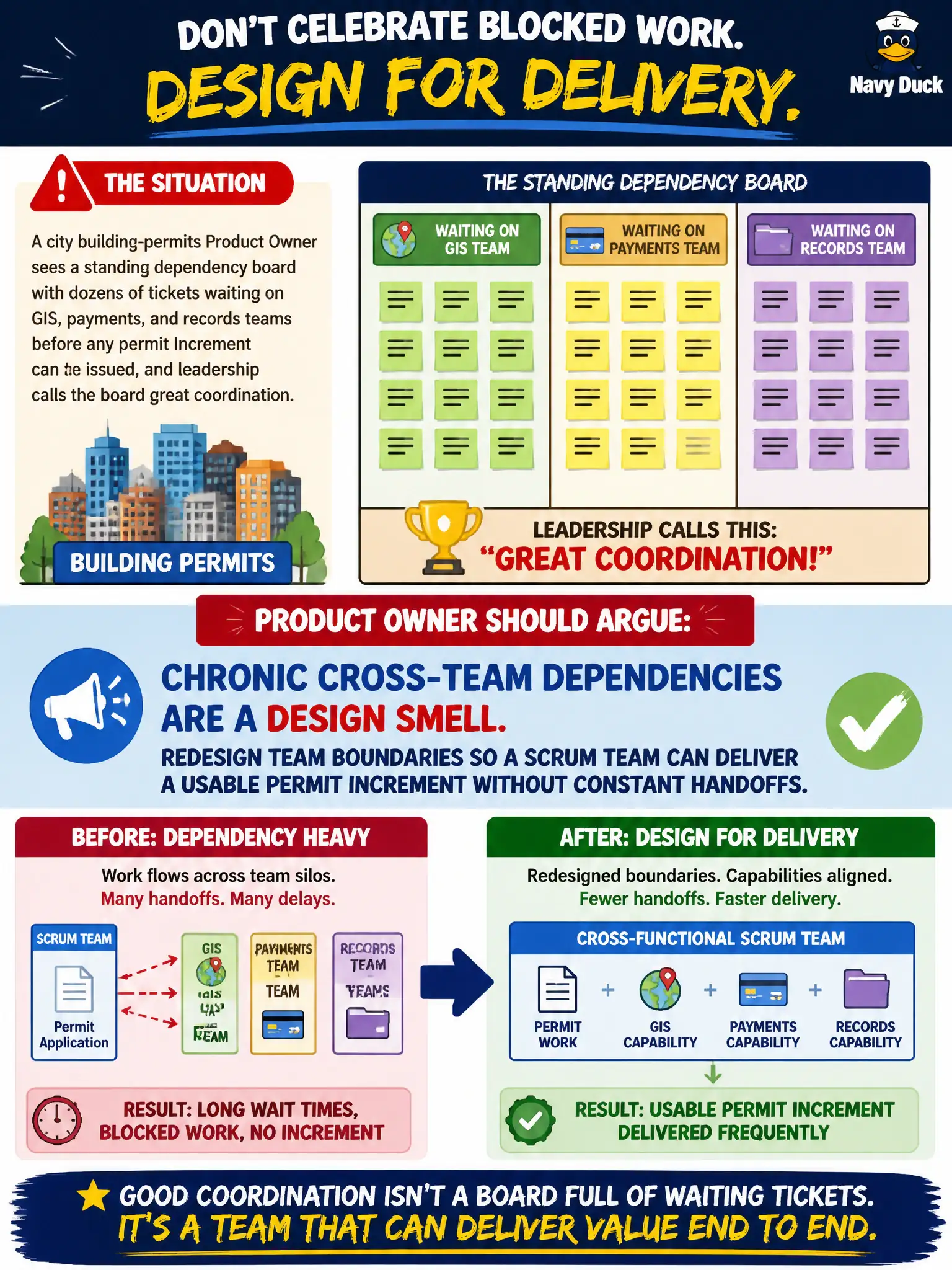
A city building-permits Product Owner sees a standing dependency board with dozens of tickets waiting on GIS, payments, and records teams before any permit Increment can be issued, and leadership calls the board great coordination. What should the Product Owner argue?
Select an answer to reveal the explanation.
Short Explanation
A packed dependency board is like a kitchen where every plate has to visit three other kitchens before it can leave. More chasing and prettier boards still leave the diner waiting. The real move is redrawing team boundaries so one Scrum Team can serve a finished permit Increment without living on other people’s queues.
Full Explanation
Persistent, high-volume dependencies on a standing board show that team boundaries do not match the citizen permit journey. When a building-permits Product Owner sees dozens of tickets waiting on GIS, payments, and records before any Increment can be issued, leadership may praise “great coordination,” but coordination boards hide the cost of handoffs. They do not restore the ability to produce a Done Increment of permit value. An advanced Product Owner treats chronic dependencies as an organizational design smell and advocates redesigning team boundaries so a Scrum Team can deliver a usable permit Increment without constant handoffs.
Keeping the dependency board and adding extra coordination meetings fails by chasing tickets faster without removing structural waits. Freezing new permit features until GIS publishes a six-month interface contract fails by substituting a predictive contract for cross-functional delivery. Converting the board into a program Gantt fails by scheduling handoffs instead of eliminating them.
Exam caveat: A packed dependency board is evidence to redesign teams, not to celebrate coordination. Operational check: Quantify average wait time on GIS/payments/records dependencies, then propose a cross-functional permit team that owns enough of the journey to release without living on other queues.