
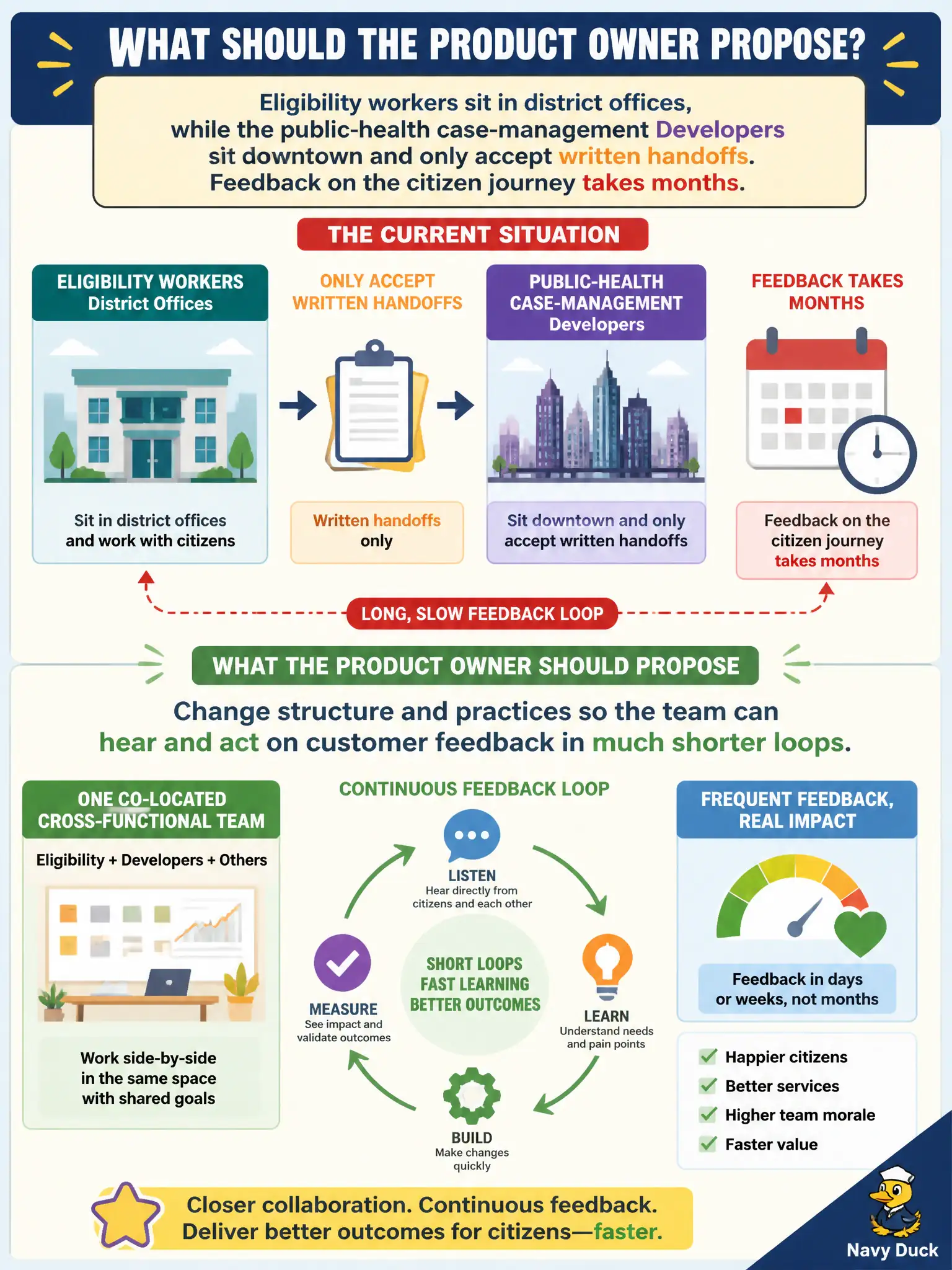
Eligibility workers sit in district offices, while the public-health case-management Developers sit downtown and only accept written handoffs. Feedback on the citizen journey takes months. What should the Product Owner propose?
Select an answer to reveal the explanation.
Short Explanation
If the people who feel the product and the people who change it only write letters, you are running a 19th-century post office. Shorten the loop. Better stationery for a slow handoff is still a slow handoff.
Full Explanation
Organizational design should shorten feedback loops to customers, not optimize the paperwork of distance. When eligibility workers sit in district offices while public-health case-management Developers downtown only accept written handoffs, feedback on the citizen journey takes months and empiricism stalls. The Product Owner should propose changing structure and practices so the team can hear and act on customer feedback in much shorter loops—shared events, closer collaboration, thinner handoffs, or team composition changes. Splitting into disconnected products or annualizing feedback lengthens the loop further.
Formalizing the handoff template fails because better documentation of a long loop is still a long loop. Moving all customer contact to an annual listening tour fails by reducing interruption at the cost of learning. Splitting into two products—one for districts and one for downtown—fails when it avoids collaboration instead of finishing one citizen journey.
Exam caveat: Structure must shrink customer feedback latency for product decisions. Operational check: Replace written-only handoffs with a biweekly district-worker review of the live journey, and staff at least one practice that lets Developers see casework friction within days, not months.