
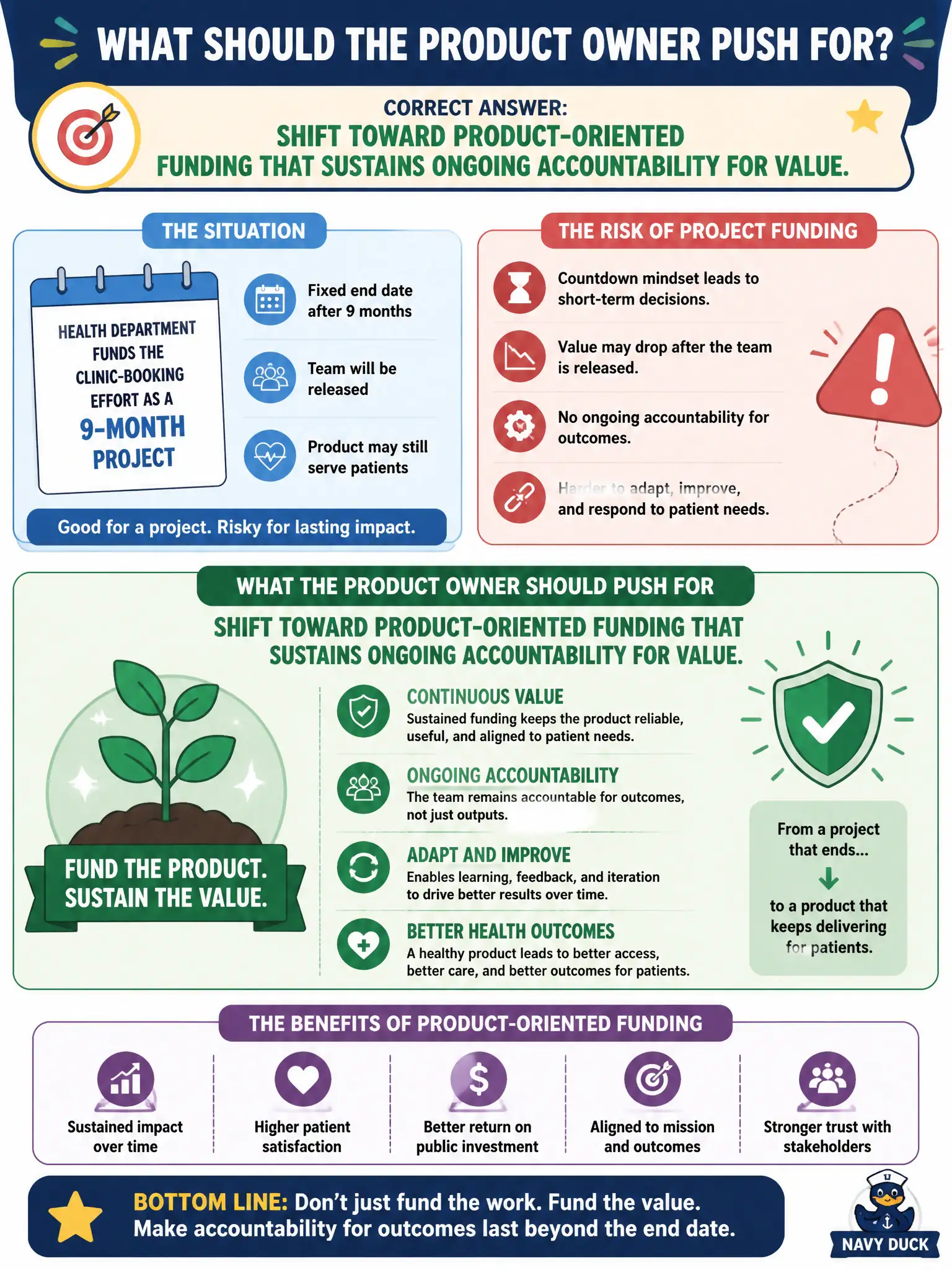
The health department funds the clinic-booking effort as a nine-month project with a fixed end date, after which the team will be released even if the product still serves patients. What should the Product Owner push for?
Select an answer to reveal the explanation.
Short Explanation
A clinic is not a ribbon-cutting; people keep booking shots after the banner comes down. Project money that evaporates on a date leaves a living product with no owner. Fund the product like you mean to keep serving patients.
Full Explanation
Project funding structures assume temporary output and then release the people accountable for value. A public-health clinic-booking effort funded as a nine-month project with a fixed end date leaves a living product—still serving patients—without durable ownership when the calendar ends. Product-oriented funding enables a durable Product Owner, a stable team, and empirical ordering over time as outcomes, risk, and unmet demand continue after first launch. The Product Owner should push to shift toward product-oriented funding that sustains ongoing accountability for value.
Keeping project funding and declaring the Product Goal complete when the calendar ends fails because patients keep booking after the ribbon-cutting. Asking finance to fund a new project every time a defect is found fails by turning sustainment into episodic project theater. Converting the Product Owner into a project manager fails by matching the wrong economic model instead of changing it.
Exam caveat: Ongoing civic products need product funding, not evaporating project envelopes. Operational check: Present finance with clinic-booking usage and risk after go-live, and propose a standing product capacity line that keeps Product Owner and team accountability beyond the original nine-month date.