
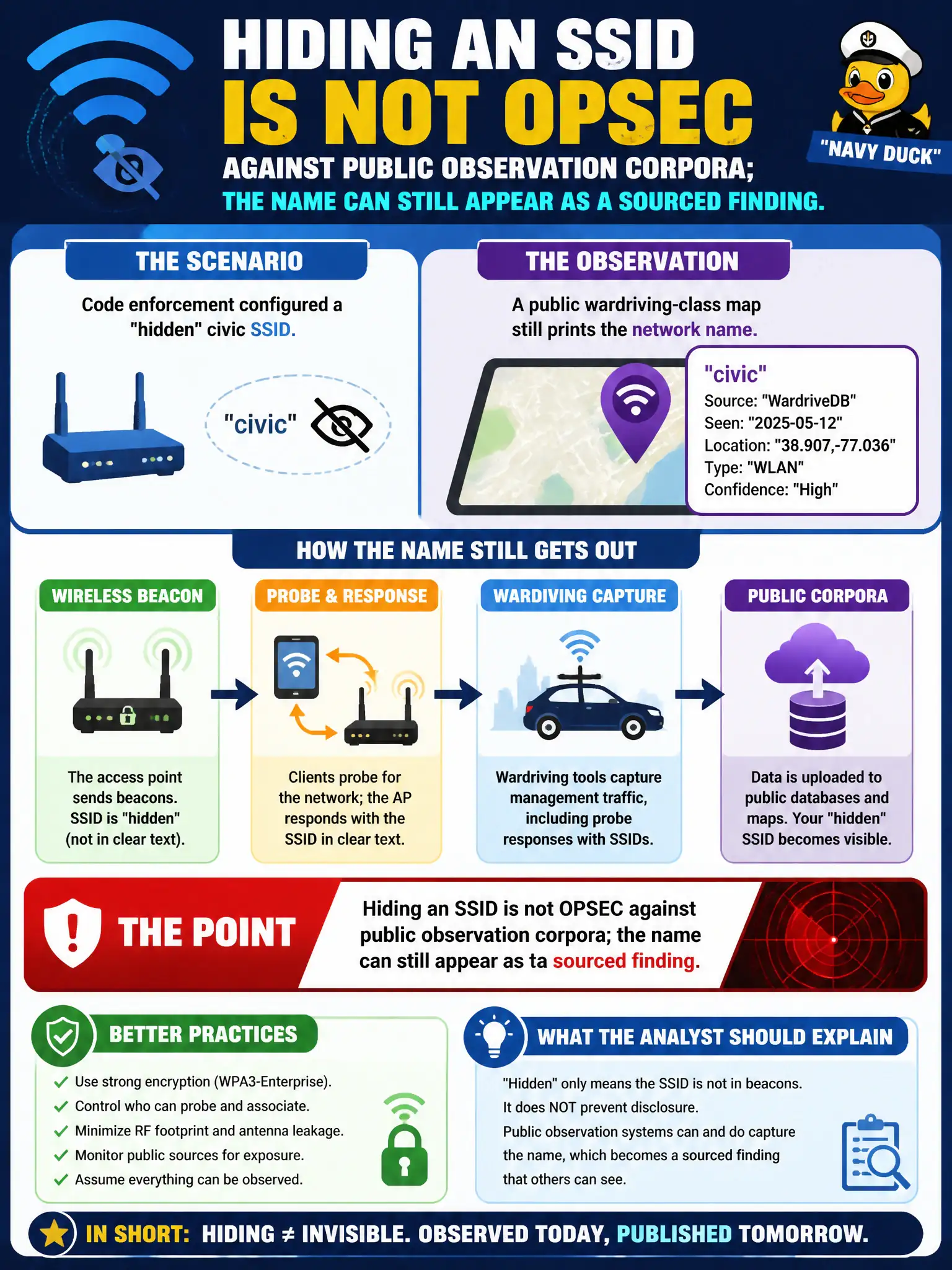
Code enforcement configured a “hidden” civic SSID, but a public wardriving-class map still prints the network name. What should the analyst explain?
Select an answer to reveal the explanation.
Short Explanation
Unchecking “broadcast” is not an invisibility cloak. Wardriving datasets still pick up names that stations or probes reveal. Cite the public map and tell code enforcement the hide box is not OPSEC—not a reason to accuse anyone of hacking.
Full Explanation
SSID hiding (non-broadcast) is a weak control because clients, probes, and observers still expose names, and public wardriving-class corpora routinely include those names. When code enforcement configured a 'hidden' civic SSID but a public map still prints the network name, the analyst should explain that hide-SSID is not OPSEC against public observation corpora and that the name appearing is a sourced finding useful for municipal network hygiene advice.
Claiming non-broadcast SSIDs are invisible forever once the checkbox is set contradicts how 802.11 and observation datasets work. Calling the map illegal and requiring purge before citation misunderstands that public observation corpora are citable OSINT sources. Asserting hidden SSIDs appear only if the analyst associated with them, so the map proves a prior hack, invents intrusion evidence from a normal observation pathway.
Exam caveat: presence of a formerly 'hidden' name in a map does not identify who first observed it or prove compromise; it proves the control failed as OPSEC against public collection.
Operational check: cite the public map entry with vintage, compare to the intended hide-SSID configuration, and brief code enforcement that non-broadcast is not reliable concealment—without accusing staff of hacking.