
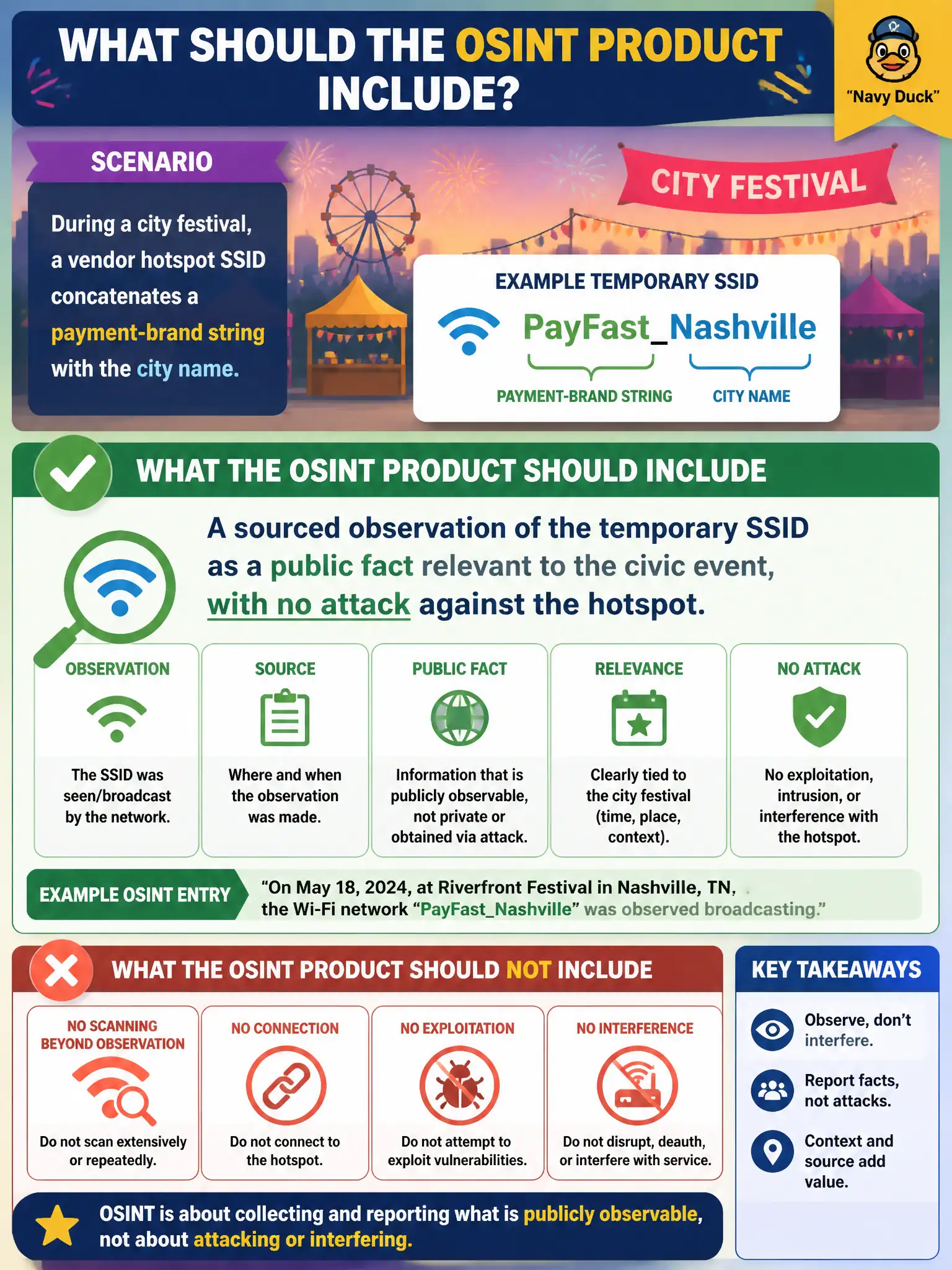
During a city festival, a vendor hotspot SSID concatenates a payment-brand string with the city name. What should the OSINT product include?
Select an answer to reveal the explanation.
Short Explanation
Festival Wi-Fi names are public signage you can write down. Note the payment-brand-plus-city SSID as an event observation and move on. No handshake hunting, no PCI raid, no jamming the funnel-cake stand.
Full Explanation
Temporary SSIDs at civic festivals are observable public facts. When a vendor hotspot concatenates a payment-brand string with the city name, the OSINT product should be a sourced observation of that temporary SSID—time, location, and string—as a public fact relevant to the event, with no attack against the hotspot. That gives event security or IT situational awareness without converting research into key recovery or enforcement theater.
Capturing a handshake and recovering the passphrase is offensive wireless work outside PORP. Conducting an on-the-spot PCI audit that demands the vendor's cardholder-data environment is a specialized compliance function, not wireless OSINT. Jamming the vendor SSID because payment-brand names are always phishing is RF disruption and an overclaim; brand-like names can be legitimate payment terminals or look-alikes that need documentation, not jamming.
Exam caveat: an observed payment-brand-plus-city SSID is not by itself proof of phishing or of PCI noncompliance; it is an event observation that authorized teams may investigate further.
Operational check: note the SSID, approximate plaza location, and observation time; photograph any sandwich-board advertising if present; and refer the note to festival IT or security—without handshake capture, PCI raids, or jamming.