
A stormwater program is vetting a contractor. A public court-index search shows the firm as a defendant on a prior municipal project, and sealed filings are not available. What is the correct OSINT use of that result?
Select an answer to reveal the explanation.
Short Explanation
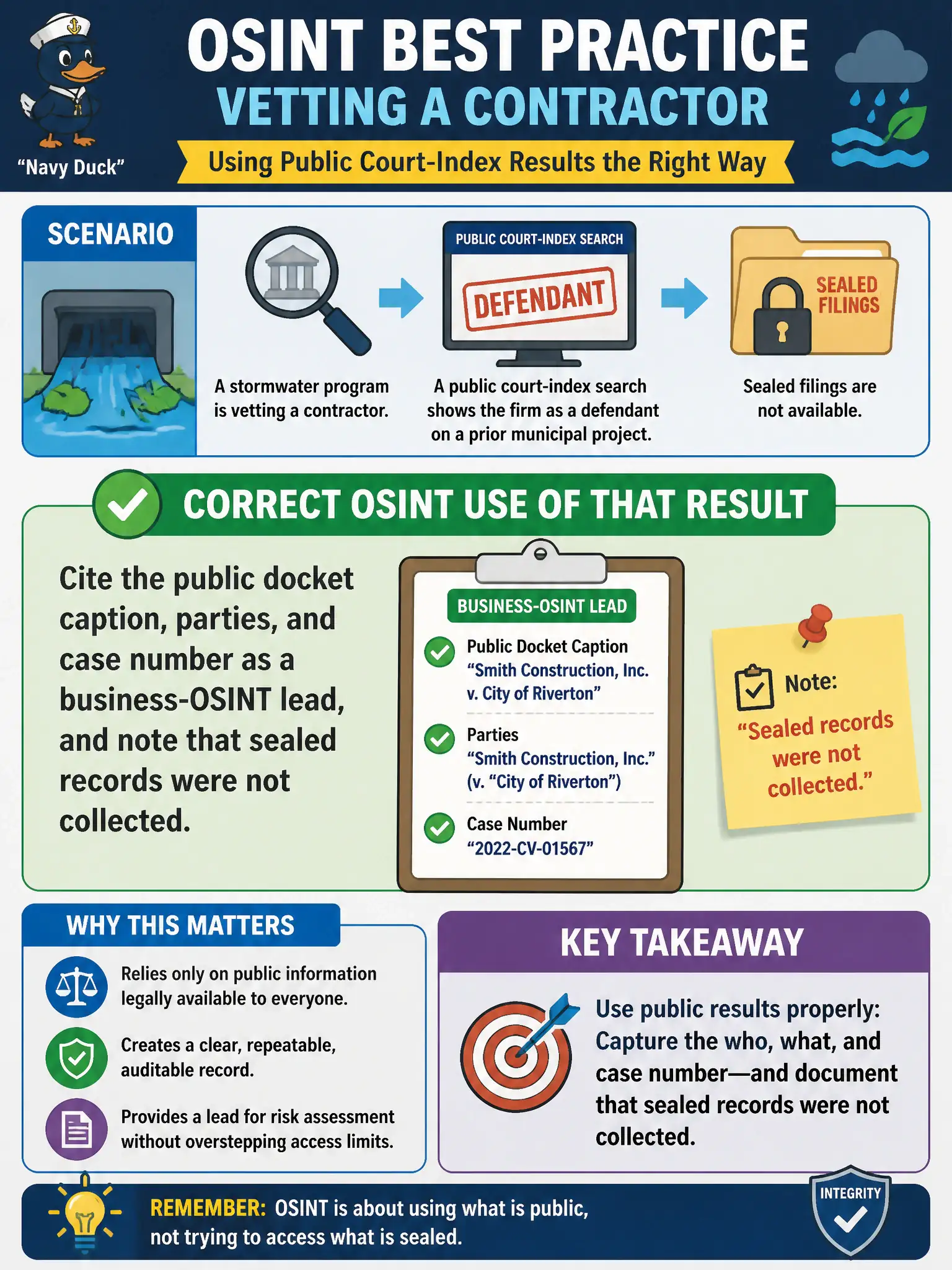
A public index is the courthouse bulletin board, not the judge’s locked drawer. Grab the caption, parties, and case number, and say out loud that sealed files stayed sealed. That is a lead for stormwater—not a homemade verdict and not a portal break-in.
Full Explanation
Public court indexes and dockets are lawful business-OSINT sources for municipal vendor due diligence. When a stormwater program finds a firm listed as a defendant on a prior municipal project, the correct PORP use is to cite the public caption, parties, case number, and docket status as a sourced lead, and to state explicitly that sealed filings were not collected. That keeps the civic report attributable, reviewable, and limited to what any member of the public could observe in the open index.
Demanding that a clerk unseal privileged exhibits so OSINT can append them confuses research with court process and seeks material that is intentionally closed. Treating an index hit as proof of fraud and disqualifying the firm without citation invents a liability finding and skips the sourcing duty that makes municipal decisions defensible. Hacking an e-filing portal for sealed PDFs is unauthorized access, not OSINT, and would contaminate the city's evidence posture.
Exam caveat: a public defendant listing is not a judgment; parties, dispositions, and sealed vs. open status matter. PORP delivers the lead; counsel or procurement decides weight after the public record is accurately described.
Operational check: capture the index or docket URL, case number, caption, parties, public status, and retrieval date; note 'sealed records not collected'; and hand the lead to stormwater procurement or legal review without adding unfounded fraud conclusions.