
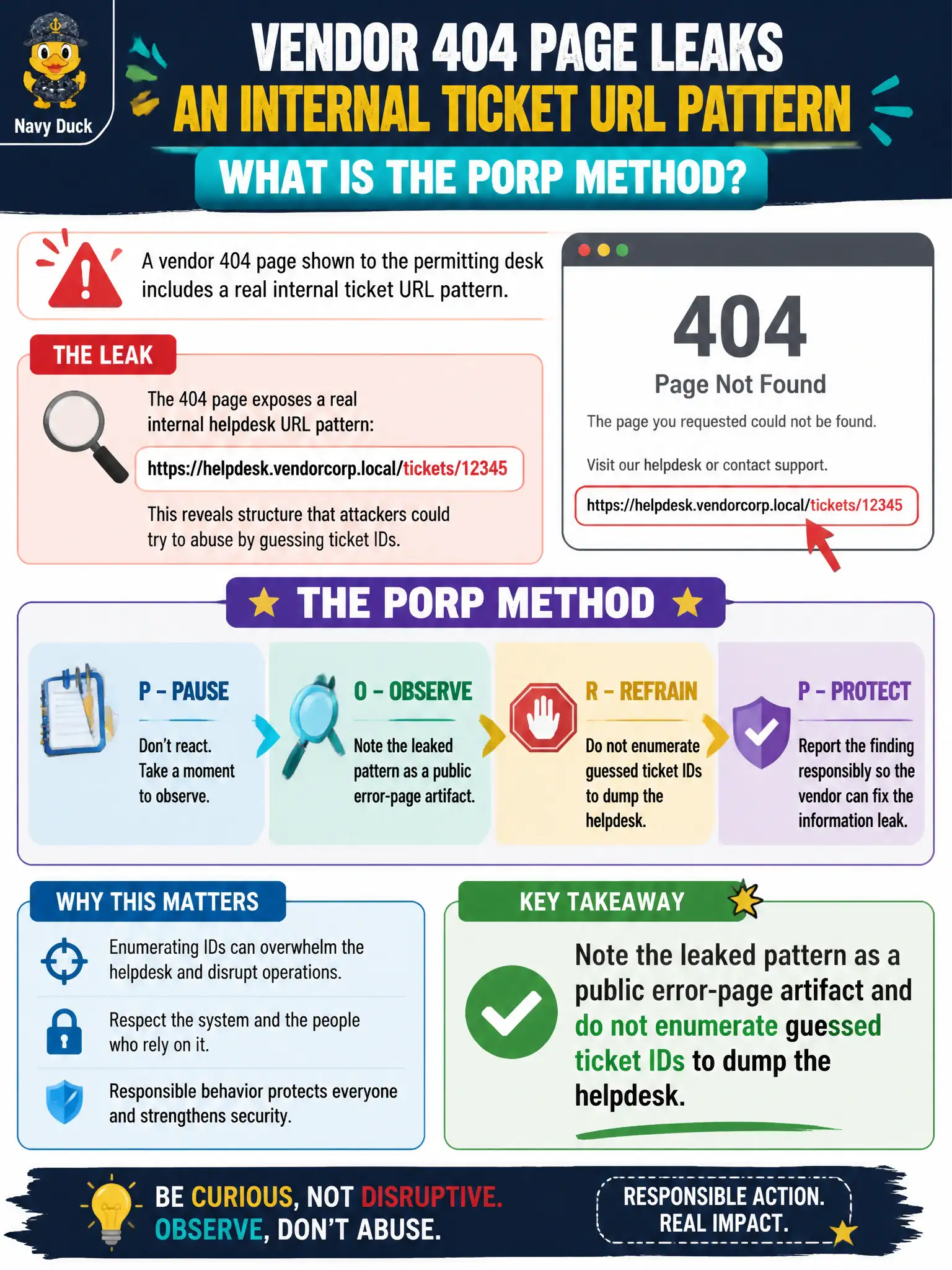
A vendor 404 page shown to the permitting desk includes a real internal ticket URL pattern. What is the PORP method?
Select an answer to reveal the explanation.
Short Explanation
A talkative 404 is like a clerk who blurts a file-number format over the counter. Write the public pattern down. Guessing the rest of the tickets to empty the helpdesk is not OSINT — that is an enumeration dump.
Full Explanation
If a vendor 404 page shown to the permitting desk includes a real internal ticket URL pattern, the PORP method is to note the leaked pattern as a public error-page artifact and not enumerate guessed ticket IDs to dump the helpdesk. Talkative error pages are collection targets, not invitation to attack. Walking sequential ticket IDs until the full civic helpdesk is exported fails as unauthorized enumeration/exfiltration. Ignoring error pages because only HTTP 200 content counts fails; error bodies are website OSINT. Submitting crafted input through the ticket URL to test the helpdesk as an attack surface fails as security testing outside open-source research. Exam caveat: pattern disclosure should be reported to the vendor/city IT for hardening, not exploited for more data. Operational check: capture the 404 body and URL pattern with date; report the exposure; do not iterate ticket IDs or probe the helpdesk. In municipal practice, record the rationale in the case file so future staff know which control was chosen and which failure modes the rejected options would create for city services. Re-validate the finding against current public sources before the next procurement or communications decision.