
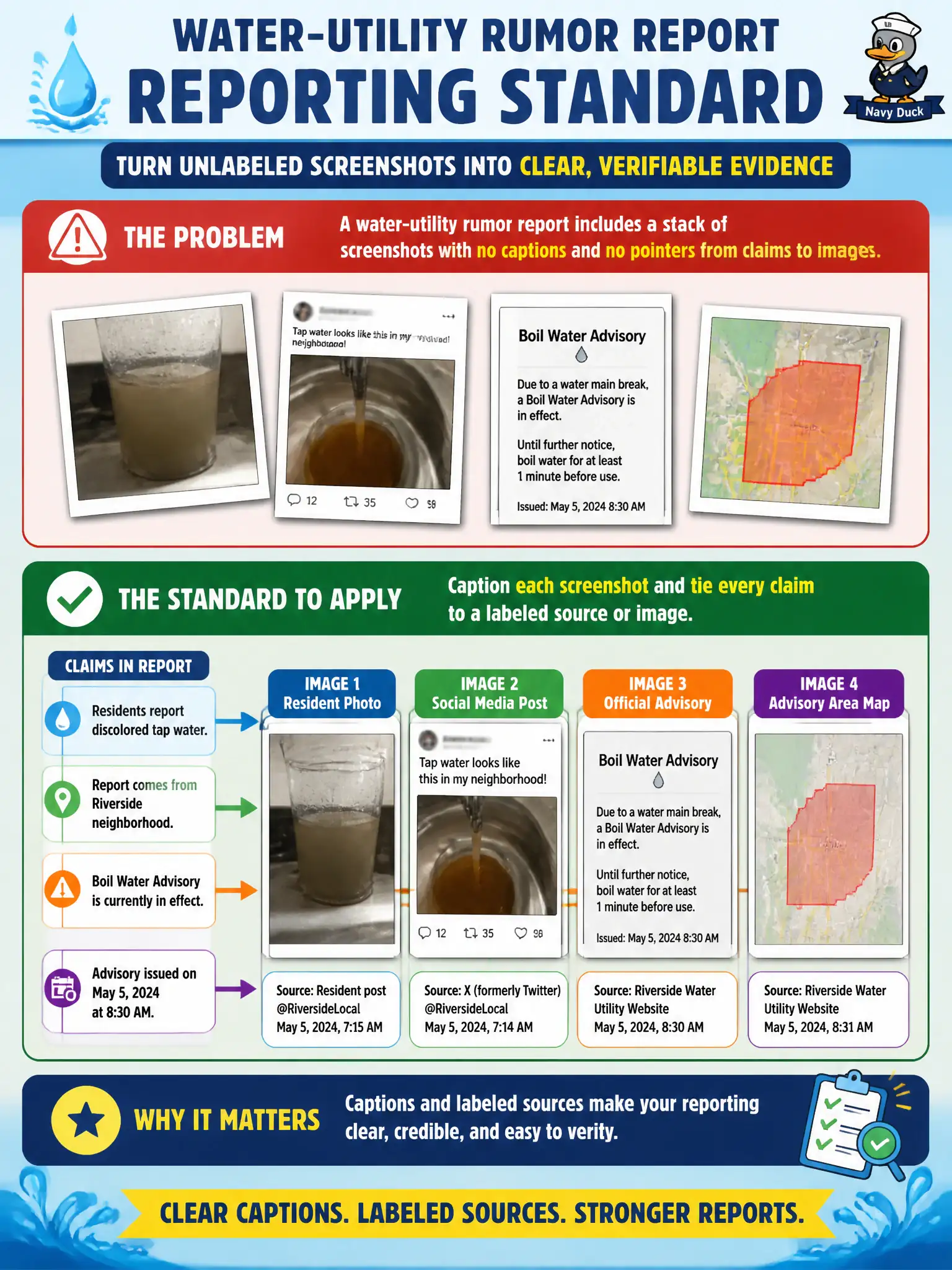
A water-utility rumor report includes a stack of screenshots with no captions and no pointers from claims to images. What reporting standard should the analyst apply?
Select an answer to reveal the explanation.
Short Explanation
Uncaptioned screenshots are like unlabeled photos spilled on a table—nobody knows which picture backs which rumor. Each claim needs a finger pointing at a labeled capture. Collages and mystery appendices just hide the trail.
Full Explanation
Evidence in an OSINT report must be attributable to a finding. When a water-utility rumor report includes a stack of screenshots with no captions and no pointers from claims to images, the analyst should caption each screenshot and tie every claim to a labeled source or image. Captions, figure IDs, and in-text pointers let a reviewer see which public page or post supports each sentence.
Letting readers guess which screenshot supports which sentence breaks the evidence link. Putting all images in an unlabeled appendix and never mentioning them in the findings hides support. Replacing screenshots with a single collage so captions become unnecessary merges distinct sources into an untraceable mashup.
Exam caveat: not every sentence needs an image, but every claim that depends on a capture needs a labeled exhibit; narrative-only statements still need URL citations.
Operational check: assign figure IDs, write captions with URL/time, add in-text references beside each rumor claim, and retire unlabeled stacks and collages from the water-utility packet. Keep municipal wording calibrated to what public sources actually show, and record retrieval dates so peers can re-perform the work. Civic reviewers expect attributable artifacts, not rhetorical certainty, when the engagement is later audited or handed off.