
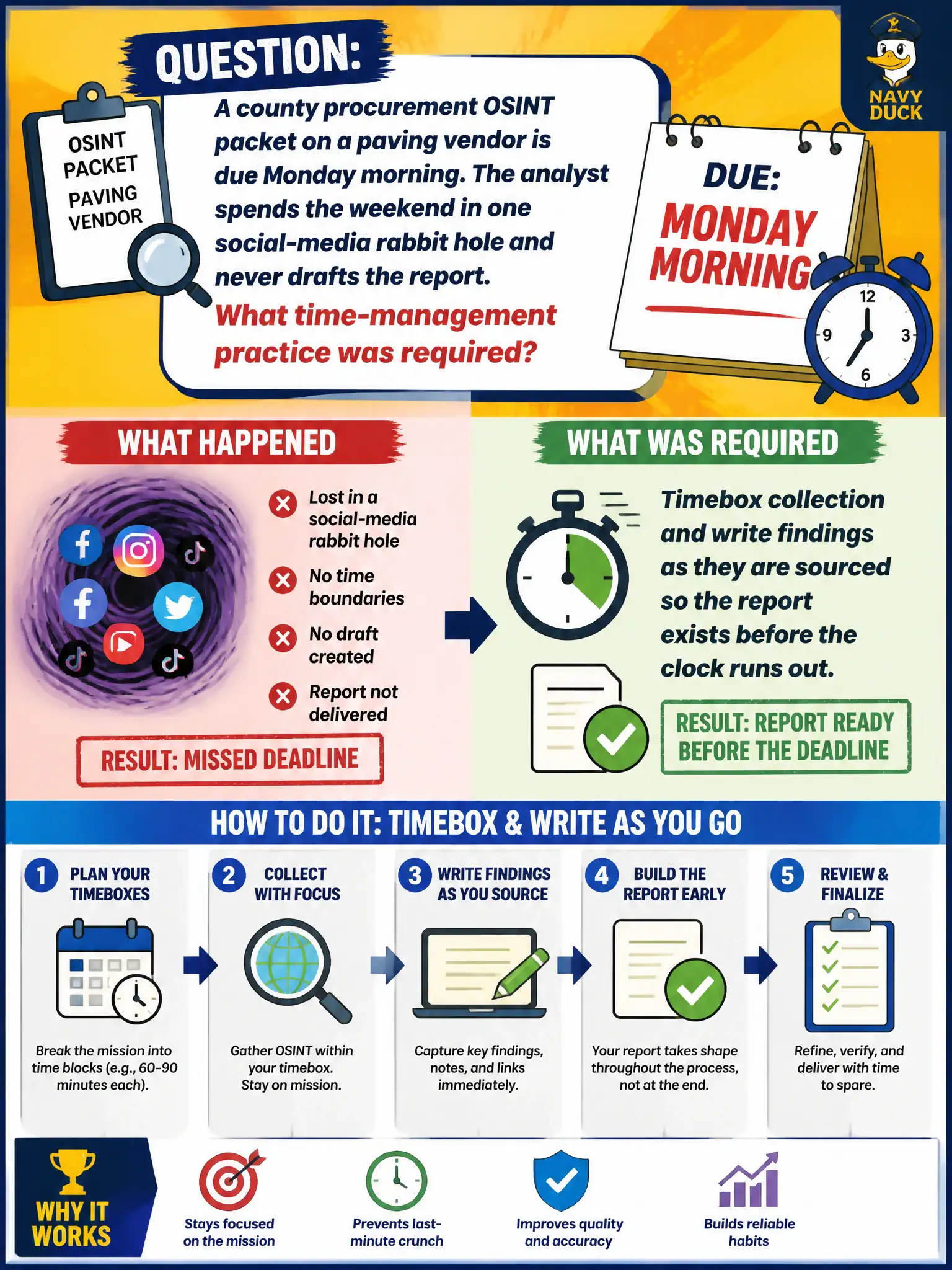
A county procurement OSINT packet on a paving vendor is due Monday morning. The analyst spends the weekend in one social-media rabbit hole and never drafts the report. What time-management practice was required?
Select an answer to reveal the explanation.
Short Explanation
A due-Monday packet is like a casserole that has to be in the oven before guests arrive—you cannot keep chopping one garnish and forget to cook. Write as you find, and cap the rabbit holes. Bookmarks without a report are just a pile of groceries.
Full Explanation
Time-boxed civic OSINT shares the clock between research and reporting. When a county procurement OSINT packet on a paving vendor is due Monday morning and the analyst spends the weekend in one social-media rabbit hole without drafting, the required practice is to timebox collection and write findings as they are sourced so the report exists before the clock runs out.
Keeping collecting until every social comment is read, then starting writing after the deadline, fails the engagement. Skipping the written product and emailing a folder of bookmarks at the last minute is not a report. Pausing to rebuild a custom scraper instead of documenting what is already in hand burns the remaining clock on tooling vanity.
Exam caveat: deep social threads can still be sampled inside a timebox; mark unfinished threads as gaps rather than letting one hole empty the packet.
Operational check: set hourly collection/write cycles, bank easy sourced findings immediately, cap the rabbit hole, and ship a structured packet on Monday with explicit gaps if needed. Keep municipal wording calibrated to what public sources actually show, and record retrieval dates so peers can re-perform the work. Civic reviewers expect attributable artifacts, not rhetorical certainty, when the engagement is later audited or handed off.