
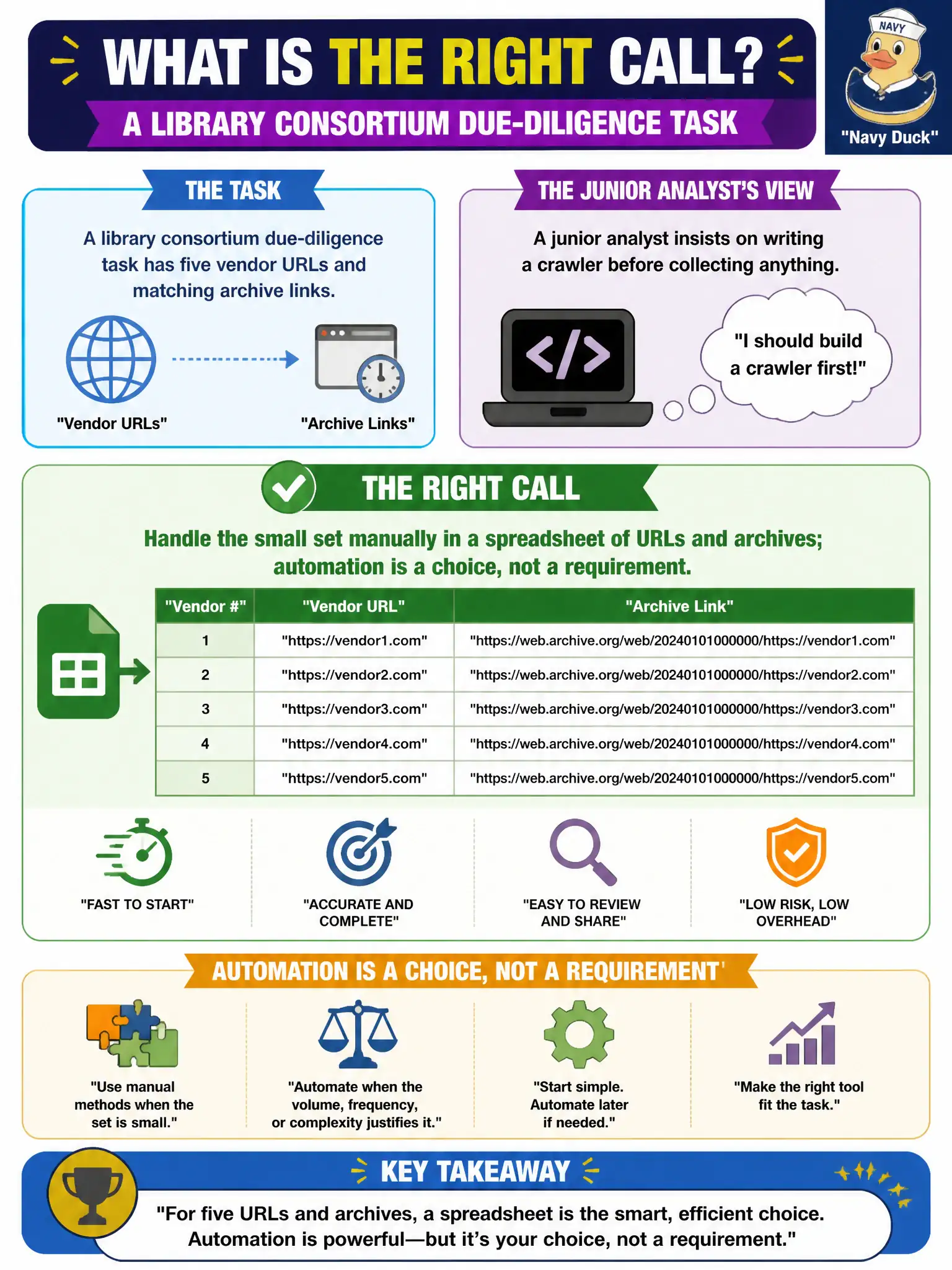
A library consortium due-diligence task has five vendor URLs and matching archive links. A junior analyst insists on writing a crawler before collecting anything. What is the right call?
Select an answer to reveal the explanation.
Short Explanation
Five bookmarks do not need a factory. Using a spreadsheet here is like taking notes with a pencil instead of building a printing press for a grocery list. Automation is a tool you pick when volume or repetition earns it—not a religion.
Full Explanation
Light automation is in scope when it reduces error on a bounded, repetitive job—but it is a choice, not a requirement. When a library consortium due-diligence task has five vendor URLs and matching archive links, and a junior analyst insists on writing a crawler before collecting anything, the right call is to handle the small set manually in a spreadsheet of URLs and archives. Five bookmarks do not need a factory.
Blocking the work until a citywide scraping platform is procured delays evidence for no analytical gain. Scraping every domain that shares a registrar with the five vendors inflates scope to justify a script. Skipping the archives and waiting for a custom bot that can 'certify' the five pages automatically postpones already available proof.
Exam caveat: if the set later grows to hundreds of repetitive URLs, revisit automation; the principle is proportionality to volume and risk, not anti-tool ideology.
Operational check: open a spreadsheet, record each live URL, archive link, retrieval time, and note; deliver the sourced five-vendor check; and defer crawler development unless volume truly demands it. Keep municipal wording calibrated to what public sources actually show, and record retrieval dates so peers can re-perform the work.