
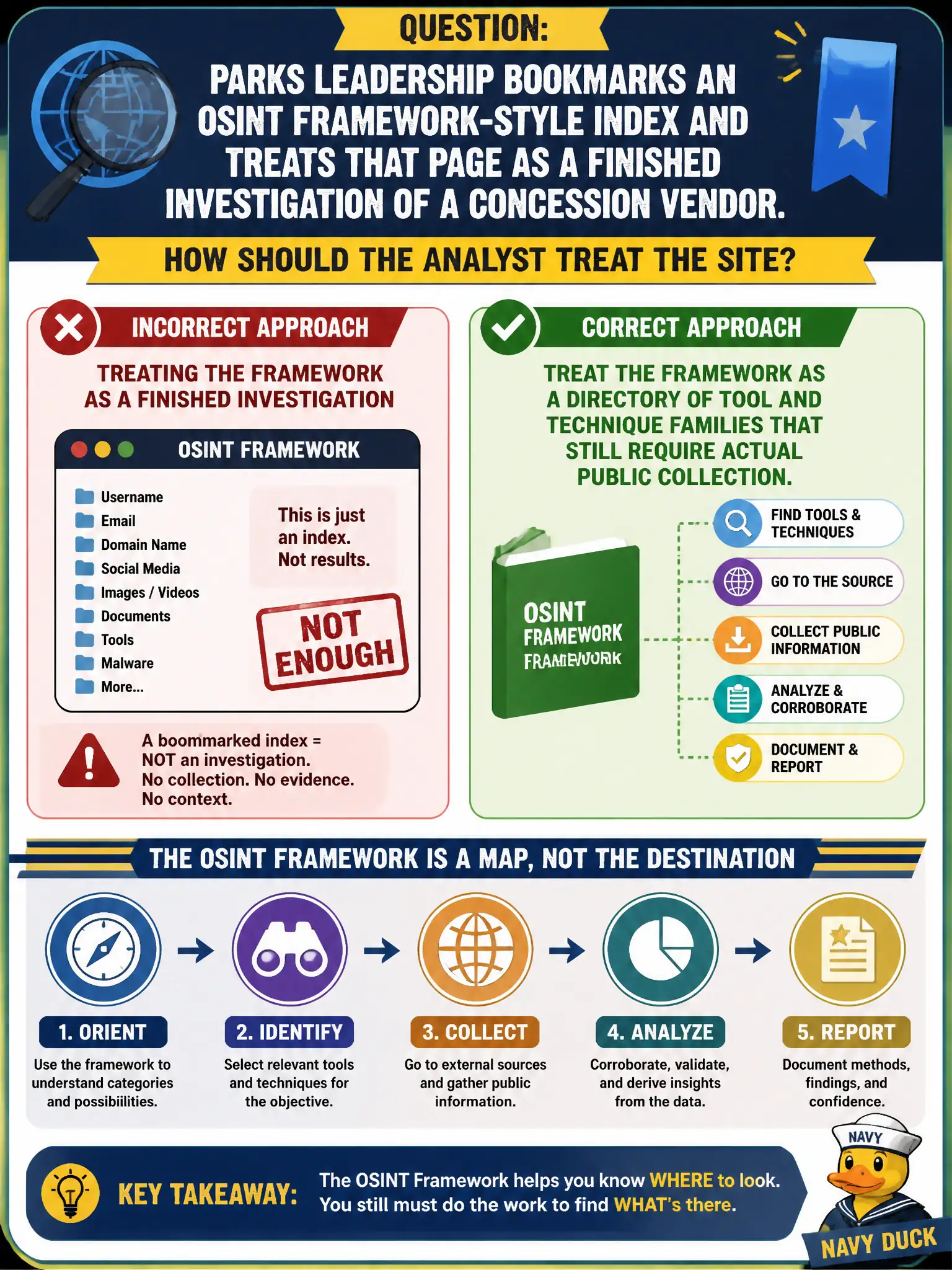
Parks leadership bookmarks an OSINT Framework-style index and treats that page as a finished investigation of a concession vendor. How should the analyst treat the site?
Select an answer to reveal the explanation.
Short Explanation
A framework site is a phone book, not the conversation. Bookmarking the tree does not collect a single URL, screenshot, or timestamp. You still have to pick a technique and do the public work.
Full Explanation
OSINT framework indexes organize tool and technique families so analysts can find a matching method; they do not replace collection. When parks leadership bookmarks an OSINT Framework-style index and treats that page as a finished investigation of a concession vendor, the analyst should treat the framework as a directory that still requires actual public collection, captures, and a sourced report.
Treating the index page as the evidence packet because every leaf is already a finding confuses a phone book with completed calls. Treating the framework as a case-management notebook that automatically stores screenshots invents features the index does not provide. Treating it as an exploit catalog for municipal websites misreads a research directory as a pentest menu.
Exam caveat: framework trees often list out-of-scope techniques beside Fundamentals families; bookmarking the tree does not authorize every leaf for PORP civic work.
Operational check: use the index only to pick an in-scope method, then visit public sources for the vendor, capture evidence with timestamps, and write findings in notes/report—not on the framework page. In municipal practice, keep the wording tied to public artifacts, retrieval dates, and the authorized civic question so peers can re-perform the work without guessing intent.