
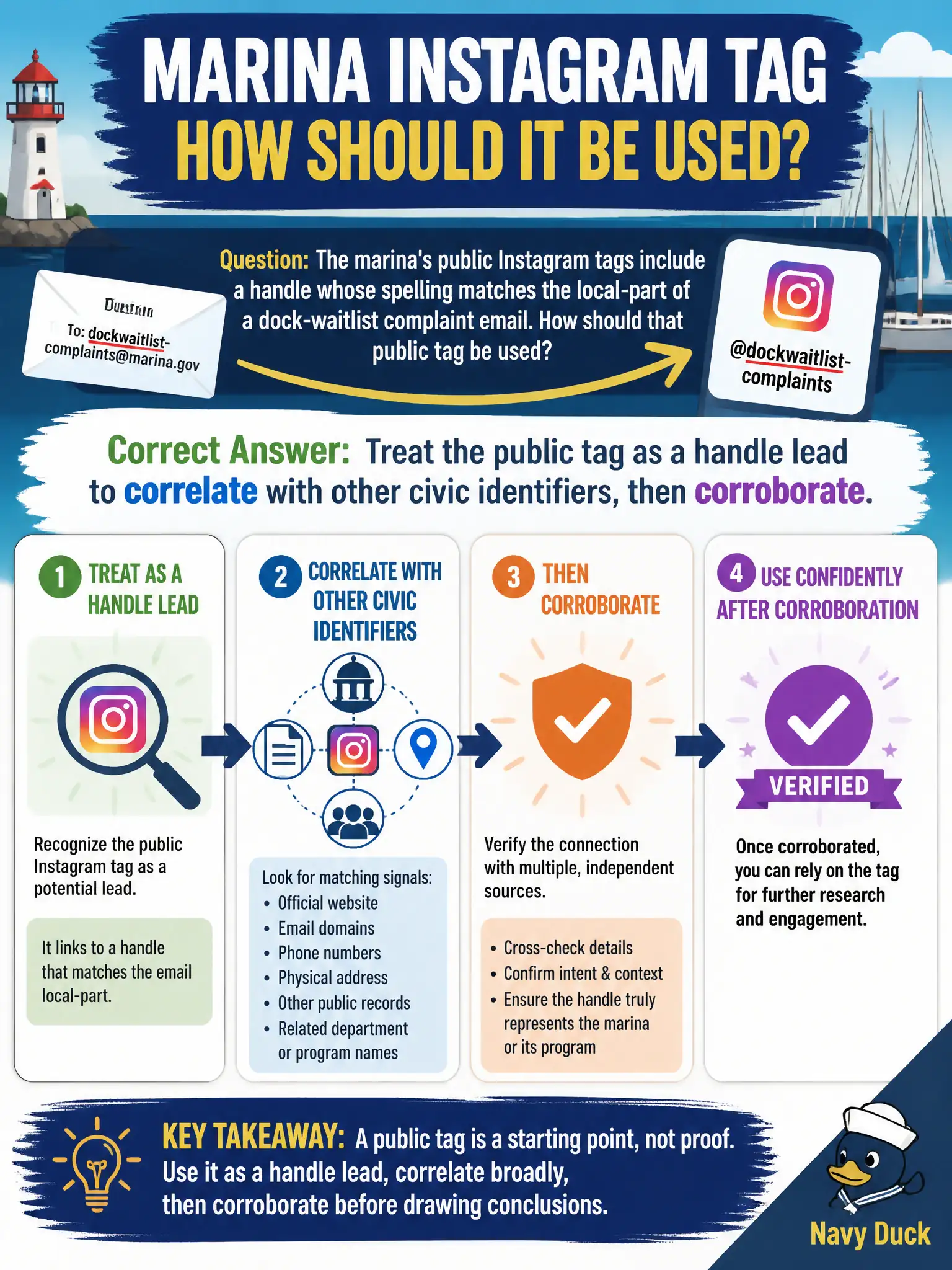
The marina's public Instagram tags include a handle whose spelling matches the local-part of a dock-waitlist complaint email. How should that public tag be used?
Select an answer to reveal the explanation.
Short Explanation
A public tag is like a name-badge sticker at an open house—it is a lead, not a signed affidavit. Match the handle to the complaint email as a hypothesis and look for more public overlap. Do not treat the tag as proof, and do not use it as a key to private stories.
Full Explanation
If the marina’s public Instagram tags include a handle whose spelling matches the local-part of a dock-waitlist complaint email, that public tag should be treated as a handle lead to correlate with other civic identifiers, then corroborated. Username overlap is a classic join-key hypothesis in municipal complaint triage, not finished attribution that legal can treat as settled identity. Treating it as proof the tagged person sent the complaint so legal can skip corroboration fails by over-promoting a spelling match into identity certainty that may be coincidence. Using it as authorization to scrape the tagged user’s private stories through a sock puppet fails because private stories are outside public OSINT even when a promising handle lead exists. Ignoring it as purely decorative tagging with no identifier value fails; rare handle matches are useful leads when handled with analytic discipline. Exam caveat: identical local-parts can be coincidence, shared nicknames, or copycats—require additional public overlap before naming someone as the complainant in a marina file. Operational check: record the tag and email local-part match as a hypothesis; seek more public artifacts such as photos, other handles, or public comments; brief marina staff with lead language only until corroboration lands.