
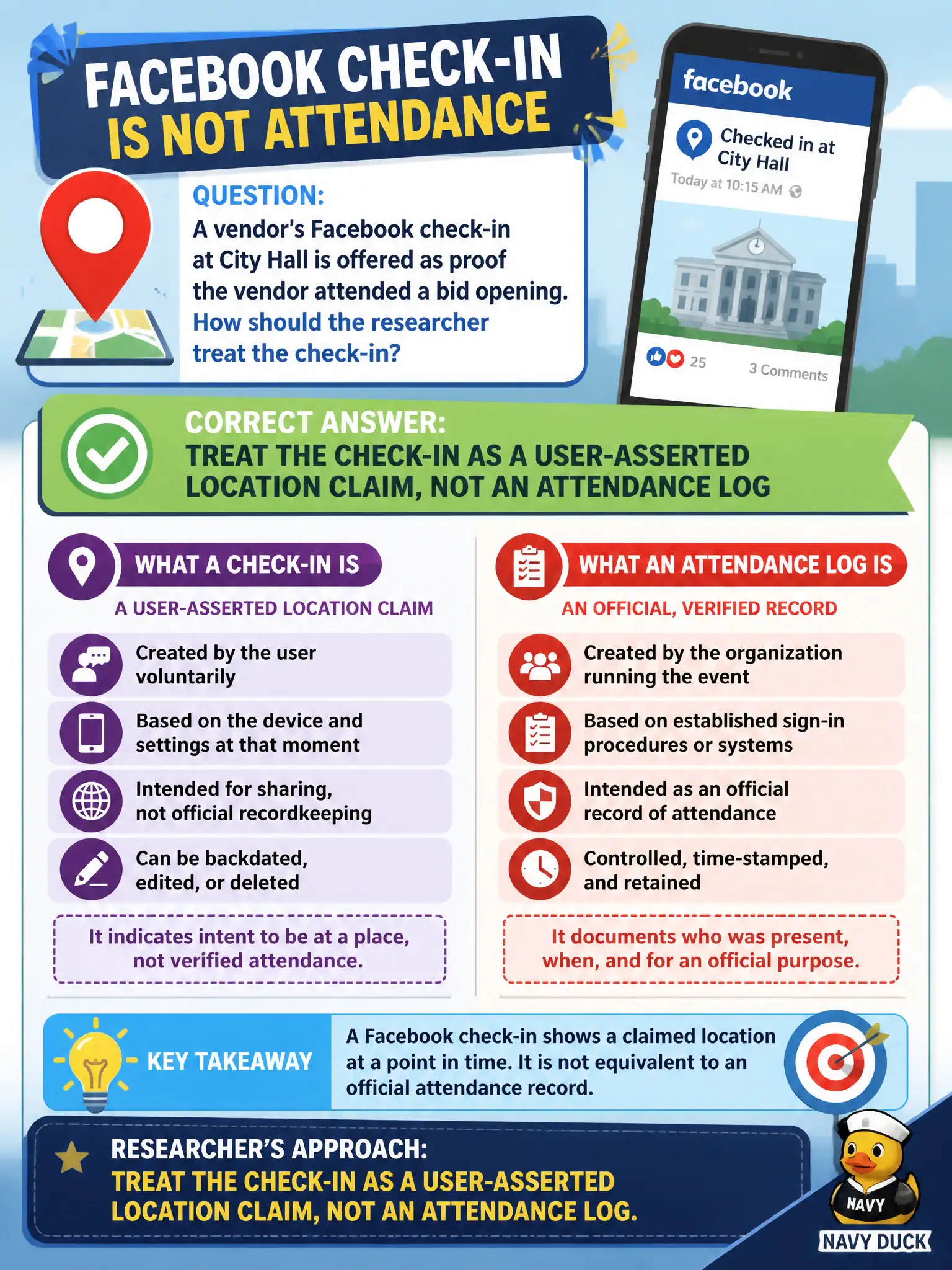
A vendor's Facebook check-in at City Hall is offered as proof the vendor attended a bid opening. How should the researcher treat the check-in?
Select an answer to reveal the explanation.
Short Explanation
A check-in is someone tapping a "here now" pin on a map. It is a claim, not the sign-in sheet from the bid opening. Collect it, but do not promote it to attendance.
Full Explanation
A vendor’s Facebook check-in at City Hall offered as proof of attending a bid opening should be treated as a user-asserted location claim, not an attendance log. Check-ins are taps on a place label and can be made remotely, jokingly, or inaccurately, so they cannot substitute for procurement integrity records. Accepting the check-in as equivalent to a signed bid-opening roster fails by promoting a weak social claim to formal attendance evidence that award protests may later scrutinize. Discarding all Facebook location artifacts because they can never be collected fails; they remain citable claims with appropriate caveats in a municipal file. Demanding raw GPS logs from the platform as the first OSINT step fails because closed location telemetry is not the open-source starting point and usually requires legal process. Exam caveat: check-ins may weakly corroborate presence when combined with other public evidence, but alone they do not equal roster proof. Operational check: capture check-in URL and time; compare to any public bid-opening materials or published attendee lists; record the check-in as claim-only in the procurement integrity note and avoid briefing it as verified attendance.