
A LinkedIn recommendation for a vendor names a Riverfront Promenade rebuild that does not appear on the city's public project list. How should that mismatch be handled?
Select an answer to reveal the explanation.
Short Explanation
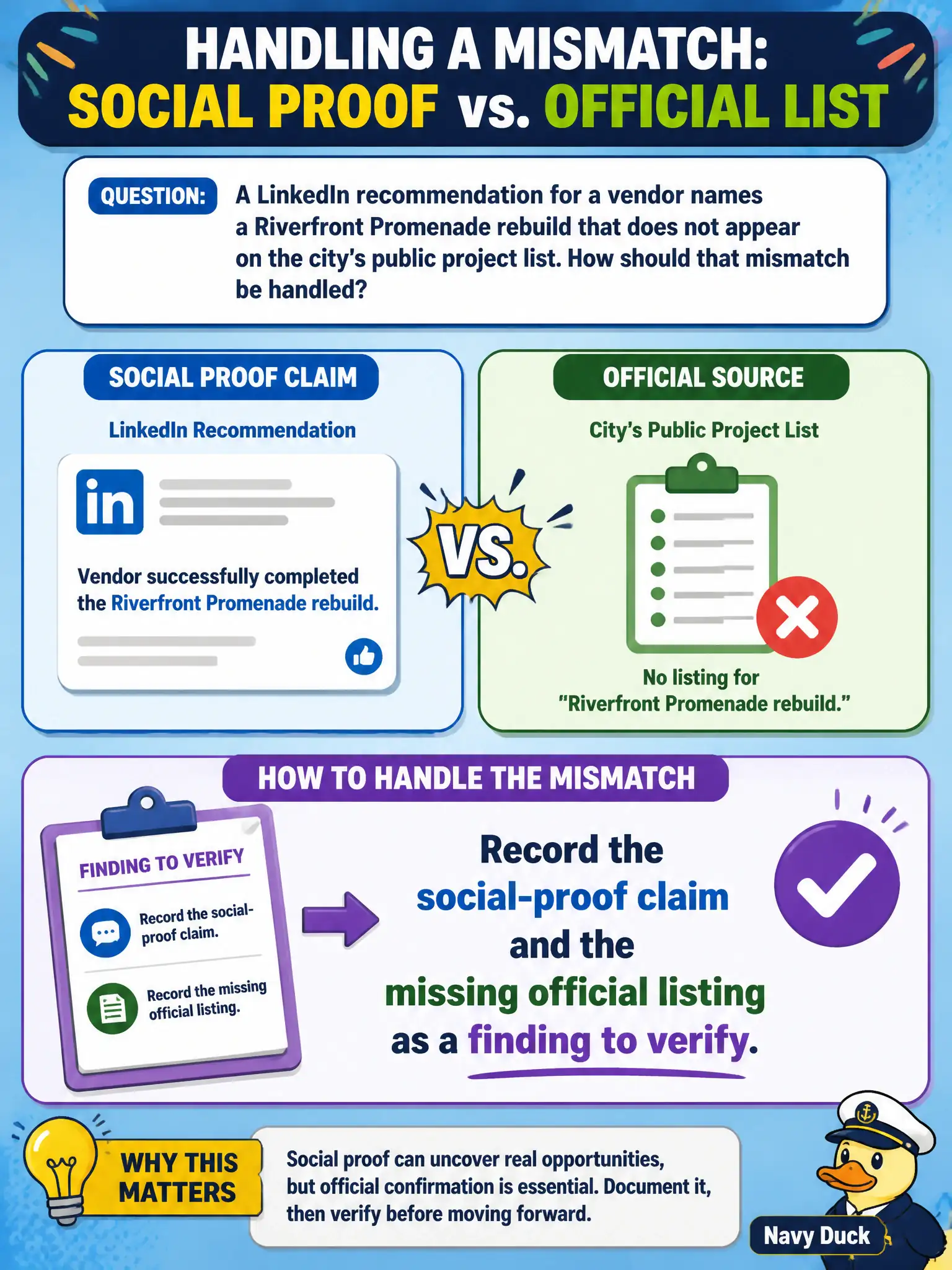
A glowing recommendation is a testimonial, not a purchase order. If the city's public project list never heard of that promenade, write down both facts. The mismatch is the finding.
Full Explanation
If a LinkedIn recommendation for a vendor names a Riverfront Promenade rebuild absent from the city’s public project list, the researcher should record the social-proof claim and the missing official listing as a finding to verify. In municipal vendor review, the mismatch itself is the analytic product until public records resolve whether the project existed under another name, was subcontracted, or never occurred. Treating the recommendation as proof the city ran that project fails because testimonials are not purchase orders, notices of award, or council authorizations. Deleting the recommendation from the report because LinkedIn is unofficial fails; unofficial public claims still belong in the evidence set when they conflict with official lists that residents and auditors can see. Assuming the city’s project list is wrong and skipping other public records fails by choosing a preferred narrative instead of checking agendas, capital budgets, and GIS project pages. Exam caveat: projects can carry unofficial nicknames, phased titles, or neighboring-jurisdiction labels—verify before alleging fabrication. Operational check: capture recommendation text and URL with retrieval date; search city project portals and agendas for promenade-related names; note any unresolved mismatch for procurement follow-up without asserting fraud in the OSINT product.