
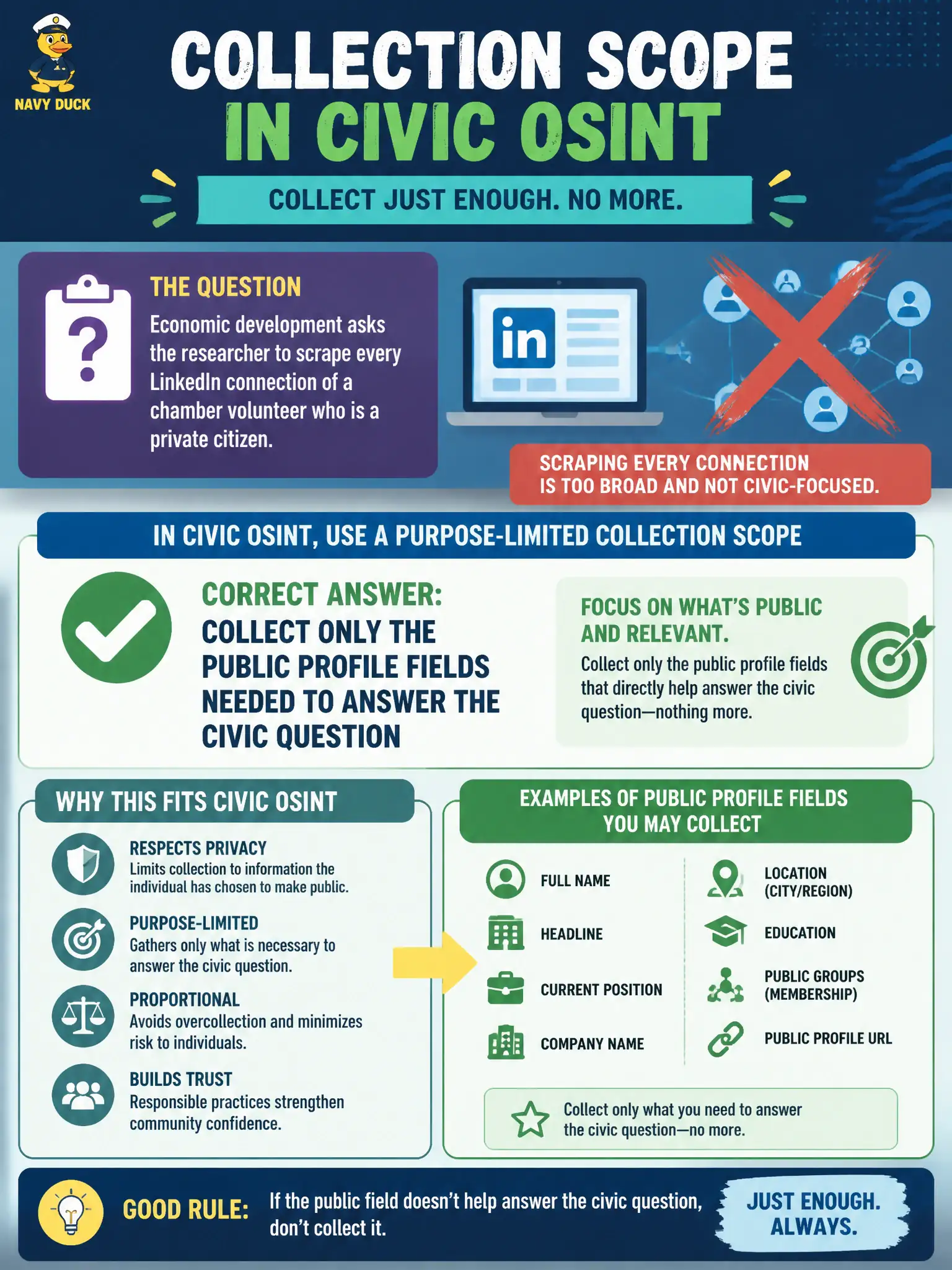
Economic development asks the researcher to scrape every LinkedIn connection of a chamber volunteer who is a private citizen. What collection scope fits civic OSINT?
Select an answer to reveal the explanation.
Short Explanation
Need-to-know still applies when the source is a public profile. Grab the fields that answer the civic question, not the volunteer's entire Christmas-card list. Hoarding a private citizen's network is not the job.
Full Explanation
When economic development asks to scrape every LinkedIn connection of a chamber volunteer who is a private citizen, civic OSINT scope is to collect only the public profile fields needed to answer the civic question. Need-to-know still applies to public sources: breadth for its own sake creates privacy, retention, and political-risk problems without improving the municipal decision under review. Downloading the volunteer’s full connection graph for a standing civic dossier fails as over-collection and dossier-building beyond the authorized question and beyond PORP public-source ethics for private citizens. Friend-requesting the volunteer from a real staff account to unlock private connections fails by using authentic civic identity to bypass privacy settings and by contaminating researcher OPSEC. Buying a people-search dump of unpublished contacts fails because closed or non-consensual bulk data is outside open-source collection and may include non-public material. Exam caveat: “public” does not mean “collect everything visible forever”; scope follows the written civic question and retention rules. Operational check: write the question first; list the minimum public fields required; capture only those; document why further connection scraping was refused in the economic-development request log for auditability.