
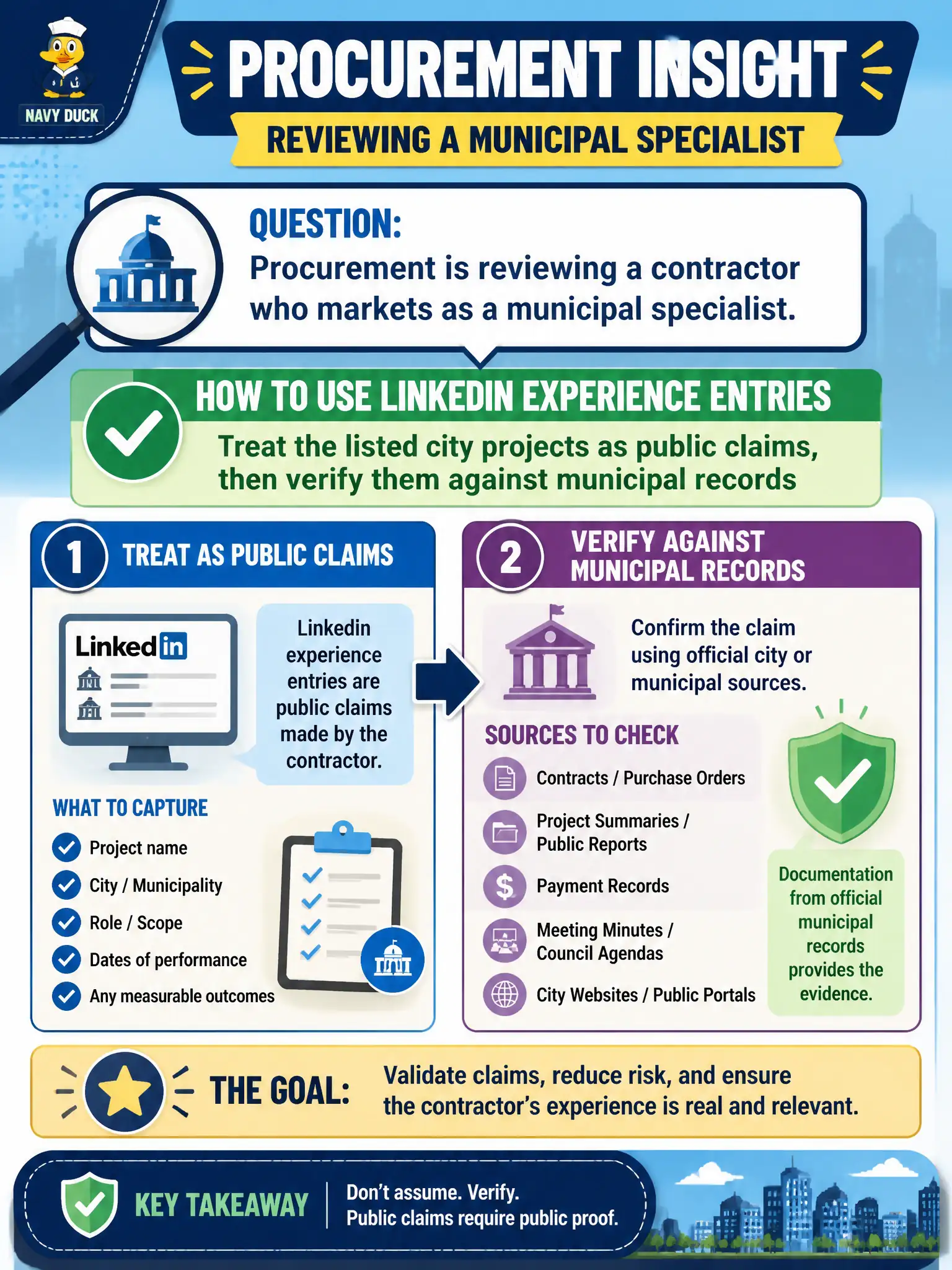
Procurement is reviewing a contractor who markets as a municipal specialist. How should the researcher use the contractor's public LinkedIn experience entries?
Select an answer to reveal the explanation.
Short Explanation
LinkedIn experience is a resume the person published on a billboard. Read the city-project claims, then check the city's own public files. The billboard is not a notarized personnel file.
Full Explanation
In procurement review of a contractor marketing as a municipal specialist, LinkedIn experience entries should be treated as public claims to verify against municipal records, not as verified employment history. Professional network profiles are useful OSINT leads for city-project names, dates, and roles, but they are self-published marketing. Treating LinkedIn work history as a verified employment record fails because the platform does not notarize personnel files for civic due diligence. Ignoring LinkedIn entirely because professional networks are never OSINT sources fails; public experience fields are in-scope social/business artifacts. Messaging every listed coworker from a real city HR account to confirm dates fails as OPSEC-poor outreach that leaks the city’s interest and steps beyond open-source verification into human contact that may be unnecessary if agendas and contracts already exist. Exam caveat: absence from a city’s public project list is a mismatch to investigate, not automatic proof of lying—projects may be renamed or subcontracted. Operational check: extract claimed city projects; search council agendas, award lists, and public contract portals; record corroborated vs uncorroborated claims in the procurement file with sources dated.