
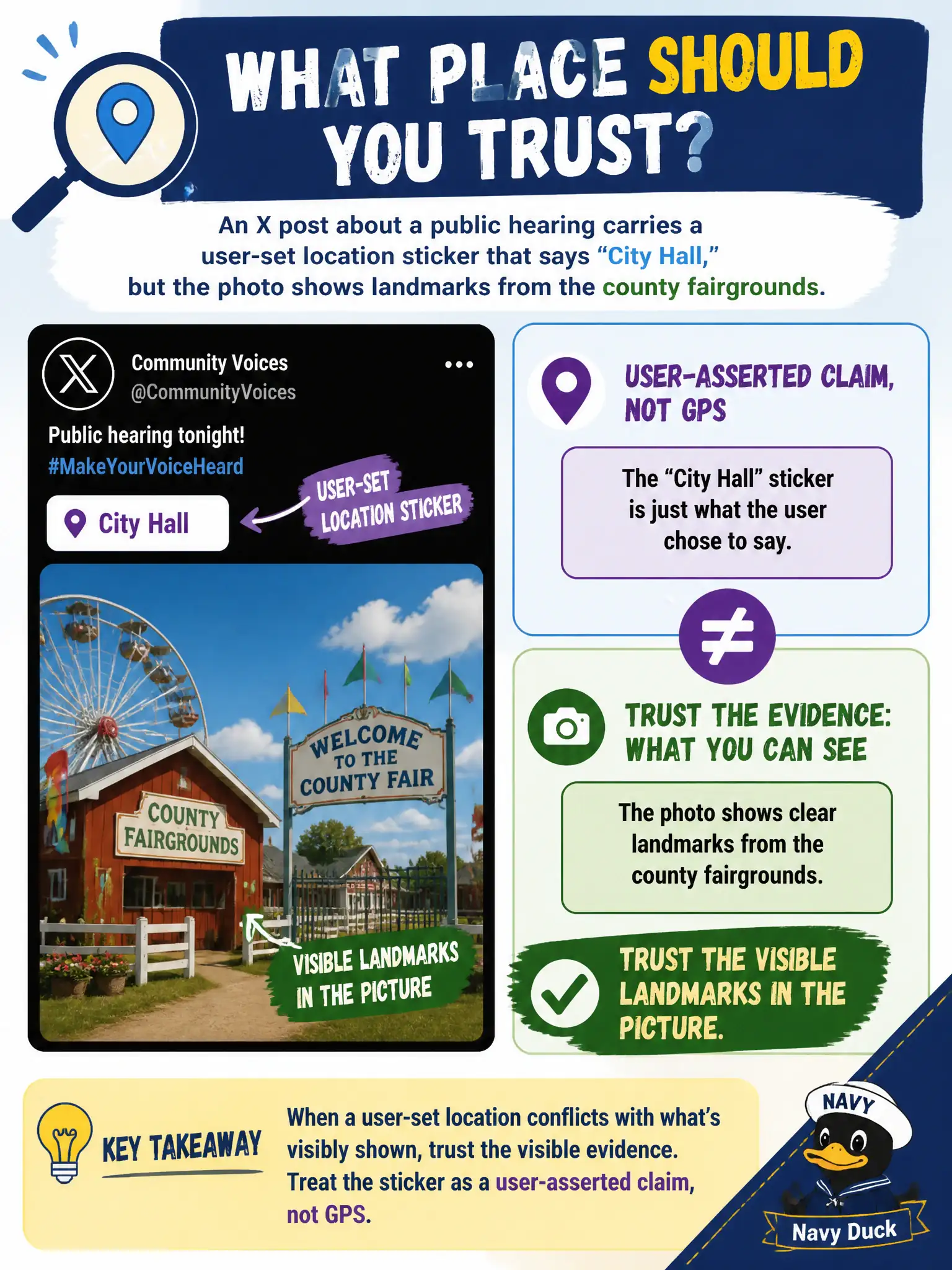
An X post about a public hearing carries a user-set location sticker that says "City Hall," but the photo shows landmarks from the county fairgrounds. What should the researcher trust for place?
Select an answer to reveal the explanation.
Short Explanation
That "City Hall" sticker is a name tag someone stuck on the photo, not a satellite ping. Believe the ferris wheel and the fairgrounds barns in the pixels. Labels are claims; pictures still need a look.
Full Explanation
For an X post about a public hearing that carries a user-set location sticker reading “City Hall” while the photo shows county fairgrounds landmarks, the researcher should trust the visible landmarks and treat the sticker as a user-asserted claim rather than GPS. Civic geolocation for hearing-related complaints or crowd estimates prefers what the pixels show over what the poster typed into a label field. Trusting the sticker because platforms always attach true GPS to user-set labels fails because many location labels are selectable place names, jokes, or defaults, not device GNSS fixes bound to the image. Rejecting both artifacts because social photos cannot support civic geolocation fails; imagery regularly supports place hypotheses when barns, rides, signage, or other landmarks are clear. Preferring the caption alone because text always beats imagery fails by ignoring stronger visual place evidence when text and picture conflict. Exam caveat: user-set stickers and captions can both be wrong or deceptive—pixels and independent public maps must corroborate before a municipal briefing asserts place. Operational check: list identifiable fairgrounds features; compare to public map imagery; note the sticker as a conflicting claim in the hearing-related OSINT note; do not brief “posted from City Hall” without visual support.