
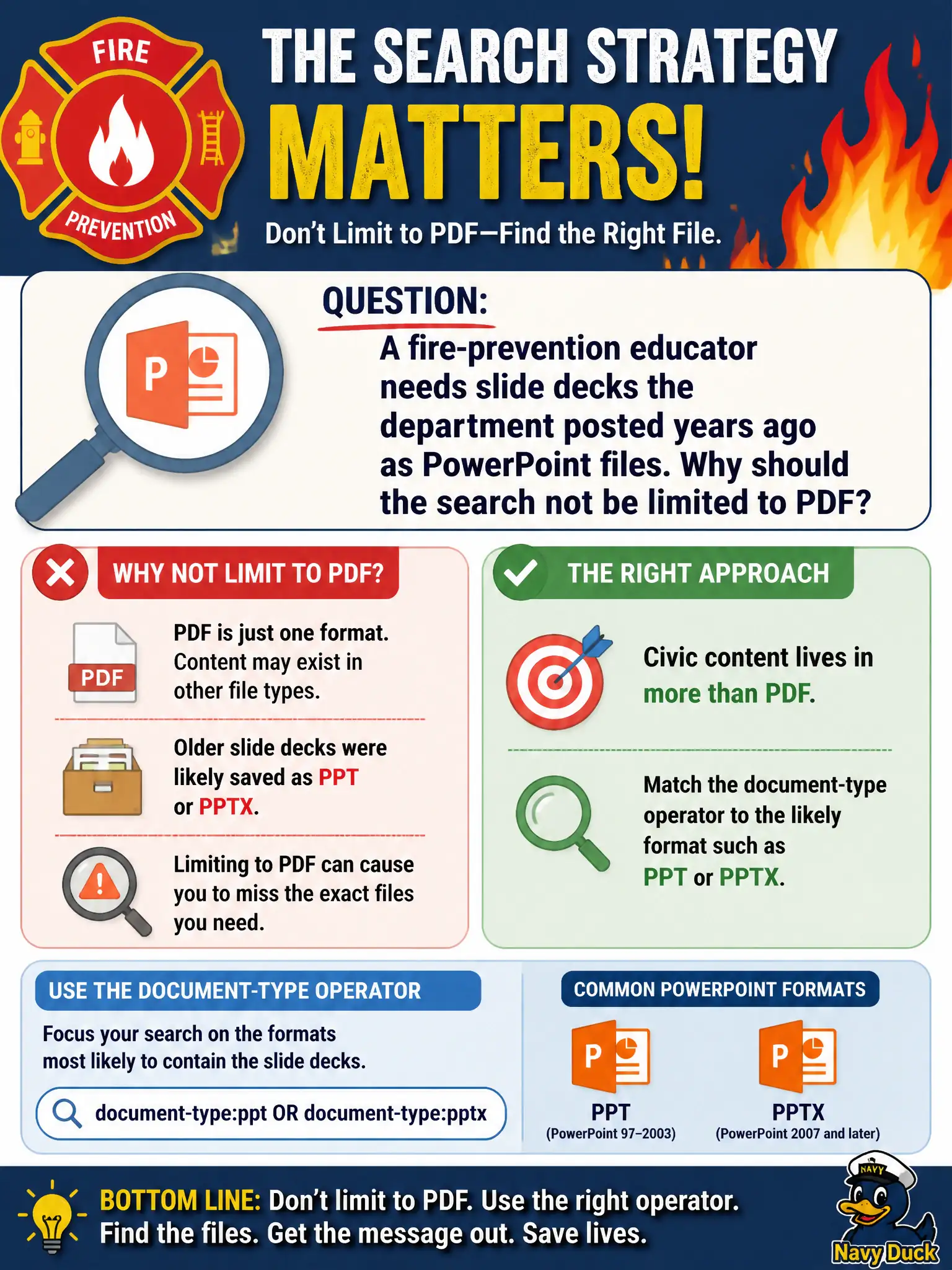
A fire-prevention educator needs slide decks the department posted years ago as PowerPoint files. Why should the search not be limited to PDF?
Select an answer to reveal the explanation.
Short Explanation
Not every city lesson made it into a PDF. If the fire house posted PowerPoint, you ask for PowerPoint—filetype is a matching game, not a PDF-only club. Hunting the wrong envelope is why old decks look 'gone.'
Full Explanation
Civic content lives in more than PDF; match the document-type operator to the likely format such as PPT or PPTX when a fire-prevention educator needs older posted slide decks. Claiming slide decks are never indexed so operators cannot help is false. Restricting municipal OSINT to PDF operators only invents a policy that hides real publications. Converting every city file to PDF before searching so other types do not matter is not a search strategy and may be impossible for historical posts. Exam caveat: try multiple filetype variants and the untyped site-restricted name query if decks were renamed. Operational check: run filetype queries for PPT/PPTX (and PDF as a secondary pass), capture matching URLs, and verify the files open as the expected training decks. Keep the civic purpose, method limits, and exhibit labels aligned so reviewers can see what was public-source work versus other authorities. Document residual uncertainty explicitly rather than implying completeness. Prefer reversible public methods and preserve exhibits that a second analyst can reopen without guessing. When sources conflict, record both locators and state the confidence level in plain language. Retain retrieval times beside every locator so volatility does not erase the observation window.