
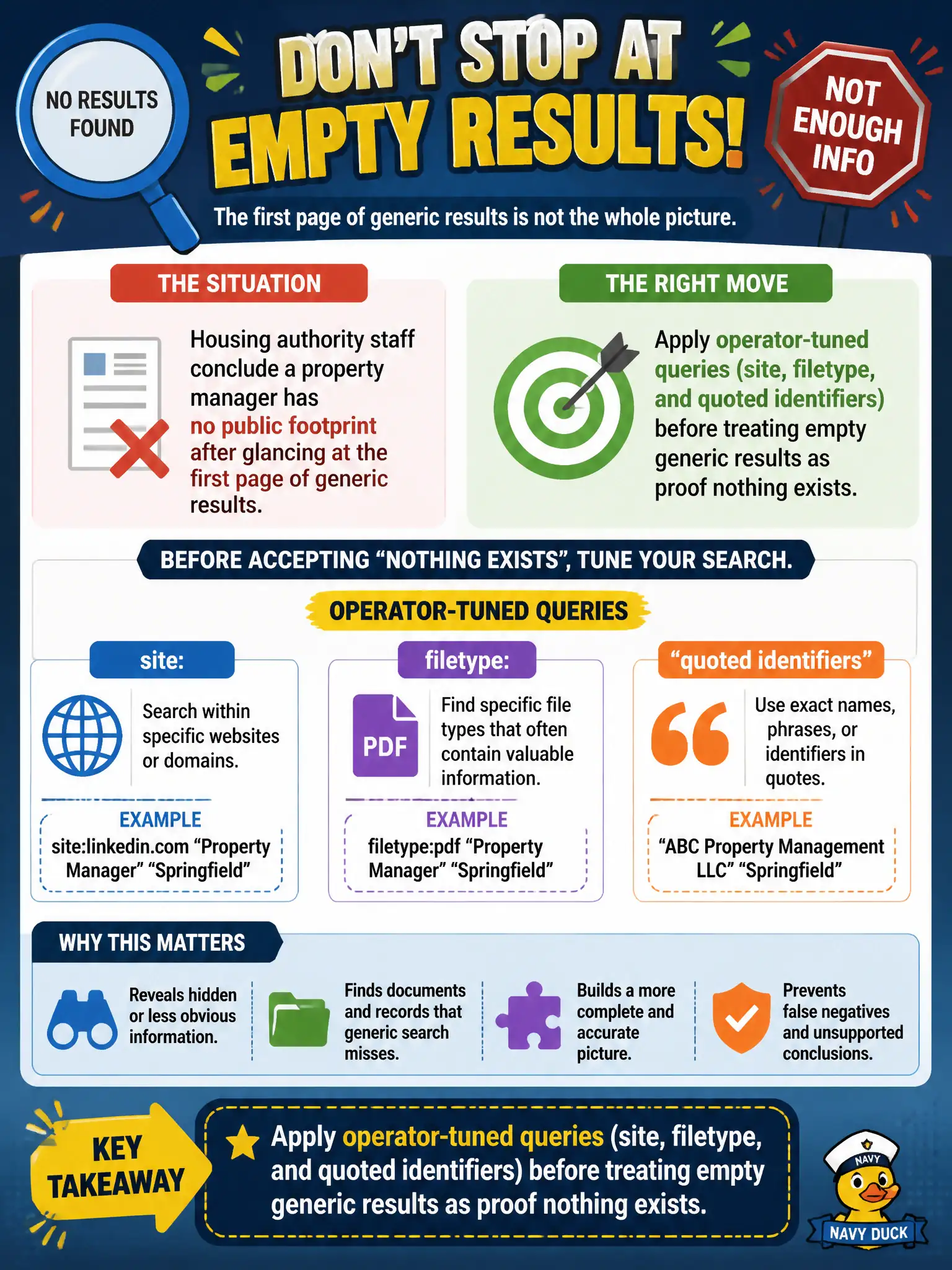
Housing authority staff conclude a property manager has no public footprint after glancing at the first page of generic results. What should the OSINT analyst do before accepting that claim?
Select an answer to reveal the explanation.
Short Explanation
A lazy first-page search is like peeking in one window and declaring the building empty. Operators are how you actually check the other rooms—site, filetype, quoted names. Empty generic results are a bad query, not a finding.
Full Explanation
Before accepting that a property manager has no public footprint, apply operator-tuned queries—site, filetype, and quoted identifiers—rather than treating empty first-page generic results as proof nothing exists. Closing the case because the first page of a generic search is a complete index of the web misunderstands search coverage. Messaging the manager from a personal account to confirm they have no website mixes contact with collection and can tip the subject. Running a vulnerability scan of the manager's office network to force more artifacts leaves OSINT for offensive testing. Exam caveat: absence of evidence after thorough operator passes is still not absolute proof of nonexistence; report it as a limited negative finding. Operational check: document the specific operator queries run and their empty or thin results before writing any no-footprint conclusion into the housing-authority file. Keep the civic purpose, method limits, and exhibit labels aligned so reviewers can see what was public-source work versus other authorities. Document residual uncertainty explicitly rather than implying completeness. Prefer reversible public methods and preserve exhibits that a second analyst can reopen without guessing.