
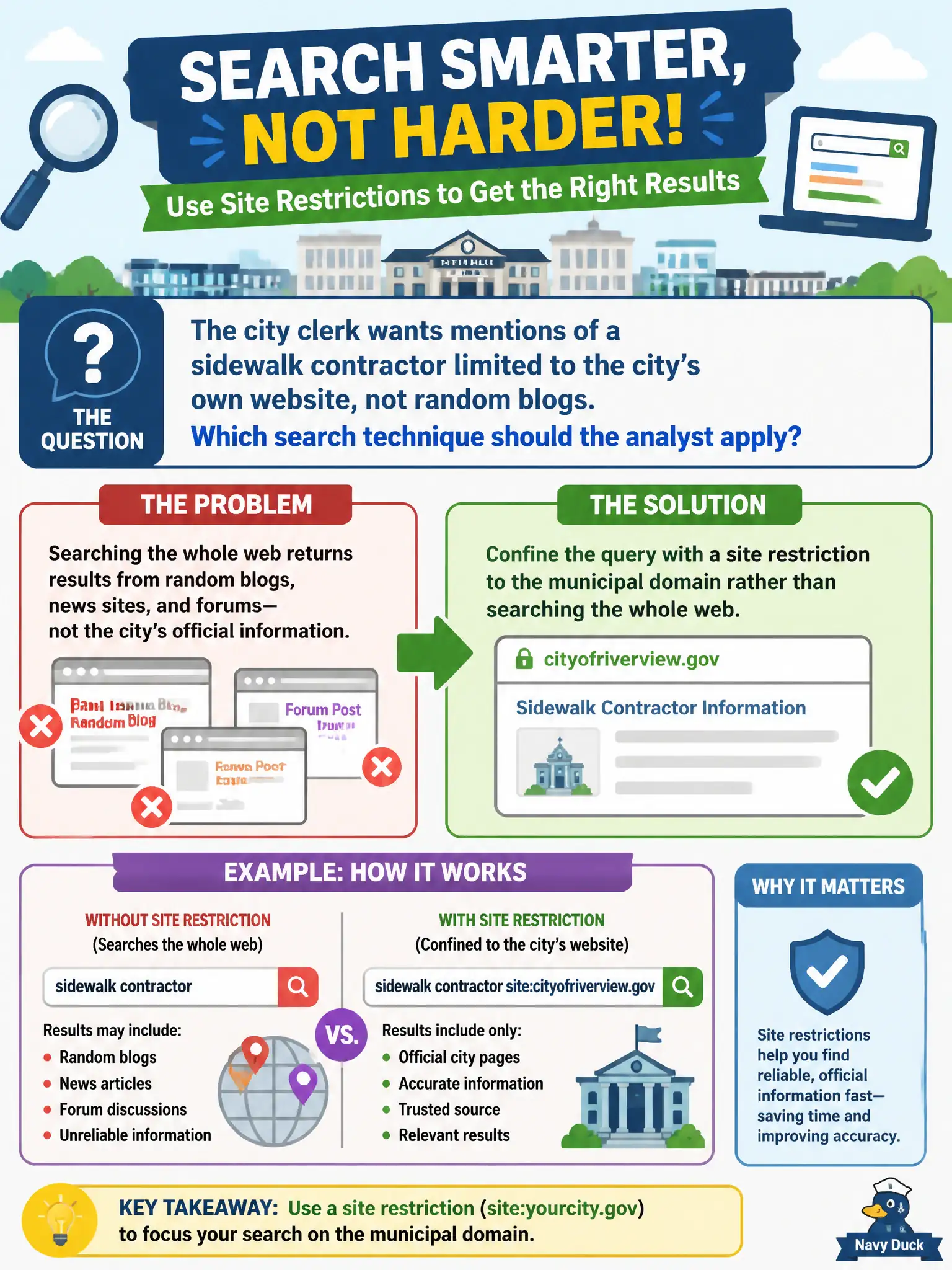
The city clerk wants mentions of a sidewalk contractor limited to the city's own website, not random blogs. Which search technique should the analyst apply?
Select an answer to reveal the explanation.
Short Explanation
The open web is a noisy cafeteria; the city site is the official menu. A site restriction keeps the query on the municipal domain so random blogs do not masquerade as clerk records. Titles that happen to say the city name are not the same as pages the city actually published.
Full Explanation
Confine the query with a site restriction to the municipal domain when the city clerk wants sidewalk-contractor mentions limited to the city's own website rather than random blogs. Trusting the first three blogs because they mention the city name in the title does not satisfy a domain-limited requirement. Port-scanning the contractor's web host to confirm they used the city as a reference leaves OSINT for active probing. Searching only image results so text blogs cannot appear is an arbitrary filter that can miss textual contract pages on the city site. Exam caveat: after finishing the on-domain pass, a separate unbounded web pass may be authorized—but label it as a different collection lane. Operational check: include an explicit site: (or equivalent) constraint for the municipal domain in the saved query string and screenshot the result set used for the clerk. Keep the civic purpose, method limits, and exhibit labels aligned so reviewers can see what was public-source work versus other authorities. Document residual uncertainty explicitly rather than implying completeness. Prefer reversible public methods and preserve exhibits that a second analyst can reopen without guessing. When sources conflict, record both locators and state the confidence level in plain language.