
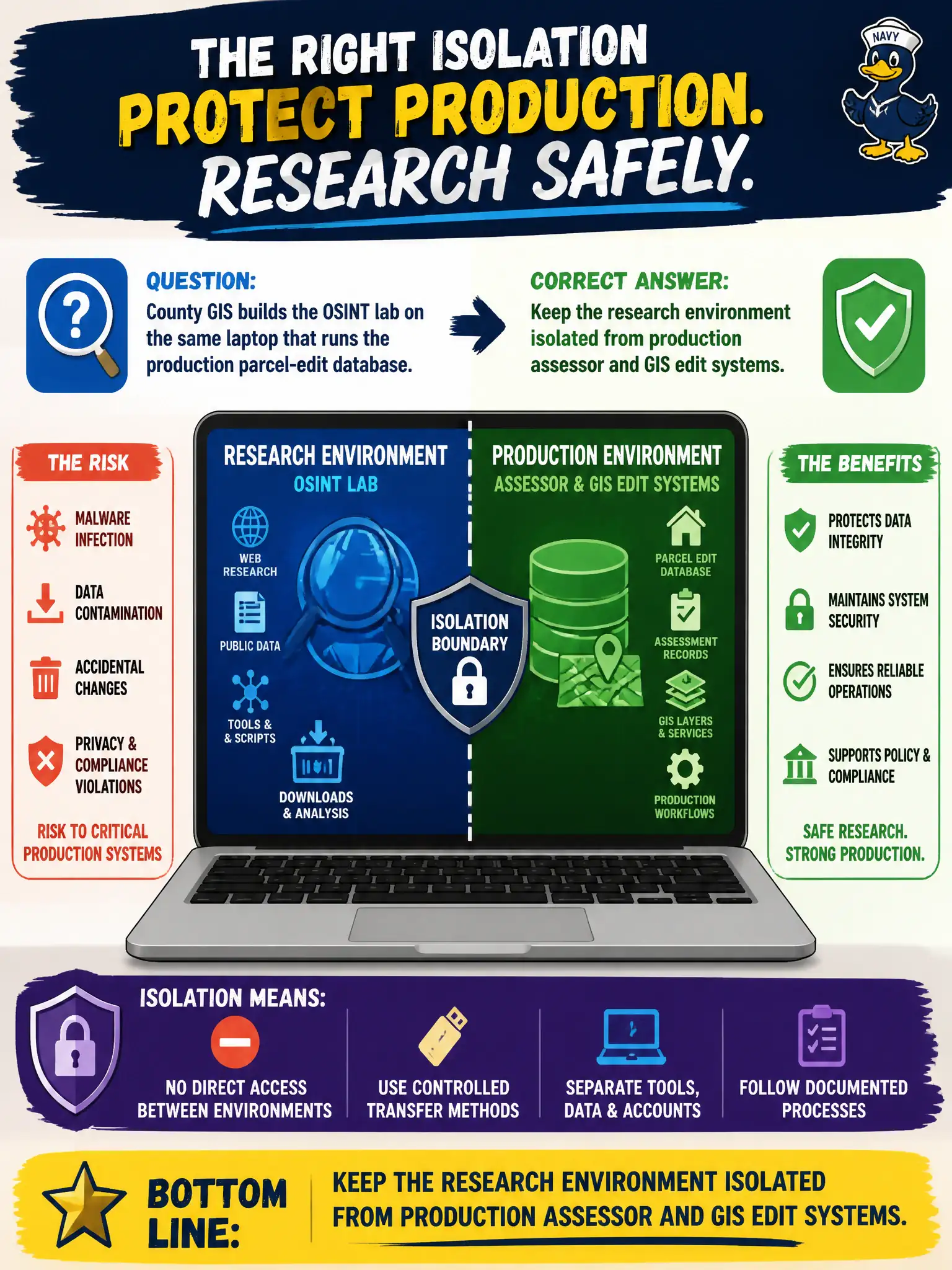
County GIS builds the OSINT lab on the same laptop that runs the production parcel-edit database. What isolation requirement should the candidate insist on?
Select an answer to reveal the explanation.
Short Explanation
Parking the OSINT lab on the parcel-edit laptop is like doing chemistry homework on the 911 CAD terminal. One sketchy site, and production GIS is in the blast radius. Research boxes stay off the systems that actually change civic records.
Full Explanation
The research environment must stay isolated from production assessor and GIS edit systems. Building the OSINT lab on the same laptop that runs the production parcel-edit database risks malware crossover, accidental edits, and mixed credentials. Preferring the combined laptop because production access makes OSINT faster optimizes convenience over safety. Dual-homing the lab into the assessor edit VPN so research traffic uses production routes extends the blast radius. Copying the production database into the research VM after every vendor lookup is unnecessary data exposure for public-source work. Exam caveat: read-only public GIS web maps are fine as OSINT sources; the isolation rule targets production edit planes and privileged databases. Operational check: confirm the research VM or laptop has no production parcel-edit clients, VPN profiles, or database drivers before the next GIS-assisted OSINT session. Keep the civic purpose, method limits, and exhibit labels aligned so reviewers can see what was public-source work versus other authorities. Document residual uncertainty explicitly rather than implying completeness. Prefer reversible public methods and preserve exhibits that a second analyst can reopen without guessing.