
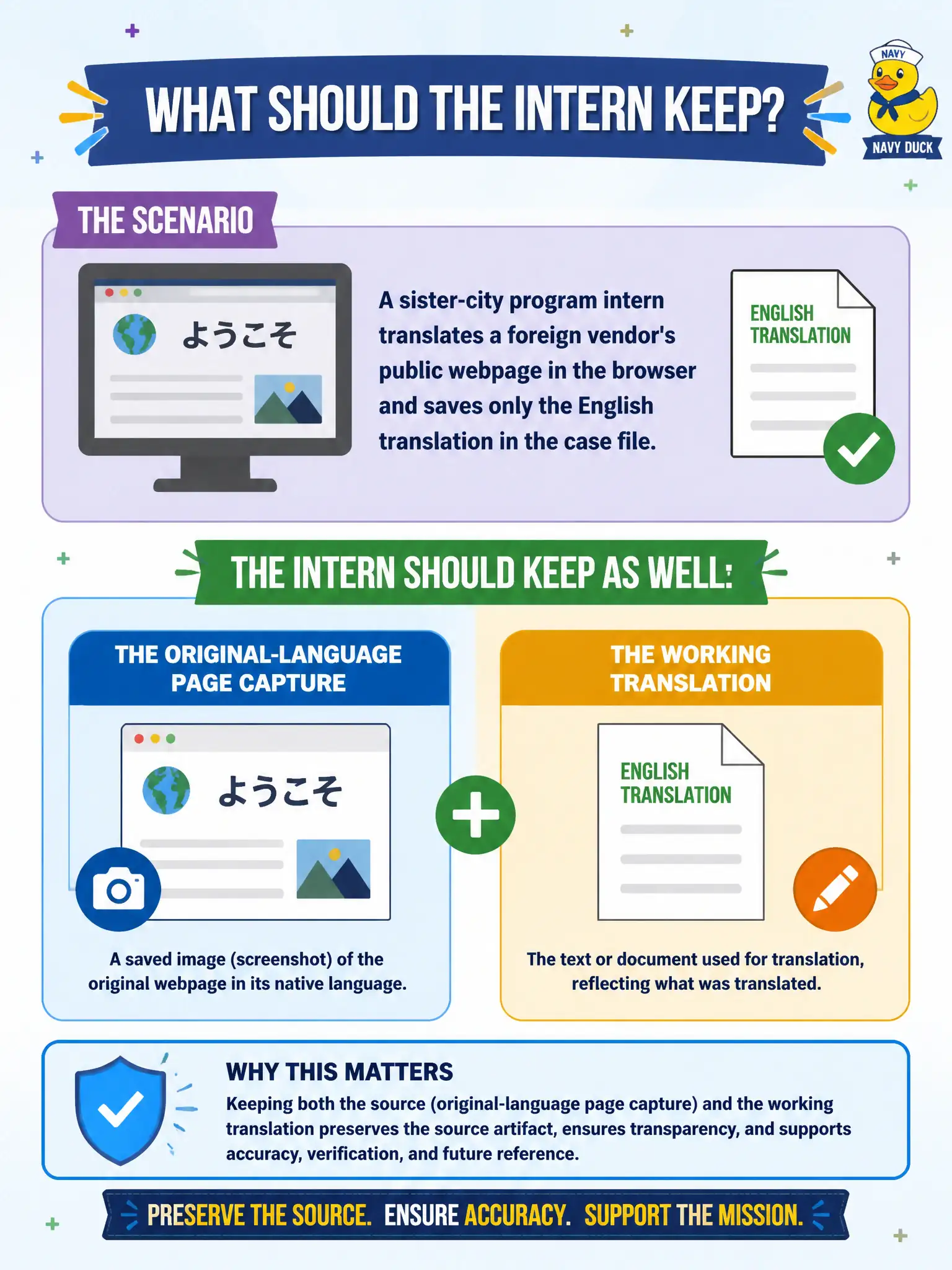
A sister-city program intern translates a foreign vendor's public webpage in the browser and saves only the English translation in the case file. What should the intern keep as well?
Select an answer to reveal the explanation.
Short Explanation
A translation is a helper, like subtitles on a movie—not the film itself. If the case file only holds the English overlay, nobody can check what the page actually said. Keep the original-language capture and use the translation as the working copy.
Full Explanation
When a sister-city intern translates a foreign vendor's public webpage, the case file should keep the original-language page capture plus the working translation so the source artifact remains available for review and re-translation. Saving only the English translation loses the authoritative text and can hide machine-translation error. Keeping only a paraphrase with the original URL discarded severs provenance. Emailing a machine-translated PDF to a personal account and deleting it from the notebook creates an uncontrolled copy and an incomplete official file. Treating a voice memo of the intern reading English as the official exhibit replaces documentary evidence with weak secondary media. Exam caveat: note the translation method and that the original governs if wording is disputed. Operational check: store a dated capture of the original URL content alongside the translation file, and cite both in the vendor note. Keep the civic purpose, method limits, and exhibit labels aligned so reviewers can see what was public-source work versus other authorities. Document residual uncertainty explicitly rather than implying completeness. Prefer reversible public methods and preserve exhibits that a second analyst can reopen without guessing.