
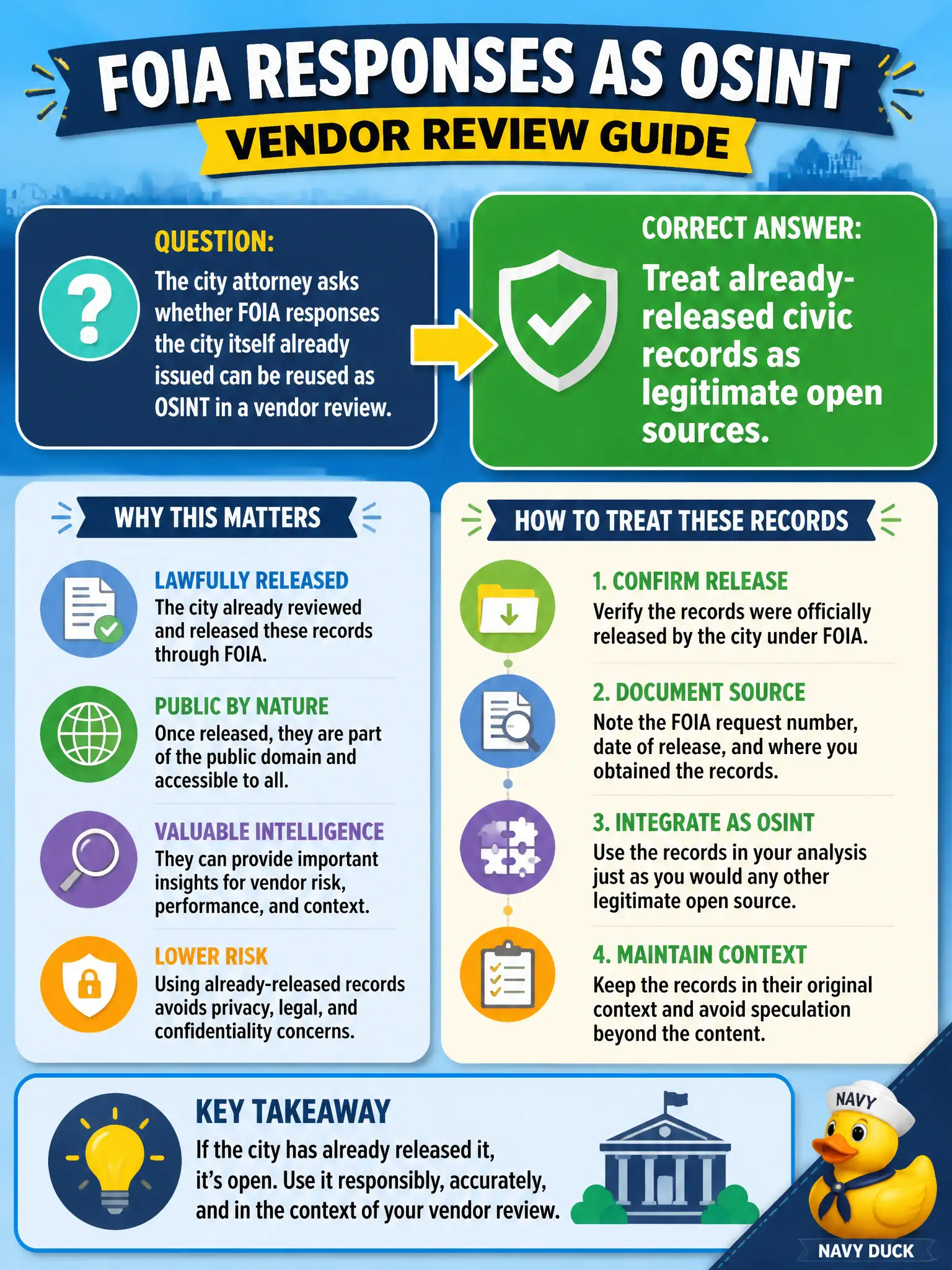
The city attorney asks whether FOIA responses the city itself already issued can be reused as OSINT in a vendor review. How should the analyst treat those records?
Select an answer to reveal the explanation.
Short Explanation
A posted notice on the courthouse door does not become secret just because the city printed it. Released FOIA packages are public records. The analyst can reuse them as OSINT the same way any other published civic document can be used.
Full Explanation
Already-released civic records are legitimate OSINT sources. FOIA or equivalent packages the city has already disclosed are public records; government origin does not make them classified, and vendor consent is not required to reuse what the city lawfully released for a vendor review. Treating released responses as closed unless the vendor consents invents a consent gate that public disclosure already removed and would freeze routine reuse of the city's own releases. Calling them HUMINT because a clerk once processed the request confuses human handling of a records workflow with human-intelligence collection methodology. Analysts should cite the released record like any other public locator and keep still-withheld material out of the OSINT lane. Exam caveat: material that remains withheld, redacted, or never released stays outside OSINT even if staff can see it internally through privileged systems. Operational check: cite the released package with its public locator or release identifier and retrieved-on date, and explicitly exclude any still-withheld portions from the OSINT exhibit list. Keep the civic purpose, method limits, and exhibit labels aligned so reviewers can see what was public-source work versus other authorities.