
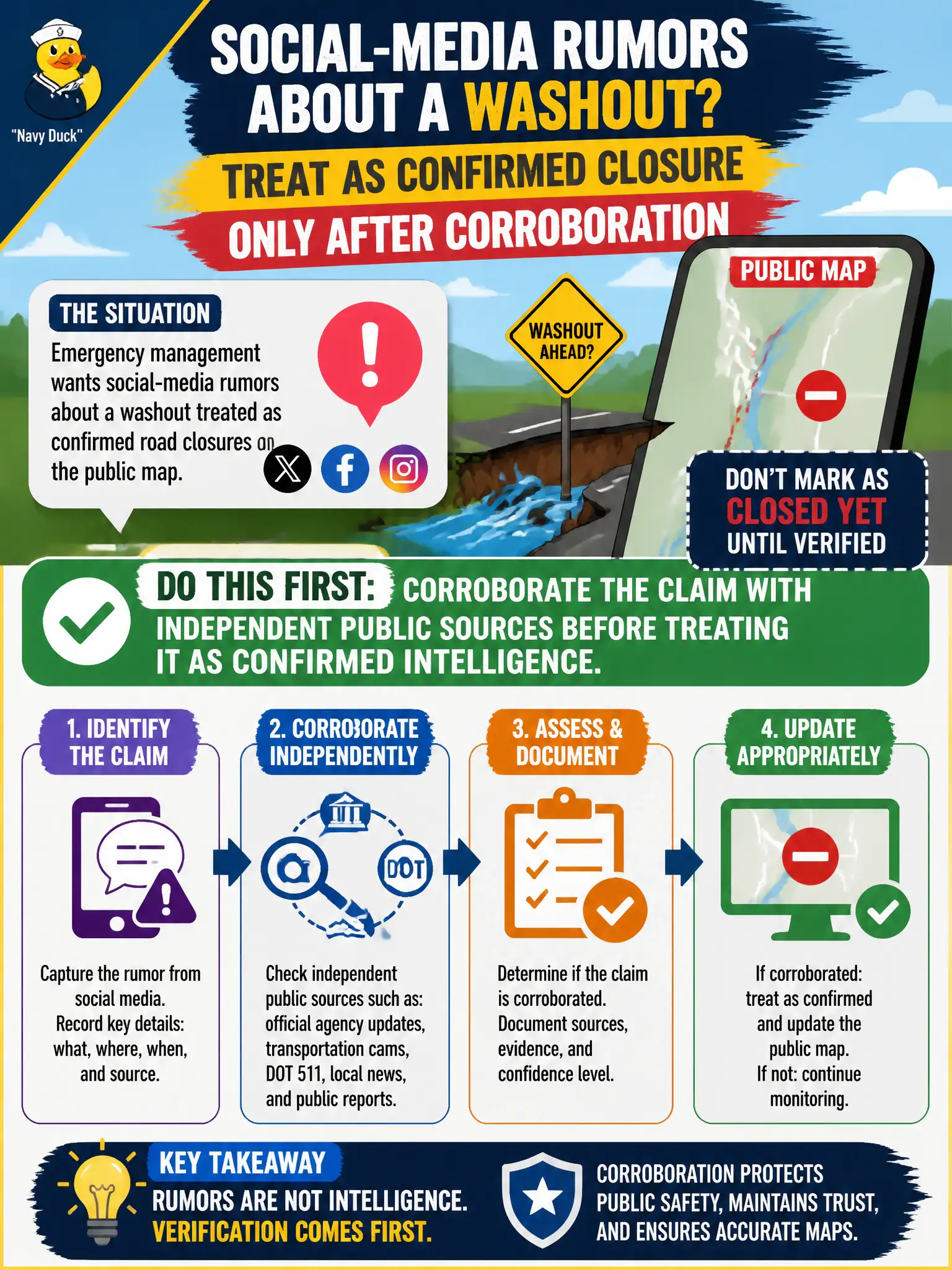
Emergency management wants social-media rumors about a washout treated as confirmed road closures on the public map. What should the OSINT analyst do first?
Select an answer to reveal the explanation.
Short Explanation
One loud smoke alarm is a clue, not a fire-marshal report. A single unofficial post can start the hunt, but it does not close a road on the official map. Civic OSINT waits for independent public corroboration.
Full Explanation
Social platforms are legitimate OSINT source classes, but a single unofficial rumor is not confirmed intelligence. Emergency management maps that show road closures affect public safety and liability, so the analyst must corroborate washout claims with independent public sources—official agency posts, credible local reporting, imagery, or other cross-checks—before treating them as confirmed. Publishing every rumor immediately to keep the map real-time prioritizes speed over accuracy and can divert responders to false closures. Treating the first viral post as confirmation because it has many likes confuses engagement metrics with verification and rewards amplification over evidence. Deleting all social posts from the collection because social media can never be an OSINT source is the opposite error: it discards a valid source class instead of applying corroboration discipline. Exam caveat: urgent protective actions may proceed on partial information under emergency protocols, but the OSINT product must still label confidence and continue verification in parallel. Operational check: hold a social rumor at lead status until at least one independent public source of a different type supports the same closure claim, and record both locators with times in the notes.