
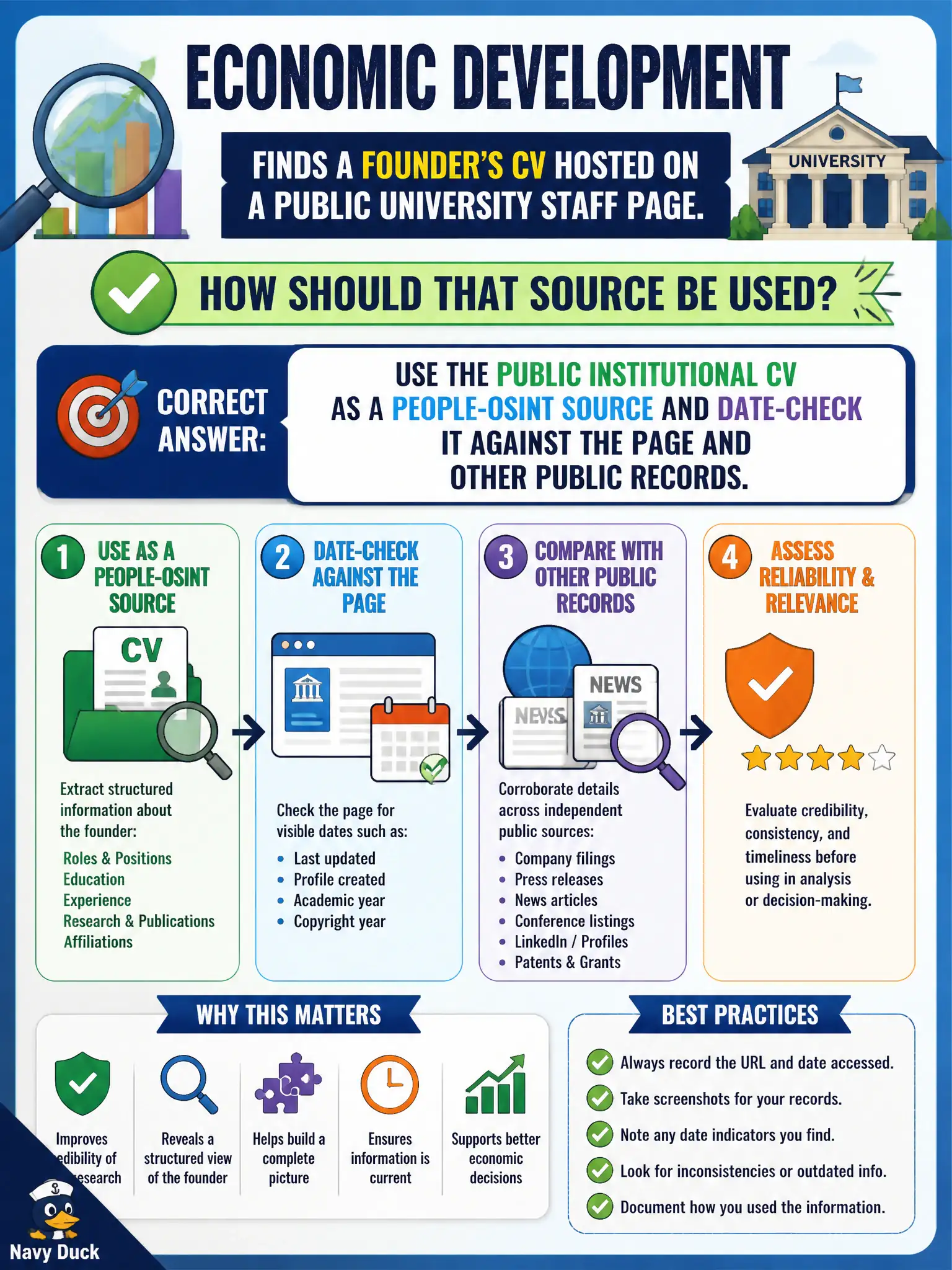
Economic development finds a founder’s CV hosted on a public university staff page. How should that source be used?
Select an answer to reveal the explanation.
Short Explanation
A faculty CV on a university page is a public flyer on the bulletin board—useful, but it might be last year’s flyer. Cite it, then check when it was posted and whether later public records still agree. Sealed transcripts are not OSINT.
Full Explanation
When economic development finds a founder’s CV hosted on a public university staff page, that institutional CV should be used as a people-OSINT source and date-checked against the page and other public records. University staff pages are ordinary open sources for bios and timelines, but they can lag after job changes. Treating the .edu CV as current employment proof with no date check risks briefing outdated affiliation as present fact. Discarding .edu pages because universities are “never” open-source material wrongly excludes a major class of public biographical pages. Demanding the founder’s sealed student transcript from the registrar as routine OSINT seeks non-public education records outside collection scope. Exam caveat: PORP accepts public institutional CVs with explicit currency checks and rejects sealed transcript requests as routine OSINT. Operational check: capture the staff-page URL and any last-updated marker, extract claims needed for the economic-development file, corroborate with company filings or later public bios, label stale items, and escalate any need for non-public education records only through lawful process—not OSINT. Economic-development briefs should show the CV capture date beside any claim that the founder still holds the university role.