
After a cloud cost spike, leadership wants a larger Cortex license. The same bill shows NAT gateways and application log storage that have nothing to do with scanners. What should be confirmed first?
Select an answer to reveal the explanation.
Short Explanation
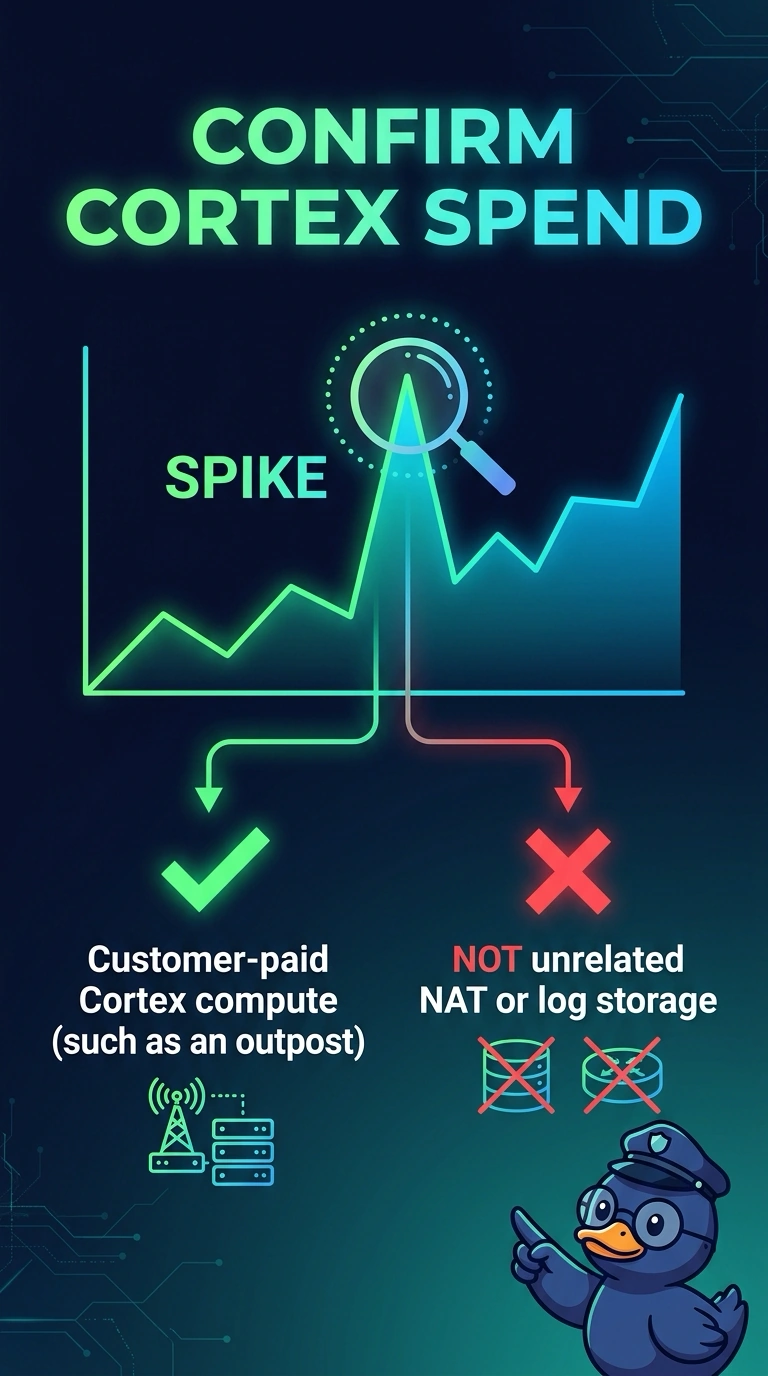
You do not buy a bigger pantry because the neighbor's delivery landed on your porch. Before you enlarge the Cortex license, you confirm the spike is customer-paid Cortex compute, such as an outpost, and not NAT gateways or application log storage. The trap is treating every new cloud dollar as a license shortage.
Full Explanation
Unexpected cloud cost is diagnosed by comparing scan mode, cadence, duplicate audit pipelines, and outpost quota before a license change. NAT gateways and application log storage that have nothing to do with scanners are not Cortex scanner compute. Confirm the spike is customer-paid Cortex compute, such as an outpost actual fleet compute/storage/transfer charges, and exclude the unrelated lines first. The asset-group ceiling of 5000 limits how many groups exist. It does not generate NAT charges or force a license upgrade. Verdicts go to the nearest region as normal agent behavior. That routing is not a license SKU you buy after a bill spike. Empty widgets on a healthy dashboard are an asset-scope result. They say nothing about license size or about which cloud line grew. Exam caveat: a cloud-scan tenant should not show a new scanner fleet on the customer bill, so a real fleet means outpost mode or some other workload, not an automatic license increase. Operational check: split the bill into outpost compute, audit ingestion, and unrelated NAT or application logs. Change deployment/scheduling to address measured cloud consumption; consider a license change only for a separately established entitlement or capacity requirement.